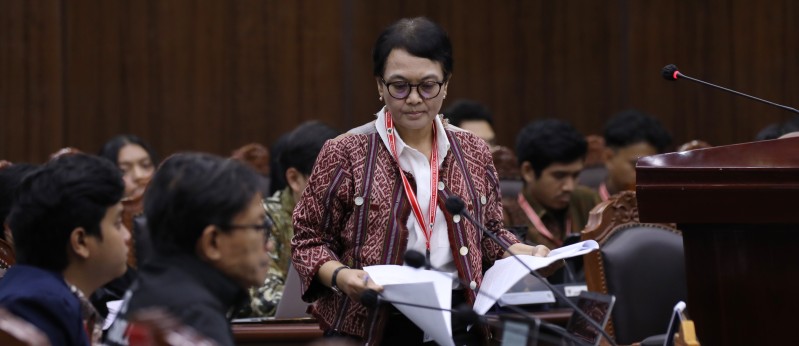
Professor of Constitutional Law, Susi Dwi Harijanti, after delivering her statement during the continued formal judicial review hearing of Law No. 3 of 2025 on Indonesian National Armed Forces, Monday (7/7). Photo by MKRI/Ifa.
Jakarta (MKRI) – Prof. Susi Dwi Harijanti, a Constitutional Law Professor at the Faculty of Law, Universitas Padjadjaran, stated that the Constitutional Court of the Republic of Indonesia could develop a test to ensure whether the enactment of Law No. 3 of 2025 on the amendment of Law No. 34 of 2004 on the Indonesian National Armed Forces (Army Law), fulfills the principle of meaningful participation as mandated by Article 96 of Law No. 13 of 2022 on the Lawmaking Law. She emphasized that the experience of the South African Constitutional Court, particularly its 2006 decision in the Doctors for Life case, is worth considering for developing a ‘meaningful involvement test’.
“Now is the right time for the Court to develop a test by establishing criteria to ensure that meaningful participation is concretely realized, in line with Constitutional Court Decision No. 91/PUU-XVIII/2020,” Susi said, who appeared as an expert for the Petitioners in Case No. 69/PUU-XXIII/2025 during the formal review hearing of the Army Law on Monday, July 7, 2025, in the Plenary Courtroom.
She explained that Constitutional Court Decision No. 91/PUU-XVIII/2020 compels lawmakers to regulate three procedural rights in the legislative process as stipulated in Article 96 of Lawmaking Law: the right to be heard, the right to be considered, and the right to have an explanation. If all legislative procedures are conducted openly and accountably, the outcome of the formal review will enhance public trust in the law and state institutions.
A formal review involves examining the stages of law-making, such as public hearings, in-depth discussions, and debates, all of which should be conducted transparently and involve the public. This thorough examination can reveal fundamental weaknesses that, in turn, will improve future legislative procedures.
Formal review serves to ensure that laws are not enacted in a manner that violates fundamental rights, such as the right to fair hearings, freedom of expression, and opinion, collectively classified as procedural rights during the legislative process. Theoretically, these procedural rights are referred to as ‘gateways’ based on the gateway theory, which paves the way for the fulfillment of substantive rights.
Without the availability and implementation of sound procedures, the state can't guarantee any specific rights. In modern practice, the realization of these rights takes various forms, such as public hearings, opportunities to submit petitions, and the establishment of complaint mechanisms.
Therefore, Article 96 of the Lawmaking Law must be interpreted as enshrining fundamental rights, not merely as a formal mechanism. Although it has particular human rights limitations, Article 96 serves as a touchstone for the Court in assessing whether the legislative process for the TNI Law has ensured meaningful participation.
Susi argued that developing a test for meaningful participation is necessary because the Lawmaking Law does not specify in detail how lawmakers should implement Article 96. This gap allows lawmakers to exercise discretion in its application. In such circumstances, the South African Constitutional Court has asserted its oversight role.
Two key points must be considered: the duty of lawmakers to provide meaningful opportunities for public participation in the legislative process and the obligation to take measures ensuring the public can effectively benefit from these opportunities. In exercising this function, the Court applies a standard of reasonableness, as used in cases concerning the fulfillment of housing rights. Actions taken by lawmakers under this standard are assessed based on several factors.
Susi noted that laws enacted through fair and transparent procedures tend to gain legitimacy from the public. Conversely, laws made through flawed processes are seen as illegitimate and face significant opposition.
During the deliberation of the Bill amending the 2004 Army Law, widespread demonstrations occurred across Indonesia, accompanied by diverse expert opinions. This resistance eventually compelled lawmakers to be more receptive to public input. However, according to Susi, lawmakers have not provided a full explanation regarding the feedback received.
“There remains a significant gap between the rational acceptance by lawmakers and the public,” Susi remarked.
She further stated that formal review can help prevent abuses of power in law-making that benefit certain groups or are designed to silence dissent. By enforcing accountable procedures, formal review serves as a check against potential abuses of authority.
“In this context, the Constitutional Court acts as a ‘judicial control of parliamentary procedure,’ overseeing the procedures followed by the legislative body,” Susi concluded.
Additionally, the Petitioners presented Rhido Anwari Arifin, Deputy Chair of the Executive Board of the Student Family of Universitas Padjajaran (BEM Kema Unpad), as a witness. He testified that since early February 2025, his organization had monitored the legislative process of the Army Law Bill for research purposes. However, up to the bill’s ratification, neither the draft bill nor the academic manuscript was made publicly available for download from the official website of the House of Representatives (DPR).
“Throughout February to March 2025, there was never reasonable public access to the draft and the academic manuscript of the Army Law Bill, which contradicts the principle of legislative transparency in a democratic rule of law,” Rhido stated.
Also read:
Petition on Army Law Highlights Armed Forces Assignment to Ministries
Reviewing Indonesian National Army Law Legislation Process
DPR: Continued Discussion on the Army Law Bill Depends on Political Agreement
Expert: Army Law Legislation Process Unconstitutional
The hearing was convened concurrently for Cases Number 45, 56, 69, 75, and 81/PUU-XXIII/2025 in the Plenary Courtroom. Seven students filed Case Number 45/PUU-XXIII/2025: Muhammad Alif Ramadhan, Namoradiarta Siaahan, Kelvin Oktariano, M. Nurrobby Fatih, Nicholas Indra Cyrill Kataren, Mohammad Syaddad Sumartadinata, and R. Yuniar A. Alpandi. Students, including Moch Rasyid Gumilar, Kartika Eka Pertiwi, Akmal Muhammad Abdullah, Fadhil Wirdiyan Ihsan, and Riyan Fernando, filed Case Number 69/PUU-XXIII/2025. Case Number 81/PUU-XXIII/2025 was filed by the Indonesian Legal Aid Foundation (YLBHI), the Participatory Society Initiative for Just Transition (Imparsial), the Commission for the Disappeared and Victims of Violence (Kontras), along with individuals Inayah WD Rahman, Eva Nurcahyani, and Fatiah Maulidiyanty.
The Petitioners essentially questioned violations of several principles in the formation of laws and regulations as stipulated in Article 5 of the Lawmaking Law. These principles include the principle of clarity of purpose, the principle of appropriate institutional or official authority, the principle of conformity between the type, hierarchy, and content, the principle of implementability, the principle of utility and effectiveness, the principle of clarity in formulation, and the principle of openness.
In their petitum, the Petitioners requested the Court to declare that the formation of Law No. 3 of 2025 on the Amendment to Law No. 34 of 2004 on the Indonesian National Armed Force does not meet the requirements of law formation under the 1945 Constitution, to declare Law No. 3 of 2025 does not have legally binding force, and to reinstate Law No. 34 of 2004 on the Indonesian National Armed Forces.
Also read:
Petitioners Argue Army Law Illegal
DPR: Continued Discussion on the Army Law Bill Depends on Political Agreement
Author: Mimi Kartika.
Editor: N. Rosi
Humas: Andhini Sayu Fauzia.
Translator: Rizky Kurnia Chaesario
Disclaimer: The original version of the news is in Indonesian. In case of any differences between the English and the Indonesian versions, the Indonesian version will prevail.
Monday, July 07, 2025 | 14:38 WIB 524