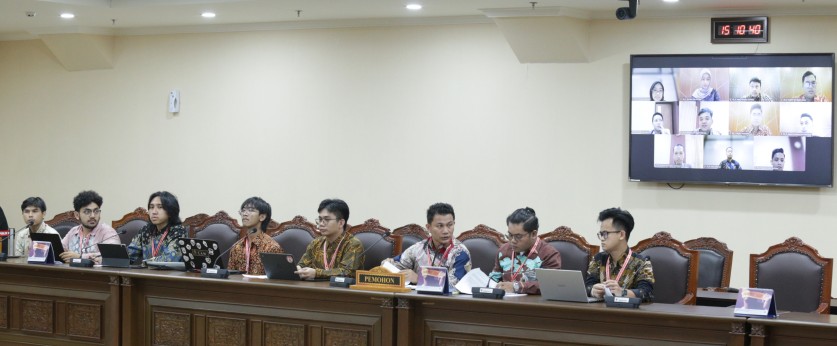
The Petitioners at the formal and/or material judicial review hearing of Law No. 3 of 2025 on Amendments to Law No. 34 of 2004 on the Indonesian National Army Case No. 45/PUU-XXIII/2025, 55/PUU-XXIII/2025, 69/PUU-XXIII/2025, and 79/PUU-XXIII/2025, Thursday (5/22/2025). Photo by MKRI/Bay
JAKARTA (MKRI) – The Panel of Justices presided over by Deputy Chief Justice of the Court (MK) Saldi Isra accompanied by Constitutional Justice Ridwan Mansyur and Constitutional Justice Arsul Sani again held a joint hearing of three cases regarding the formal and/or material review of Law No. 3 of 2025 on Amendments to Law No. 34 of 2004 on the Indonesian National Army (UU TNI) on Thursday (5/22/2025). Those three cases are Case No. 45/PUU-XXIII/2025, Case No. 55/PUU-XXIII/2025, Case No. 69/PUU-XXIII/2025, and Case No. 79/PUU-XXIII/2025. In this second hearing, the Petitioners for each case submitted revised petitions.
There was revision in the Petitioner in Case No. 45/PUU-XXIII/2025 to Muhammad Alif Ramadhan, Kelvin Oktariano, Mohammad Syaddad Sumartadinata, Fiqhi Firmansyah, and Imam Morezki Bastanta Manihuruk. The Petitioners said that the formation of Law No. 3 of 2025 on Amendments to Law No. 34 of 2004 did not use a carryover mechanism.
The carry-over mechanism is regulated in Article 71A of Law No. 15 of 2019 on the Formation of Legislation (UU P3). In the event that the discussion of the Bill of Law (RUU) has entered the discussion of the Problem Inventory List (DIM) during the current House of Representatives (DPR) membership period, the results of the discussion of the RUU are submitted to the DPR for the next period and based on the agreement of the DPR, the President, and/or the DPD, the RUU can be re-inserted into the list of medium-term National Legislation Programs (Prolegnas) and/or annual priority Prolegnas.
The Petitioner explained that the stages of the formation of laws as regulated in the P3 Law must be followed in their entirety to guarantee the legality and legitimacy of the resulting legal product, so that if the carry-over mechanism cannot be applied due to the lack of information and agreement as required in Article 71A of the P3 Law, then the legislative process must start from the initial stages such as planning through the Prolegnas and the re-drafting of the TNI Bill.
Then, Case No. 55/PUU-XXIII/2025 was filed by private employees Christian Adrianus Sihite, Noverianus Samosir, and additional Petitioner, a student Agam Firdaus. The Petitioners said that the formation of Law No. 3 of 2025 was not based on the legal needs of the people and was not to address the legal vacuum.
The Petitioners assessed that the TNI Bill drafting process was rushed because the DPR did not prioritize a number of bills that were more pro-people such as the Domestic Workers Protection Bill, the Indigenous Peoples Bill, and the Asset Confiscation Bill. A number of these bills were actually neglected for years, unlike the TNI Bill where the DPR responded very quickly and approved the TNI Bill proposal in just five days.
Both cases, including Case No. 69/PUU-XXIII/2025 filed by students including Moch Rasyid Gumilar, Kartika Eka Pertiwi, Akmal Muhammad Abdullah, Fadhil Wirdiyan Ihsan, and Riyan Fernando have similar petitums. The Petitioners asked the Court to declare the TNI Law does not fulfill the provisions for the formation of laws based on the 1945 Constitution of the Republic of Indonesia and does not have binding legal force.
Meanwhile, in addition to formal review, Case No. 79/PUU-XXIII/2025 filed by students Endrianto Bayu Setiawan, Raditya Nur Sya'bani, Felix Rafiansyah Affandi, Dinda Rahmalia, Muhamad Teguh Pebrian, and Andrean Agus Budiyanto also filed a petition for material review of a number of articles in the TNI Law. The Petitioner revised the articles being reviewed to Article 7 paragraph (4), Article 47 paragraph (1), and Article 47 paragraph (3) of the TNI Law.
In their petition, the Petitioners requested the Court to declare Article 7 paragraph (4) of the TNI Law contradictory to the 1945 Constitution of the Republic of Indonesia and not have conditional binding legal force as long as it is not interpreted as "The implementation of military operations other than war as referred to in paragraph (2) letter b is further regulated by law"; to declare Article 47 paragraph (1) of the TNI Law contradictory to the 1945 Constitution of the Republic of Indonesia and not have conditional binding legal force as long as it is not interpreted as "Soldiers may hold positions in ministries/institutions that oversee the presidential military secretariat, the Republic of Indonesia Attorney General's Office, and the Supreme Court"; and to declare Article 47 paragraph (3) of the TNI Law contradictory to the 1945 Constitution of the Republic of Indonesia and not have conditional binding legal force as long as it is not interpreted as "Soldiers who hold certain positions as referred to in paragraph (1) are based on the provisions of the law and are subject to the administrative provisions applicable within the ministry and institution".
Read also:
Petition on Army Law Highlights Armed Forces Assignment to Ministries
Author : Mimi Kartika.
Editor : N. Rosi
PR : Andhini Sayu Fauzia.
Translator : Donny Yuniarto
Disclaimer: The original version of the news is in Indonesian. In case of any differences between the English and the Indonesian versions, the Indonesian version will prevail.
Thursday, May 22, 2025 | 17:46 WIB 1353