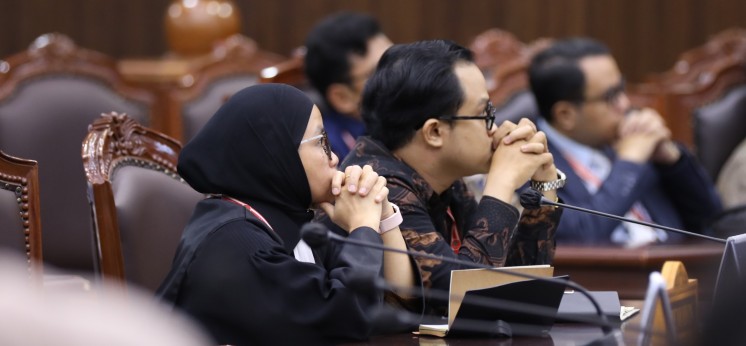
The Petitioners’ legal counsel attending the ruling hearing of the judicial review of the Law on Zakat Management, Thursday (8/28/2025). Photo by MKRI/Ifa.
JAKARTA (MKRI) — The Constitutional Court (MK) dismissed the petition for judicial review of Article 7 paragraph (1) letter b of Law No. 23 of 2011 on Zakat Management filed by Muhammad Jazir (Petitioner I) and Indonesia Zakat Watch (Petitioner II). The Court rejected the remainder of the Petitioners’ arguments.
The ruling hearing of case No. 54/PUU-XXIII/2025 took place on Thursday, August 28, 2025 in the plenary courtroom of the Court. In the legal considerations read out by Constitutional Justice Arief Hidayat, the Court addressed the Petitioners’ claims questioning the constitutionality of the provisions under review, which, according to them, disregarded the original intention of the academic manuscript of Law No. 23 of 2011. The Petitioners argued that the law retained the definition of BAZNAS instead of BPZ, thereby making BAZNAS a “superbody” functioning both as regulator and operator of zakat, allegedly contravening Article 28C paragraph (2), Article 28D paragraph (1), and Article 29 paragraph (2) of the 1945 Constitution.
On this point, the Court emphasized that although the academic manuscript serves as a reference in drafting a bill, it does not automatically render a statute unconstitutional when certain provisions differ from it. Likewise, provisions included in the academic manuscript but later amended or omitted during the legislative process do not necessarily invalidate a statute’s constitutionality.
The Court referred to its previous decisions in Constitutional Court Decision No. 73/PUU-XII/2014 and Decision No. 49/PUU-XX/2022, which remain consistent precedent. Thus, Justice Arief asserted, the Petitioners’ argument that the provisions under review betrayed the original intention of the academic manuscript of Law No. 23 of 2011 was unfounded.
Definition of the National Zakat Agency
The Court also examined the review of Article 1 points 7, 8, and 9 of Law No. 23 of 2011, which the Petitioners argued had a cascading effect on other provisions concerning BAZNAS’ authority as zakat collector. The Court observed that the Petitioners essentially disputed the definition of the National Zakat Agency (BAZNAS).
Should the Petitioners’ petitum be granted, it would affect the entire statute, as those provisions serve as the foundation for many other articles, including Article 6 on BAZNAS’ institutional provisions.
“In other words, replacing BAZNAS with BPZ, as the Petitioners argued, would be tantamount to enacting an entirely new law. In this regard, the House of Representatives (DPR) has explained in the hearing that Law No. 23 of 2011 is already listed in the 2025–2029 National Legislation Program at number 18, and a draft amendment has been prepared as a DPR initiative. Therefore, the Petitioners may channel their aspirations to the DPR to prioritize deliberation of the amendment,” Justice Arief explained.
Revision Within Two Years
The Court further addressed the Petitioners’ claim of unconstitutionality regarding Article 1 points 7, 8, and 9 in conjunction with Article 16 paragraph (2), Article 22, Article 23 paragraph (1), Article 24, Article 28 paragraph (1), Article 30, and Article 31 of Law No. 23 of 2011. According to the Court, the Petitioners’ petitum in effect sought to alter the nomenclature of BAZNAS, thereby disrupting the structure of the entire statute.
Moreover, such a change lies within the legislature’s authority. Hence, the Petitioners’ claim that those provisions contravene Article 28C paragraph (2), Article 28D paragraph (1), and Article 29 paragraph (2) of the 1945 Constitution is no longer relevant for further consideration.
“The Court has thus considered it necessary for the legislature to revise Law No. 23 of 2011 within no later than two years from the pronouncement of this decision,” Justice Arief concluded.
Also read:
Petitioners Urge Baznas Be Made Zakat Manager, Supervisor
Petitioners Challenge Legal Barriers to Zakat Management
House Explains Baznas and LAZ
Government Clarifies the Purpose of Establishing Zakat Collection Units
Expert: Baznas’ Dual Role Conflicts with Rule of Law
Expert: Unified Zakat System Key to Enhancing Social Welfare
Author: Sri Pujianti
Editor: N. Rosi
PR: Andhini SF
Translator: Yuanna Sisilia
Disclaimer: The original version of the news is in Indonesian. In case of any differences between the English and the Indonesian versions, the Indonesian version will prevail.
Thursday, August 28, 2025 | 19:14 WIB 177