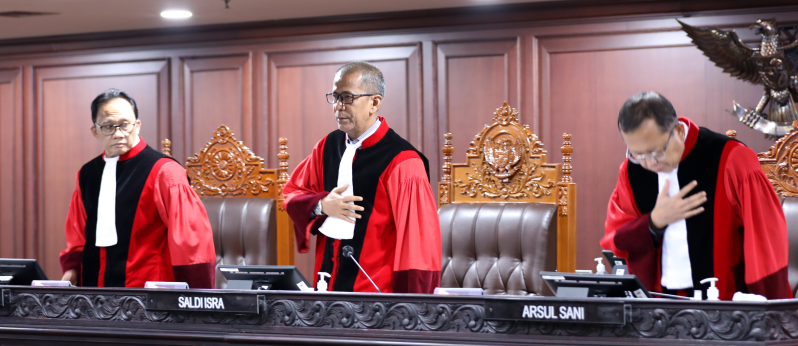
Deputy Chief Justice Saldi Isra accompanied by Constitutional Justices Ridwan Mansyur and Arsul Sani entering the Panel Courtroom on the 4th floor, Wednesday (5/21/2025). Photo by MKRI/Fauzan
JAKARTA (MKRI) — The Constitutional Court (MK) held the second hearing for the judicial review of Law No. 23 of 2011 on Zakat Management (Zakat Management Law) on Wednesday, May 21, 2025. This petition revision hearing for Case No. 54/PUU-XXIII/2025 was filed by Muhammad Jazir (Petitioner I) and Indonesia Zakat Watch (Petitioner II), and took place in the Panel Courtroom.
During the session, the Petitioners’ legal counsel Sri Afrianis explained that the articles being reviewed had been refined to include Article 1 (7), (8), and (9); Article 6; Article 7(1)(b); Articles 16, 17, 22, 23(1), 24, 28(1), 30, and 31 of the Zakat Management Law. In addition, the Petitioners reinforced their legal standing to clearly establish the constitutional impairment they have suffered as a result of the prevailing norms.
“Donors who had transferred their zakat to the Baitul Maal of Jogokariyan Mosque later requested to reroute their funds to another institution because the mosque could not issue an official zakat receipt required for tax deductions. This is due to the fact that the mosque does not yet hold a permit as an official zakat institution (LAZ). Therefore, Petitioner I is hindered in his efforts to manage zakat effectively under the current law. Consequently, zakat collection has declined and will likely continue to drop in the future,” said Afrianis before the panel of justices chaired by Deputy Chief Justice Saldi Isra, alongside Constitutional Justices Ridwan Mansyur and Arsul Sani.
Also read: Petitioners Urge Baznas Be Made Zakat Manager, Supervisor
As background, the judicial review was filed by Muhammad Jazir—an initiator of zakat collection at Jogokariyan Mosque in Yogyakarta and currently the Chair of the mosque’s Syuro Council—and Indonesia Zakat Watch, a non-governmental organization based in South Tangerang, Banten Province.
The Petitioners challenge the constitutionality of multiple provisions in the Zakat Management Law, which they believe are in contradiction with Articles 28C(2), 28D(1), and 29(2) of the 1945 Constitution.
During the preliminary hearing on May 8, 2025, their other legal representative, Ibnu Syamsu Hidayat, stated that the centralized authorization of zakat institutions under the National Zakat Agency (Baznas), which also functions as a zakat operator, places Petitioner I’s long-standing institution at risk of being delegitimized.
Meanwhile, Petitioner II argued that the current framework obstructs their oversight role in promoting transparent and accountable zakat governance. According to them, Baznas wields excessive power, enabling arbitrary practices in zakat management that deviate from good governance principles and open doors to potential corruption, collusion, and nepotism.
The Petitioners asserted that Baznas’ dual role as both regulator and operator has led to overlaps in authority. In practice, Baznas maximizes zakat collection efforts using the authority of the state, when it should instead focus on regulatory and supervisory functions. They proposed renaming Baznas to Zakat Regulation and Supervision Agency (BPPZ), emphasizing a shift in focus to oversight and institutional monitoring.
Read more: Petition for Case No. 54/PUU-XXIII/2025
Author: Sri Pujianti
Editor: N. Rosi
PR: Andhini SF
Translator: Yuanna Sisilia
Disclaimer: The original version of the news is in Indonesian. In case of any differences between the English and the Indonesian versions, the Indonesian version will prevail.
Wednesday, May 21, 2025 | 17:05 WIB 280