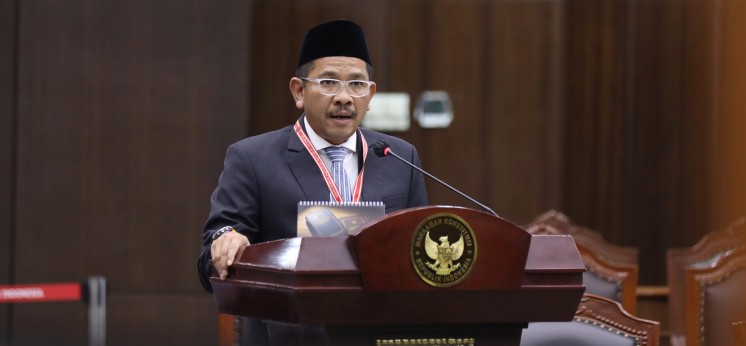
Abu Rokhmad delivering the Government’s statement at the judicial review hearing of Law No. 23 of 2011 on Zakat Management, Monday (7/21/2025). Photo by MKRI/Ifa.
JAKARTA (MKRI) — The authority to establish zakat collection units (Unit Pengumpul Zakat or UPZ) lies with the legislative, which has delegated this discretion to the National Zakat Agency (Baznas) at the national, provincial, and regency/city levels. This discretionary power is intended to provide flexibility in establishing UPZs according to specific contexts and conditions.
Government representative Abu Rokhmad delivered this statement in response to the judicial review petition of Law No. 23 of 2011 on Zakat Management. The petition, filed under case No. 54/PUU-XXIII/2025, challenges Baznas’s role as regulator, operator, supervisor, and auditor, claiming such concentration of functions undermines checks and balances and may lead to arbitrariness.
The evidentiary hearing, held on Monday, July 21, 2025, was convened to hear statements from the Government and the relevant party, represented by Baznas.
Abu Rokhmad elaborated that the formation of UPZs within government agencies, state-owned and regional enterprises, private corporations, and Indonesian missions abroad is designed to facilitate Muslim employees in fulfilling their zakat obligations. Article 16 of the Zakat Management Law mandates that zakat must be managed institutionally and in accordance with Islamic principles, trustworthiness, utility, fairness, legal certainty, integration, and accountability. These institutional mechanisms aim to enhance both the efficiency and effectiveness of zakat collection and distribution through officially recognized bodies.
“This provision does not preclude public involvement in national zakat management. Individuals and communities may still participate by establishing or engaging with Zakat Management Organizations (Lembaga Amil Zakat or LAZ), provided they meet the administrative and substantive requirements stipulated in the law,” he asserted. This regulatory framework, he added, is meant to mitigate the risk of fund mismanagement and ensure that zakat governance aligns with Shariah principles.
Chief Justice Suhartoyo chaired the hearing alongside the other eight constitutional justices.
Role of Baznas and Development of Community-Based Zakat Institutions
Representing the relevant party, Baznas Chair Noor Achmad emphasized that LAZs, community-established zakat agencies as referred to in Article 1(8) of Law No. 23 of 2011, are meant to support Baznas. This “supporting role” should be interpreted as assisting Baznas in enabling the state to manage zakat transparently and accountably.
He highlighted that the synergistic relationship between Baznas and the increasing number of LAZs illustrates the effectiveness of the law’s unified system. “Baznas and LAZs can coexist and operate in harmony,” he said. He cited data showing that prior to the enactment of Law No. 23 of 2011, only 18 LAZs had obtained official licenses. By 2024, the number had grown to 181.
“In 2020, LAZs collected Rp 3.78 trillion in zakat funds nationally. By 2024, this figure had nearly doubled to Rp 7.35 trillion. These numbers reflect the law’s success in catalyzing positive growth in zakat governance,” Noor Achmad stated.
Also read:
Petitioners Urge Baznas Be Made Zakat Manager, Supervisor
Petitioners Challenge Legal Barriers to Zakat Management
House Explains Baznas and LAZ
The petition was filed by Muhammad Jazir (Petitioner I), the initiator of zakat collection at Jogokariyan Mosque in Yogyakarta and currently serving as Chair of the mosque’s Dewan Syuro, and Indonesia Zakat Watch (Petitioner II), a non-governmental organization based in South Tangerang.
They challenge the constitutionality of multiple provisions within the Zakat Management Law, namely Articles 1(7), 1(8), 1(9), 6, 7(1)(b), 16, 17, 22, 23(1), 24, 28(1), 30, and 31, arguing that these articles violate Articles 28C(2), 28D(1), and 29(2) of the 1945 Constitution. In an earlier hearing on May 8, 2025, they also cited violations of Articles 28E(1), 28I(2), and 28I(5).
Petitioner I contended that the current centralization of authority in Baznas endangers the legitimacy of long-standing LAZs such as theirs, while Petitioner II expressed concern over the lack of institutional checks and balances, alleging that Baznas’ broad powers foster potential abuse and misgovernance. They criticized what they viewed as coercive practices by Baznas in compelling various groups, including those affiliated with public institutions and private corporations, to register as UPZs under Baznas’ control.
To address this perceived overreach, the Petitioners proposed rebranding Baznas as the “Zakat Regulatory and Supervisory Agency” (BPPZ). Under this revised model, Baznas would no longer act as a fund collector but would instead focus solely on regulating and supervising zakat institutions. Existing zakat funds would be channeled to LAZs through an accreditation process managed by BPPZ.
They recommended a two-year transition period following the Court’s ruling to facilitate this structural shift, primarily to safeguard the interests of zakat recipients (mustahik) during the adjustment phase.
Author: Sri Pujianti
Editor: N. Rosi
PR: Andhini SF
Translator: Yuanna Sisilia
Read the full petition (in Indonesian): Petition for Case No. 54/PUU-XXIII/2025
Disclaimer: The original version of the news is in Indonesian. In case of any differences between the English and the Indonesian versions, the Indonesian version will prevail.
Monday, July 21, 2025 | 15:15 WIB 426