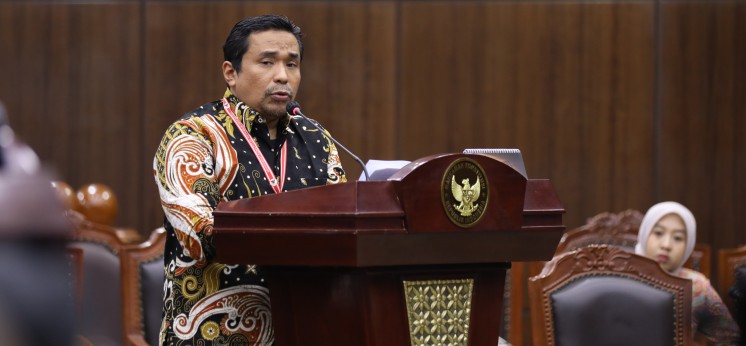
Charles Simabura, the Petitioners’ expert, presenting his opinion at the judicial review hearing of Law No. 23 of 2011 on Zakat Management, Tuesday (7/29/2025) in the Courtroom. Photo by MKRI/Ifa.
JAKARTA (MKRI) — Charles Simabura, expert presented by the Petitioners, argued that Baznas’ dual role as regulator and operator may give rise to normative conflicts and deviate from the principles of a rule-of-law state. At the fifth hearing of the judicial review of Law No. 23 of 2011 on Zakat Management (case No. 54/PUU-XXIII/2025), he emphasized the importance of institutional separation between regulatory and operational functions.
According to him, combining these roles may lead to conflicts of interest and unequal treatment, particularly when the state institution ends up competing with community-established zakat institutions, some of which predate Baznas. He suggested redesigning Baznas into a purely regulatory agency and assigning its operational function to a separate entity equal to community-based zakat managers. If Baznas continues as an operator, its authority should be limited to internal regulation.
During the same hearing, Imam Alfaruq testified as a witness. As Secretary-General of the National Mosque Empowerment Collaboration (2022–2023) and board member of Darussalam Mosque Foundation, he said that their attempt to obtain a recommendation from Baznas to establish a zakat agency in 2022 was rejected. Baznas argued the foundation was ineligible due to its affiliation with a mosque and limited fundraising capacity.
Also read:
The petition was filed by Muhammad Jazir (Petitioner I), initiator of zakat collection at Jogokariyan Mosque Yogyakarta, and Indonesia Zakat Watch (Petitioner II), an NGO based in South Tangerang. They challenged 13 provisions of the Zakat Management Law, citing violations of several constitutional articles. At the preliminary hearing, they argued that the centralization of LAZ recommendations in Baznas had harmed their legal standing and hindered oversight, while also enabling arbitrary and KKN-prone zakat governance.
They criticized Baznas for exercising excessive authority as both regulator and operator, including coercing organizations affiliated with government institutions or state-owned companies to establish Zakat Collection Units (UPZ) under Baznas, despite the Law’s use of permissive rather than mandatory language.
The Petitioners proposed renaming Baznas to the Zakat Regulatory and Supervisory Agency (BPPZ), limiting its function to oversight. The operational role and zakat collection would be delegated to accredited LAZs, with a proposed two-year transition period after the Court’s ruling to accommodate necessary adjustments.
Read the full petition: Case No. 54/PUU-XXIII/2025 (in Bahasa)
Author: Sri Pujianti
Editor: N. Rosi
PR: Andhini SF
Translator: Yuanna Sisilia
Disclaimer: The original version of the news is in Indonesian. In case of any differences between the English and the Indonesian versions, the Indonesian version will prevail.
Tuesday, July 29, 2025 | 16:19 WIB 201