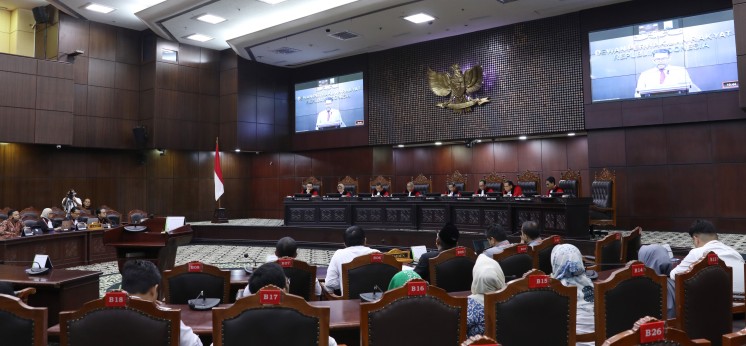
A judicial review hearing of Law No. 23 of 2011 on Zakat Management to hear the House, Tuesday (7/8/2025). Photo by MKRI/Ifa.
JAKARTA (MKRI) — Under the Law on Zakat Management, regulatory authority is vested in the Minister of Religious Affairs. This is evident in the mandate to further regulate requirements and procedures for calculating Islamic alms zakat al mal and zakat al-fitr, as well as the utilization of zakat for productive enterprises. In addition, the establishment of provincial and regency/city Baznas falls under the minister’s authority upon the recommendation of governors, regents, or mayors.
Furthermore, the establishment of zakat manager institutions (LAZ) must obtain approval from an official appointed by the minister. Therefore, pursuant to Article 34 paragraph (1) of the Zakat Management Law, the Minister of Religious Affairs is also responsible for providing guidance and supervision to the central, provincial, and regency/city Baznas, as well as LAZs. Moreover, in accordance with Article 29 paragraph (4) of the Law, Baznas is obliged to report on its zakat management activities.
Such was the statement delivered by M. Nasir Djamil on behalf of the House of Representatives (DPR) at a hearing on Tuesday, July 8, 2025. This statement was a response to the Petitioners’ claim that Baznas functions simultaneously as regulator, operator, controller, and auditor, leading to the absence of a checks and balances mechanism as well as arbitrary conduct.
This third hearing was originally scheduled to hear statements from the House and the President or Government; however, the President or Government’s representative had requested a postponement, citing unpreparedness.
Audit of LAZs
The House clarified that the authority over the audits of LAZs is in compliance with both sharia and financial standards. The audits are conducted by individuals competent in the fields of sharia and finance to ensure LAZs’ compliance with Islamic values and prevailing regulations. The audits are carried out by the Ministry of Religious Affairs and involve public accounting firms as well as the ministry’s internal auditors.
“Therefore, the audits of LAZs do not fall under the authority of Baznas. Indeed, Article 19 of the Zakat Management Law stipulates that LAZs must submit audited reports on the collection, distribution, and utilization of zakat to Baznas periodically,” Nasir explained at the hearing chaired by Chief Justice Suhartoyo from the plenary courtroom.
Baznas’ Accountability
Regarding the accountability of Baznas in managing zakat pursuant to Article 29 paragraphs (4) and (5) of the Law, Nasir stated that Baznas is required to submit periodic reports on the management of zakat, infaq, sadaqah, and other religious social funds to the minister. In addition, it must publish its annual balance sheet through print or electronic media. It is also obligated to provide a written report on its activities to the president, through the minister, and to the House at least once a year.
“This demonstrates that Baznas is subject to oversight under the provisions of the a quo Law, thereby preventing Baznas—which is established and mandated by the Government—from exercising its authority arbitrarily,” Nasir elaborated.
Implementation of Provisions
Concerning zakat management institutions established before the enactment of the Zakat Management Law, Nasir clarified that, under its transitional provisions, LAZs recognized by the minister before the Law came into force must adjust to the new legal framework within five years from the Law’s enactment.
This provision shows that, despite the introduction of centralized zakat management through Baznas, lawmakers still provided space for community participation by allowing LAZs to manage zakat under the Government’s coordination through Baznas.
“If, in implementing the Law, the Petitioners encountered issues, such as Baznas allegedly forcing a LAZ to convert into a UPZ/Baznas branch, this is not regulated by the Zakat Management Law. Therefore, it cannot be considered an issue of normative implementation under the a quo Law,” Nasir stated.
Zakat Distribution
Nasir explained that zakat distribution follows a prioritization scale based on principles of equity, justice, and territorial considerations. Zakat may also be used for productive endeavors to assist the poor and enhance the quality of Islamic communities, provided the basic needs of zakat recipients have been met. To improve zakat’s effectiveness and efficiency, it must be managed institutionally in accordance with Islamic law, trustworthiness, utility, fairness, legal certainty, integration, and accountability.
To achieve zakat management goals, the law establishes the National Zakat Board (BAZNAS), headquartered in the state capital. Baznas is a non-structural government body that operates independently and is accountable to the president through the minister. Baznas holds the authority to manage zakat at the national level, while the community can form LAZs to support Baznas in collecting, distributing, and utilizing zakat.
Academic Papers
In response to the Petitioners’ claim that the provisions under review allegedly contradict the academic paper, the House explained that the academic paper serves as a conceptual framework for drafting a bill. The drafting of the current bill underwent various mechanisms and discussions. Consequently, differences between the bill and the academic paper are part of the legislative process and deliberation accommodated by lawmakers. Therefore, discrepancies between the academic paper and the final law cannot, by themselves, be used to argue that the law is unconstitutional.
“This view aligns with the Constitutional Court’s legal considerations in Decision No. 49/PUU-XX/2022, where the Court held that such discrepancies do not automatically render the law unconstitutional. Likewise, the legislative process sought to improve zakat management to better promote public welfare,” Nasir added.
Sources of Islamic Law
Regarding the Petitioners’ claim that the contested provisions prevent them from practicing zakat management according to their beliefs, the House clarified that the Law’s provisions have considered the management of zakat as prescribed in the Qur’an, Hadith, and Islamic jurisprudence (fiqh). These sources guide Muslim religious practices and have been accommodated within the state’s legal framework.
Expanding the Benefits of Zakat
The House further explained that, to broaden the benefits of zakat, infaq, and sadaqah, these funds may be distributed from surplus regions to under-resourced areas. Such redistribution cannot be effectively carried out by individual zakat managers or institutions with limited capacity. Moreover, requiring local zakat managers to plan and distribute funds outside their working areas would impose additional burdens.
The equitable distribution of zakat, infaq, and sadaqah is as vital as the benefits these funds provide themselves, serving as instruments for public welfare. Based on this, it is reasonable for zakat payers (muzaki) and zakat managers (amil) to understand, or at least be informed about, how their zakat, infaq, and sadaqah are used.
“This is not only a matter of accountability in zakat distribution but also fulfills zakat’s social dimension: promoting the welfare of society, particularly those with the lowest quality of life,” Nasir concluded.
Also read:
Petitioners Urge Baznas Be Made Zakat Manager, Supervisor
Petitioners Challenge Legal Barriers to Zakat Management
The petition No. 54/PUU-XXIII/2025 was filed by Muhammad Jazir (Petitioner I), an initiator of zakat collection at Jogokariyan Mosque in Yogyakarta and currently the chair of the mosque’s Syuro Council, and Indonesia Zakat Watch (Petitioner II), a non-governmental organization based in South Tangerang, Banten Province.
They challenge the constitutionality of Article 1 points 7, 8, and 9; Article 6, Article 7 paragraph (1) letter b; Article 16; Article 17; Article 22; Article 23 paragraph (1); Article 24; Article 28 paragraph (1); Article 30; and Article 31 of the Zakat Management Law against Article 28C paragraph (2), Article 28D paragraph (1), and Article 29 paragraph (2) of the 1945 Constitution.
At the preliminary hearing on May 8, 2025, their legal counsel Ibnu Syamsu Hidayat stated that the centralized authorization of zakat amil (manager) institutions (LAZ) under the National Zakat Board (Baznas), which also functions as a zakat operator, has placed the long-standing institution of Petitioner I at risk of delegitimization.
Meanwhile, Petitioner II feels that checks and balances and good zakat management would not be possible due to Baznas being a superpower. Not to mention, the enforcement of those articles has led to Baznas running zakat management arbitrarily. As a result, zakat management is often not based on the principles of good governance, anti-corruption, collusion, and nepotism (KKN).
The ongoing use of the term Baznas in the Zakat Management Law as led to an overlap of function and authority, as it now functions as both a regulator and an operator. In fact, as an operator, it has been collecting zakat from all sources through coercion using its authority as an organ under the Government, when its coercive power should be used for regulatory and supervisory purposes in order to optimize zakat management governance by zakat-collecting institutions (LPZ) and for zakat collection. The Petitioners recommended that Baznas be renamed Zakat Regulatory and Supervisory Agency (BPPZ), so that it will be focused on regulating and supervising existing LAZ
Author : Sri Pujianti
Editor : N. Rosi
PR : Andhini S.F.
Translator : Yuniar Widiastuti (NL)
Disclaimer: The original version of the news is in Indonesian. In case of any differences between the English and the Indonesian versions, the Indonesian version will prevail.
Tuesday, July 08, 2025 | 15:52 WIB 2965