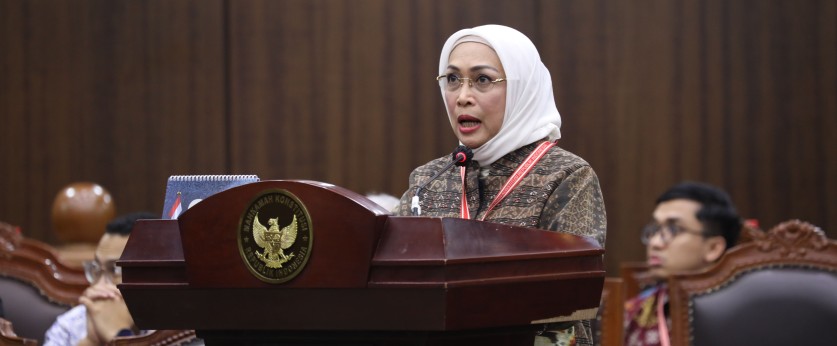
Pininta Ambuwaru testifying as a witness for the House at a formal judicial review hearing of Law No. 1 of 2025 on State-Owned Enterprises, Wednesday (8/6/2025). Photo by MKRI/Panji.
JAKARTA (MKRI) — Pininta Ambuwaru, a legal consultant specializing in state finance and state-owned enterprises (BUMN), stated that she had been invited by the House of Representatives (DPR) to participate in a discussion on the proposed amendment to the BUMN Law on June 18, 2020. During the session, she offered several recommendations aimed at improving the legal framework governing BUMN, she said while testifying for the House at a hearing for cases No. 52/PUU-XXIII/2025 and No. 64/PUU-XXIII/2025 on the formal judicial review of Law No. 1 of 2025 on the Third Amendment to Law No. 19 of 2003 on State-Owned Enterprises (BUMN Law).
Speaking at the Constitutional Court’s (MK) plenary courtroom on Wednesday, August 6, 2025, she emphasized the need to clearly define the legal status of BUMN—whether they should fall under the regime of state finance law or corporate law. “I underlined, among other points, that the definition of BUMN must be clarified, particularly regarding whether they are governed by the state finance regime or by the corporate regime,” she said.
She proposed that BUMN be classified based on their foundational objectives. Some enterprises may be established to serve the public interest, in which case they should not be burdened with profit-making obligations. Others may exist to generate dividends for the state and should therefore operate under different expectations and regulatory constraints.
She further argued that removing BUMN from the purview of the state finance regime could enable them to operate with greater agility and efficiency. If a BUMN remains under the state finance regime, its board of directors will often face limitations when making decisions or taking action due to bureaucratic constraints.
“Another key point raised in the discussion with the House was if BUMN are to remain subject to BPK (Audit Board) audit, [the revised legislation] must clearly stipulate the mechanisms and scope by which such audits may be conducted by BPK,” she explained.
Also read:
Govt’s Expert Reveals Why Pension Be Paid Periodically
Petitioners Argue Inconsistency in the Formation of BUMN Law
Eddy Hiariej: BUMN Law Revised for BPI Danantara’s Establishment
Bivitri Susanti Proposes Formal Review for Constitutional Complaint
Expert Talks DPD, BPK’s Disconnect from BUMN Law’s Formation
The Petitioners of case No. 52/PUU-XXIII/2025 are Abu Rizal Biladina and Bima Surya, fourth-semester law students of the University of Indonesia (UI). They believe the House had not complied with the statutory laws on lawmaking embodied in Article 22A of the 1945 Constitution, thus violating their constitutional rights protected under Article 28D paragraph (1) of the 1945 Constitution. As such, they emphasized, the BUMN Law is invalid as it did not follow applicable lawmaking procedure, given that it was not in the National Legislative Program (Prolegnas).
Therefore, in the petitums, they request that the Court declare Law No. 1 of 2025 on BUMN not meeting lawmaking provisions mandated by the 1945 Constitution. They also request that the Court declare it unconstitutional and, thus, not legally binding, and declare the norms in the Law that have been amended, removed, and/or declared unconstitutional back in effect.
Also read:
LKBH HMI Challenges Lawmaking of BUMN Law
More Petitioners Challenge Lack of Public Participation in SOEs Law Formulation
The case No. 64/PUU-XXIII/2025 was filed by the West Jakarta Branch of the Legal Aid and Consultation Institute for Muslim Students (LKBHMI), Lokataru Foundation, and individual citizen Kusuma Al Rasyid Agdar Maulana Putra. As legal aid organizations, the Petitioners, argue that they were neither notified nor involved at any stage in the drafting of the BUMN Law. Therefore, they believe the lawmaking process had failed to meet the constitutional requirement for meaningful public participation, as set out Article 1 paragraphs (2) and (3), Article 27 paragraph (1), Article 28C, Article 28D paragraph (1), and Article 28F of the 1945 Constitution.
The Petitioners requested the Court to declare Law No. 1 of 2025 on the Third Amendment to Law No. 19 of 2003 on State-Owned Enterprises as not having followed proper legislative procedures based on the 1945 Constitution, and thus unconstitutional and not legally binding.
The revised petition also introduced a provisional petitum, requesting the Court to suspend the implementation of Law No. 1 of 2025 until a final ruling is rendered. The Petitioners further urged the Court to declare the law unconstitutional and not legally binding due to its failure to comply with legislative procedures mandated by the 1945 Constitution.
Author : Mimi Kartika
Editor : N. Rosi
PR : Fauzan F.
Translator : Yuniar Widiastuti (NL)
Disclaimer: The original version of the news is in Indonesian. In case of any differences between the English and the Indonesian versions, the Indonesian version will prevail.
Wednesday, August 06, 2025 | 15:32 WIB 409