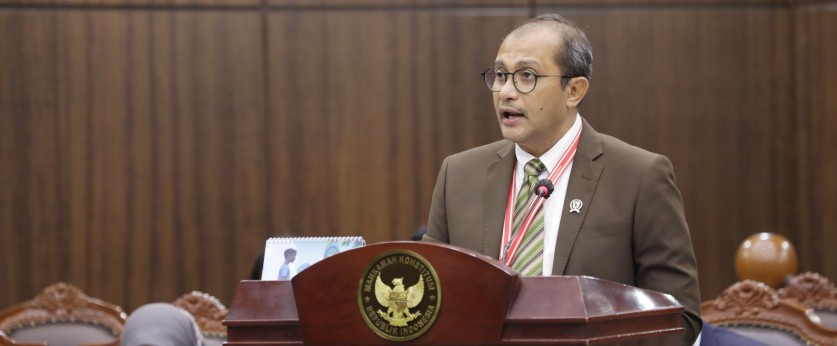
Law Deputy Minister Edward Omar Sharif Hiariej speaking on behalf of the Governmnet at a judicial review hearing of the BUMN Law, Tuesday (6/24/2025). Photo by MKRI/Panji.
JAKARTA (MKRI) — The Constitutional Court (MK) held another hearing for the formal judicial review of Law No. 1 of 2025 on the Third Amendment to Law No. 19 of 2003 on State-Owned Enterprises (BUMN Law) for cases No. 52/PUU-XXIII/2025 and No. 64/PUU-XXIII/2025 on Tuesday, June 24, 2025. Law Deputy Minister Edward Omar Sharif Hiariej or Eddy Hiariej said on behalf of the President that the bill for the revision of the BUMN Law was proposed due to the national urgency of the establishment of the Daya Anagata Nusantara Investment Management Agency (BPI Danantara).
“The Government must clarify that the amendment bill to the BUMN Law was proposed based on three factors: first, the national urgency to establish BPI Danantara in support of the President’s Asta Cita agenda; second, as a follow-up to a Constitutional Court decision; and third, the shared intention of the lawmakers to continue the legislative process to revise Law No. 19 of 2003 on State-Owned Enterprises,” Hiariej stated at the session before the constitutional justices in the plenary courtroom.
Hiariej explained that the BUMN Bill was proposed by the House of Representatives (DPR) and has been prioritized for deliberation annually within the National Legislative Program (Prolegnas) for both the 2020–2024 and 2025–2029 terms. This is reflected in DPR Decree No. 64/DPR RI/I/2024-2025 on the 2025–2029 Prolegnas and the 2025 Priority Prolegnas, where the BUMN Law is listed as item number 2 in the cumulative open list of draft laws mandated by Constitutional Court rulings.
The Government claimed it had carried out a series of public consultations between 2020 and 2021 to gather inputs in preparation for the BUMN Bill. These inputs were incorporated into the Government’s Problem Inventory List (DIM), which was subsequently discussed during the first stage of deliberations. This stage included at least four sessions, culminating in a working meeting on February 1, 2025 between House Commission VI and the Government to present the working committee’s (Panja) report, hear the mini-faction statements, the President’s final opinion, and to adopt a decision on the draft bill to proceed to the second stage of deliberation.
The second-stage deliberation took place in a House plenary session on February 4, 2025, following an official invitation attended by House leadership, members, and government representatives. The House leadership then issued a letter to the President (No. B/1638/LG.01.03/02/2025) conveying the House’s approval of the third amendment bill to Law No. 19 of 2003 on State-Owned Enterprises.
Hiariej explained the ratification of the BUMN Law amendment bill had followed proper procedures, beginning with a formal request for ratification submitted by the House speaker to the president. In line with Article 85 of Law No. 13 of 2022, the Minister of State Secretariat reported the bill and simultaneously requested the president’s signature. Upon the president’s signing, the minister promulgated the law by assigning it a law number and publishing it in the State Gazette.
“Thus, based on the entire sequence of events, the enactment of Law No. 1 of 2025 on the Amendment to the BUMN Law has adhered to all procedural stages required in the legislative process,” Hiariej concluded.
Meanwhile, chairperson of the House Commission VI Anggia Erma Rini refuted claims that the amendment process failed to uphold the principle of meaningful public participation. She asserted that the House had invited a wide range of stakeholders to supplement the substance of the BUMN Bill.
“Considering that Law No. 19 of 2003 has been in effect for 19 years, it is necessary to revise it promptly,” Anggia added.
On the other hand, the constitutional justices reminded both the House and the Government that, as lawmakers, they must substantiate that the legislative process for the revised BUMN Law complied with the applicable laws and regulations. All activities related to the legislative process must be supported by documentary evidence, including photos, videos, or other materials. These can be submitted to the Court as supporting evidence in the formal review proceedings.
Also read:
Govt’s Expert Reveals Why Pension Be Paid Periodically
Petitioners Argue Inconsistency in the Formation of BUMN Law
The Petitioners of case No. 52/PUU-XXIII/2025 are Abu Rizal Biladina and Bima Surya, fourth-semester law students of the University of Indonesia (UI). They believe the House of Representatives (DPR) had not complied with the statutory laws on lawmaking embodied in Article 22A of the 1945 Constitution, thus violating their constitutional rights protected under Article 28D paragraph (1) of the 1945 Constitution. As such, they emphasized, the BUMN Law is invalid as it did not follow applicable lawmaking procedure.
Therefore, in the petitums, they request that the Court declare Law No. 1 of 2025 on BUMN not meeting lawmaking provisions mandated by the 1945 Constitution. They also request that the Court declare it unconstitutional and, thus, not legally binding, and declare the norms in the Law that have been amended, removed, and/or declared unconstitutional back in effect.
Also read:
LKBH HMI Challenges Lawmaking of BUMN Law
More Petitioners Challenge Lack of Public Participation in SOEs Law Formulation
The case No. 64/PUU-XXIII/2025 was filed by the West Jakarta Branch of the Legal Aid and Consultation Institute for Muslim Students (LKBHMI), Lokataru Foundation, and individual citizen Kusuma Al Rasyid Agdar Maulana Putra.
As legal aid organizations, the Petitioners, argue that they were neither notified nor involved at any stage in the drafting of the BUMN Law. Therefore, they believe the lawmaking process had failed to meet the constitutional requirement for meaningful public participation, as set out Article 1 paragraphs (2) and (3), Article 27 paragraph (1), Article 28C, Article 28D paragraph (1), and Article 28F of the 1945 Constitution.
The Petitioners believe that because SOEs receive capital from the state budget (APBN), their activities are an integral part of the state financial system. For that reason, any profits or losses they make should be seen not only as those of the SOEs, but also as gains or losses for the state.
The revised petition also introduced a provisional petitum, requesting the Court to suspend the implementation of Law No. 1 of 2025 until a final ruling is rendered. The Petitioners further urged the Court to declare the law unconstitutional and not legally binding due to its failure to comply with legislative procedures mandated by the 1945 Constitution.
Author : Mimi Kartika
Editor : N. Rosi
Translator : Yuniar Widiastuti (NL)
Disclaimer: The original version of the news is in Indonesian. In case of any differences between the English and the Indonesian versions, the Indonesian version will prevail.
Tuesday, June 24, 2025 | 17:57 WIB 867