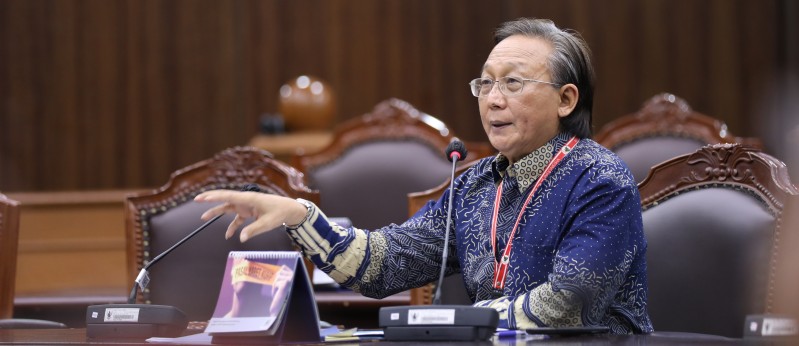
Steve Tanner testifying as an expert for the President/Government at a judicial review hearing of the Law on Financial Sector Development and Reinforcement, Wednesday (5/21/2025). Photo by MKRI/Ifa.
JAKARTA (MKRI) — The main purpose of making pension payment periodically is to ensure continuity of income so that the participants’ welfare is guaranteed throughout their lives. While actively working, they receive income in the form of salaries or wages, while after no longer working they will receive income in the form of pension.
The statement was made by the Steve Tanner, an expert presented by the President/Government at a material judicial review hearing of Article 161 paragraph (2) of Law No. 4 of 2023 on the Financial Sector Development and Reinforcement (PPSK Law) on Wednesday, May 7, 2025 in the plenary courtroom. The hearing for case No. 152/PUU-XXII/2024, filed by Freddy T.H. Sinurat and fifteen other private employees, was presided over by Chief Justice Suhartoyo, Deputy Chief Justice Saldi Isra, and the other seven constitutional justices.
Steven explained that retirement welfare benefits can be measured by the level of retirement income (TPP), which is a ratio between income during retirement and the last income shortly before. Experts say the adequate TPP to maintain the same quality of life before and after retirement ranges from 70-80% of a person’s last income just before retirement. Income after retirement comes from mandatory and voluntary programs. In Indonesia, continued Steven, mandatory programs are the old age benefit (JHT) and pension benefit (JP) managed by the Social Security Administrative Body (BPJS), as well as employment benefits in the form of severance pay as stipulated in the provisions of employment laws and regulations.
Steven admitted that in Indonesia participation in the pension system is very low, not even up to 16% of the workforce. Therefore, the elderly lacks retirement security due to inadequate retirement income. The Government continues to make efforts to make people aware of pension programs, such as by providing tax incentives to voluntary programs, which are organized through pension fund institutions, both the employer-sponsored pension fund (DPPK) and the financial institution pension fund (DPLK). This program is expected to complement the benefits of mandatory programs. The consequence is a strict regulation where pension funds cannot be withdrawn before retirement age. In addition, there are restrictions on the lump sum pension withdrawal due to the main objective of a pension system, which is to ensure income consistency to guarantee the participants’ welfare during their lifetime.
“This is the basis and main reason for Law No. 11 of 1992 on Pension Funds and the P2SK Law to regulate that pension payment must be made periodically under normal conditions. While under certain conditions, both laws still allow participants to receive their pension in a lump sum,” he said.
Reason for Periodic Pension Payment
In response, Constitutional Justice M. Guntur Hamzah asked the lacking pension benefits, “Why does the provision regulate that it be paid periodically?”
Next, Constitutional Justice Asrul Sani asked, “Can a person’s pension right be made loan collateral?”
Meanwhile, Constitutional Justice Enny Nurbaningsih asked, “Can the pension investment suffer losses? How to anticipate that?”
In response, Steven said that pension paid periodically can only be put into time deposits. “The funds used to pay can only be placed in time deposits and government bonds. It cannot be placed in stocks,” he said.
This was the last hearing for the case. Chief Justice Suhartoyo said that the OJK (Financial Services Authority) can submit testimonies of their experts and witnesses in writing. These testimonies would be very helpful for the constitutional justices to decide on the case.
Also read:
Employees Challenge Provision on Periodic Pension Payment
Petitioners of Periodic Pension Payment in PPSK Law Challenge More Articles
Govt: Periodic Pension Payments Help Manage Participants’ Financial Risks
At the preliminary hearing, the Petitioners argued that Article 161 paragraph (2) of the PPSK Law, which reads, “Payment of pension benefits to participants and their widows/widowers or children shall be made periodically,” in violation of Article 28H paragraph (4) of the 1945 Constitution. They believe that the phrase “shall be made periodically” implies coercion and arbitrariness in the takeover of the Petitioners’ private property rights in the form of pension benefits. They believe the word “shall be” does not provide any choice.
However, the mandate concerns the Petitioners’ personal asset, which is deducted from their monthly salaries. Therefore, the provision in the norm has deprived the Petitioners of their right to choose and determine the payment method of their pension benefits. In addition, it has also deprived them of the right and opportunity to utilize the pension benefits in accordance with their and their families’ plans, aspirations, needs, and personal challenges.
In the revised petitum, the Petitioners request that the Court declare the clause “Payment of pension benefits to participants and their widows/widowers or children shall be made periodically” in Article 161 paragraph (2) of the PPSK Law unconstitutional and not legally binding if not interpreted as “Payment of pension benefits to Participants and their Widows/Widowers or Children shall be made periodically upon approval by the Participants, their Widows/Widowers or Children; or the payment of pension benefits shall follow the wishes of Participants and their Widows/Widowers or Children.”
Author : Sri Pujianti
Editor : Lulu Anjarsari P.
PR : Fauzan Febriyan
Translator : Yuniar Widiastuti (NL)
Disclaimer: The original version of the news is in Indonesian. In case of any differences between the English and the Indonesian versions, the Indonesian version will prevail.
Wednesday, May 21, 2025 | 15:47 WIB 361