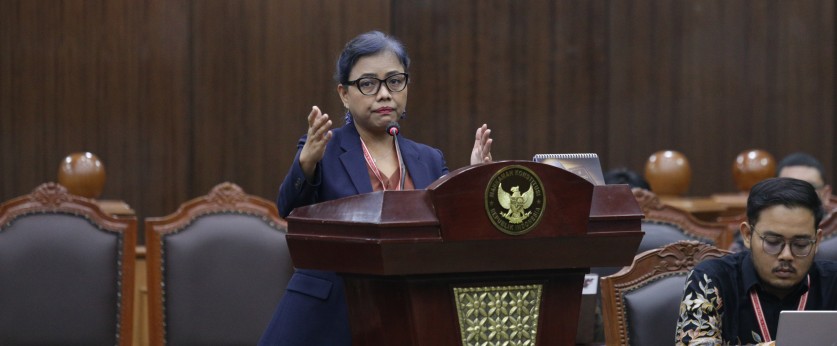
Lecturer at the Jentera School of Law Bivitri Susanti testifying as an expert for the petitioners at a formal judicial review hearing of the Law No. 1 of 2025 on State-Owned Enterprises, Wednesday (7/16/2025). Photo by MKRI/Bayu.
JAKARTA (MKRI) — Lecturer at the Jentera School of Law Bivitri Susanti introduced a paradigm shift by framing formal judicial review as a form of constitutional complaint before the Constitutional Court (MK) when testifying as an expert for the Petitioners of case No. 64/PUU-XXIII/2025 on the formal judicial review of Law No. 1 of 2025 on the Third Amendment to Law No. 19 of 2003 on State-Owned Enterprises (BUMN Law) on Wednesday, July 16, 2025 in the plenary courtroom.
“There are two paradigms I would like to discuss with Your Honors: first, formal judicial review as a form of constitutional complaint,” said the chairperson of the Constitutional and Administrative Law Society (CALS).
This proposal stems from concerns about the current approach to formal judicial review, which often appears to scrutinize and question the legislative process. At the hearing, a central question arose: How can political agreements be measured by legal standards? For instance, if only four out of five stakeholders are invited to a discussion, does that render a law formally defective?
Bivitri suggested that such confusion arises from viewing formal judicial review narrowly—as merely a legalistic assessment of the lawmaking process—rather than as a broader constitutional safeguard. She noted that, while Constitutional Court decisions such as No. 91/PUU-XVIII/2020 and evolving interpretations of “meaningful participation” have sought to clarify standards, the focus remains largely on procedural compliance during the planning, drafting, and deliberation phases of legislation.
Bivitri argued that this limited perspective overlooks a crucial aspect frequently discussed by the Court, constitutional justices, and former constitutional justices, as well as legal scholars: constitutional complaint. In conventional judicial review, the law itself is objectum litis or the object of scrutiny. However, she emphasized that the true subject should be the conduct of lawmakers—whether their actions in enacting the law conform to constitutional mandates.
In this case, the Petitioners alleged that the lawmakers violated constitutional mandates in several respects: not only in failing to ensure meaningful public participation, but also in disregarding principles of legislative drafting, sidelining the Regional Representatives Council (DPD), and excluding the Audit Board (BPK). Ultimately, the Petitioners concluded that the State-Owned Enterprises (BUMN) Law lacks legal validity and legitimacy because it deviates from the provisions of the 1945 Constitution and thus should not be enforced.
The Imperative of Meaningful Participation
Bivitri also highlighted concerns regarding meaningful participation during the deliberation of the BUMN Bill. She noted that the process was exceptionally rapid: it spanned only three days. Although the presidential letter was received in late 2024, the House of Representatives (DPR) began deliberations on January 23, 2025, established a working committee on January 24 through a Commission VI session, and finalized the bill for a plenary vote on February 1, which approved the bill on February 4, 2025.
In this compressed timeframe, she questioned how genuine public participation could be achieved, especially given the absence of published academic papers or draft bills from the House and/or government websites as well as official publication of all documents on the House or Government websites, including updated drafts with dates—key prerequisites for meaningful engagement.
She outlined other standards for meaningful participation: public announcement of participation forums (not closed, informal meetings); provision of all relevant documents to participants at least two working days in advance; publication of session records on the House or Government websites; and formal responses to public input, including reasons for acceptance or rejection.
In the case of the BUMN Bill, Bivitri observed only one public hearing, which sought input from two law professors—one from the University of Indonesia, the other from Gadjah Mada University—and found no evidence of meaningful participation as described above.
“Three days is clearly insufficient. The benchmarks are clear, and the study should have been conducted at the academic paper stage, because the academic paper must precede the draft law,” she asserted.
She stressed that no stage of the legislative process should be skipped, noting that while the BUMN Bill had been in preparation in 2020, 2023, and 2024, substantive deliberation occurred in just three days. She proposed evaluating the lawmaking process within the context of the current DPR and presidential terms.
“For example, for the BUMN Law, [former president Joko Widodo] had not imagined Danantara in his administration. The idea of Danantara came from [President] Prabowo,” she said.
BPK’s Role in Meaningful Participation
The Petitioners also called Bhima Yudhistira Adhinegara, economist and executive director of the Center of Economic and Law Studies (CELIOS), as an expert. Bhima emphasized that the meaningful involvement of BPK in drafting the amended BUMN Law was essential, given its potential direct impact on the management of the consolidated assets of SOEs after the enactment of the new BUMN Law.
“BPK, which has the functions of auditing, supervision, and assessment of SOEs, became a party not much involved in the process of formulating Law No. 1 of 2025. Without its meaningful involvement, especially in the deliberations of Article 71 paragraph (2), it has consequences for the weakness of supervision over SOEs and Danantara,” he said.
Bhima further observed that the amendment process did not meaningfully involve depositors or the public with savings in state-owned banks (Himbara), leading to public unease and calls to withdraw funds—a counterproductive outcome. He argued that the lack of transparent participation of the deliberation of the new BUMN Law eroded depositors’ sense of security, as they felt excluded from a process that directly affected their interests.
Before adjourning the session, Chief Justice Suhartoyo announced that at the next hearing for cases No. 52/PUU-XXIII/2025 and No. 64/PUU-XXIII/2025 will take place on Wednesday, July 23 at 10:30 WIB, in which the Court will hear the President’s experts/witnesses, whose CVs and statements must be submitted no later than two days prior to the hearing.
Baca juga:
Kurang Partisipasi Publik, Mahasiswa UI Uji Formil UU BUMN
Kejanggalan Prosedur Program Legislasi RUU BUMN
Eddy Hiariej: Revisi UU BUMN Urgensi Nasional Pembentukan BPI Danantara
Pemohon Belum Siapkan Ahli, Sidang Uji Formil UU BUMN Ditunda
Pemohon Tidak Siapkan Ahli, Sidang Uji Formil UU BUMN Ditunda
Baca selengkapnya:
Permohonan Perkara Nomor 52/PUU-XXIII/2025
Also read:
Govt’s Expert Reveals Why Pension Be Paid Periodically
Petitioners Argue Inconsistency in the Formation of BUMN Law
Eddy Hiariej: BUMN Law Revised for BPI Danantara’s Establishment
The Petitioners of case No. 52/PUU-XXIII/2025 are Abu Rizal Biladina and Bima Surya, fourth-semester law students of the University of Indonesia (UI). They believe the House of Representatives (DPR) had not complied with the statutory laws on lawmaking embodied in Article 22A of the 1945 Constitution, thus violating their constitutional rights protected under Article 28D paragraph (1) of the 1945 Constitution. As such, they emphasized, the BUMN Law is invalid as it did not follow applicable lawmaking procedure.
Therefore, in the petitums, they request that the Court declare Law No. 1 of 2025 on BUMN not meeting lawmaking provisions mandated by the 1945 Constitution. They also request that the Court declare it unconstitutional and, thus, not legally binding, and declare the norms in the Law that have been amended, removed, and/or declared unconstitutional back in effect.
Also read:
LKBH HMI Challenges Lawmaking of BUMN Law
More Petitioners Challenge Lack of Public Participation in SOEs Law Formulation
Eddy Hiariej: BUMN Law Revised for BPI Danantara’s Establishment
The case No. 64/PUU-XXIII/2025 was filed by the West Jakarta Branch of the Legal Aid and Consultation Institute for Muslim Students (LKBHMI), Lokataru Foundation, and individual citizen Kusuma Al Rasyid Agdar Maulana Putra. As legal aid organizations, the Petitioners, argue that they were neither notified nor involved at any stage in the drafting of the BUMN Law. Therefore, they believe the lawmaking process had failed to meet the constitutional requirement for meaningful public participation, as set out Article 1 paragraphs (2) and (3), Article 27 paragraph (1), Article 28C, Article 28D paragraph (1), and Article 28F of the 1945 Constitution.
The Petitioners requested the Court to declare Law No. 1 of 2025 on the Third Amendment to Law No. 19 of 2003 on State-Owned Enterprises as not having followed proper legislative procedures based on the 1945 Constitution, and thus unconstitutional and not legally binding.
The revised petition also introduced a provisional petitum, requesting the Court to suspend the implementation of Law No. 1 of 2025 until a final ruling is rendered. The Petitioners further urged the Court to declare the law unconstitutional and not legally binding due to its failure to comply with legislative procedures mandated by the 1945 Constitution.
Author : Mimi Kartika
Editor : N. Rosi
PR : Fauzan F.
Translator : Yuniar Widiastuti (NL)
Disclaimer: The original version of the news is in Indonesian. In case of any differences between the English and the Indonesian versions, the Indonesian version will prevail.
Wednesday, July 16, 2025 | 14:12 WIB 546