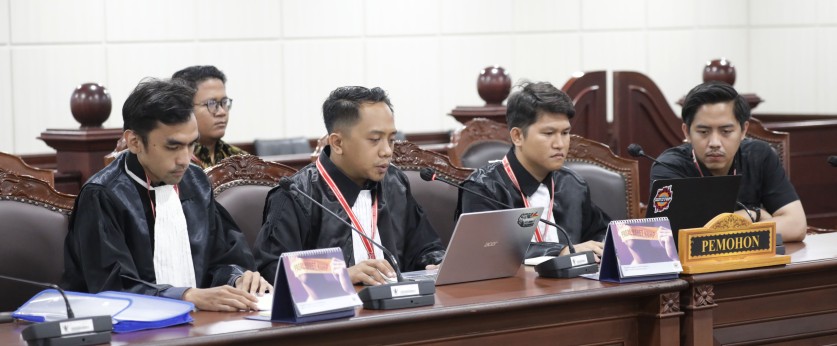
The Petitioner’s legal counsel addressing the key points of the petition at a panel courtroom hearing, Friday (5/16/2025). Photo by MKRI/Panji.
JAKARTA (MKRI) — The Legal Consultation and Assistance Institute (LKBH) of the Islamic Student Association (HMI) West Jakarta Branch, through Executive Director Rizki Hidayat and Finance Director Yoga Prawira Suhut, filed a formal judicial review of Law No. 1 of 2025 on the Third Amendment to Law No. 19 of 2003 on State-Owned Enterprises (the SOE Law) with the Constitutional Court (MK). The preliminary hearing of case No. 64/PUU-XXIII/2025 was chaired by Constitutional Justice Arief Hidayat, with Justices Anwar Usman and Enny Nurbaningsih, on Friday, May 16, 2025.
The Petitioners, as a public legal aid institution, argued that they were neither notified nor involved at any stage in the drafting of the SOE Law. Therefore, they believe the lawmaking process failed to meet the constitutional requirement for meaningful public participation, as set out in several articles of the 1945 Constitution, including Articles 1(2), 1(3), 27(1), 28C, 28D(1), and 28F.
Rizki Hidayat as the petitioners legal counsel, argued that under the State Finance Law, SOEs are part of the state financial system. Therefore, he considered it inaccurate for Article 3H paragraph (2) of the SOE Law to state that any profits or losses from the entity’s investments belong solely to the SOE, without recognizing the involvement of state funds.
Hidayat explained that because SOEs receive capital from the State Budget (APBN), their activities are part of the state financial system. For that reason, any profits or losses they make should be seen not only as those of the SOEs, but also as gains or losses for the state itself.
“The Petitioners respectfully request the Court to declare that Law No. 1 of 2025, which amends the SOE Law, was not passed in accordance with constitutional procedures. Therefore, the law should be declared inconsistent with the 1945 Constitution and no longer legally binding,” said Muhammad Dzikrullah, a member of the Petitioners’ legal team.
Formal Review
Responding to the petition, Constitutional Justice Enny Nurbaningsih emphasized that the matter under review constitutes a formal judicial review, which challenges the procedural aspects of lawmaking. “This differs from a material review. You must prove your involvement—or lack thereof—beginning from the planning stage, the national legislative program, the academic manuscript, to the deliberations. You need to demonstrate the precise deficiencies in the legislative process of this SOE Law,” said Justice Enny.
In response, Constitutional Justice Enny Nurbaningsih underlined that the petition is a formal judicial review, which focuses on how the law was made. “This is different from a material review. You must prove your involvement starting from the planning stage, the national legislative program, the academic draft, up to the discussion process. You need to demonstrate the precise deficiencies in the legislative process of this SOE Law,” said Justice Enny.
Meanwhile, Justice Anwar Usman reminded the Petitioners to clarify their legal standing, both as a legal aid institution and as individual taxpayers. “If your standing is based on your organization’s articles of association, you must elaborate on who is authorized to represent it before the Court. You also mentioned the non-involvement of the Regional Representatives Council (DPD) and the Audit Board of Indonesia (BPK). How exactly were these institutions excluded, especially the BPK, which should have been engaged in the drafting process of the SOE Law?” he asked.
Presiding over the hearing, Justice Arief Hidayat advised the Petitioners to examine Constitutional Court Decision No. 7/PUU-XVII/2019 as a reference for reviewing the formal constitutionality of a law. “There are important points you must explore thoroughly, especially to prove your legal standing. You also need to elaborate how the concept of meaningful participation in this digital era has evolved, including whether providing public access to the draft law online is enough to fulfill the participation standard,” he explained.
Before closing the session, Justice Arief informed the Petitioners that they were granted 14 working days to revise and refine their petition. The revised petition must be submitted to the Registrar’s Office of the Court no later than Monday, June 2, 2025. The next hearing will be scheduled to hear the main points of the amended petition.
Author: Sri Pujianti
Editor: Lulu Anjarsari P.
PR: Fauzan Febriyan
Translator: Yuanna Sisilia
Disclaimer: The original version of this news article is in Indonesian. In case of discrepancies, the Indonesian version shall prevail.
Friday, May 16, 2025 | 11:31 WIB 284