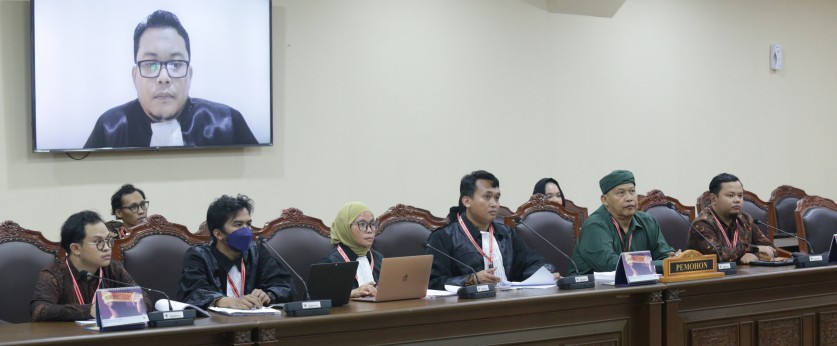
The Petitioners and their legal counsels at the preliminary hearing for the judicial review of the Zakat Management Law, Thursday (5/8/2025). Photo by MKRI/Panji.
JAKARTA (MKRI) — Muhammad Jazir and the Indonesia Zakat Watch (Petitioners I-II) challenge Article 1 points 7-9, Article 6, Article 7 paragraph (1), Article 16, Article 17, Article 22, Article 23 paragraph (1), Article 24, Article 28 paragraph (1), Article 30, and Article 31 of Law No. 23 of 2011 on Zakat Management materially at the Constitutional Court (MK). The preliminary hearing for case No. 54/PUU-XXIII/2025 took place on Thursday, May 8, 2025 in the plenary courtroom.
Through legal counsel Ibnu Syamsu Hidayat, the Petitioners argued that the articles are against Article 28C paragraph (2), Article 28E paragraph (1), Article 28H paragraph (2), Article 28I paragraphs (2) and (5), and Article 29 paragraph (2) of the 1945 Constitution. Due to their enforcement, Petitioner I has been disadvantaged because long-established zakat managing institutions could potentially be called into question due to the centralization of zakat amil (manager) institutions (LAZ) under the National Zakat Board (Baznas), which will also act as zakat operator. Meanwhile, Petitioner II feels that checks and balances and good zakat management would not be possible due to Baznas being a superpower. Not to mention, the enforcement of those articles has led to Baznas running zakat management arbitrarily. As a result, zakat management is often not based on the principles of good governance, anti-corruption, collusion, and nepotism (KKN).
Baznas as Regulator and Operator
The ongoing use of the term Baznas in the Zakat Management Law as led to an overlap of function and authority, as it now functions as both a regulator and an operator. In fact, as an operator, it has been collecting zakat from all sources through coercion using its authority as an organ under the Government, when its coercive power should be used for regulatory and supervisory purposes in order to optimize zakat management governance by zakat-collecting institutions (LPZ) and for zakat collection.
“Given the role of Baznas in Indonesia as a regulating, operating, and controlling institution as well as an auditor, it is clear that there is no checks and balances mechanism against the institution itself. So, this law has clearly and obviously given Baznas excessive authority,” said legal counsel Kafin Muhammad before Deputy Chief Justice Saldi Isra (panel chair) and Constitutional Justices Ridwan Mansyur and Asrul Sani.
Kafin further explained that as a zakat collector, the national, provincial, and regency/city Baznas are allowed to establish a zakat collection unit (UPZ) to help Baznas collect zakat. This is stipulated in Article 16 paragraph (1) of the Zakat Management Law, which reads, “In carrying out its duties and functions, BAZNAS, Provincial BAZNAS, and Regency/City BAZNAS may establish a UPZ in government institutions, state-owned enterprises, region-owned enterprises, private companies, and representatives of the Republic of Indonesia abroad and may establish a UPZ at the district, village levels or other designations, and at other places.”
The article includes the phrase “may establish a UPZ,” making it optional for Baznas to form a UPZ or not, Kafin argued. However, in practice, Baznas has changed the word “may” into “has the right to” to coerce zakat managing community groups affiliated with government institutions, state-owned enterprises, region-owned enterprises, private companies, and representatives of the Republic of Indonesia abroad to establish a UPZ for Baznas.
The Petitioners recommended that Baznas be renamed Zakat Regulatory and Supervisory Agency (BPPZ), so that it will be focused on regulating and supervising existing LAZ. For this reason, the Petitioners realized that the elimination of Baznas’ function to collect zakat, infaq, and sadaqah or charity funds (ZIS) will require some time for adjustment, especially with regard to the mustahik (zakat recipients) who will be affected.
In addition, the new name will mean that Baznas’ collecting function will be eliminated and the already-collected charity funds will be handed over to LAZ through accreditation by the BPPZ. Two stages of transition can be done within two years since the decision.
Justices’ Advice
In response, Constitutional Justice Ridwan Mansyur stated that the Petitioners’ constitutional impairment due to the petitioned norms had not been evident. “[The norms] are not [made out to] correlate with potential constitutional impairment, such as constraints in zakat management due to the provisions in the norms being petitioned, cases of arising problems where you are disadvantaged,” he explained.
Meanwhile, Constitutional Justice Asrul Sani highlighted the requirement for constitutional impairment. “It must be more concrete and firm because the constitutional justices will decide. If the loss is said to be actual, [you] must believe so, but there seems to be some doubt here,” he said.
Deputy Chief Justice Saldi Isra as panel chair advised the Petitioners not to focus on the concrete case. “The concrete case is merely a way in, so the norms are the ones being challenged. Find arguments why these norms are unconstitutional,” he stressed.
At the end of the hearing, Deputy Chief Justice Saldi Isra said the Petitioners would have 14 days to revise the petition. The revised petition must be submitted to the Registrar’s Office by Wednesday, May 21, 2025, after which the Court will schedule the next hearing to examine the revisions to the petition.
Read the petition for case No. 54/PUU-XXIII/2025 here.
Author : Sri Pujianti
Editor : N. Rosi
PR : Andhini S.F.
Translator : Yuniar Widiastuti (NL)
Disclaimer: The original version of the news is in Indonesian. In case of any differences between the English and the Indonesian versions, the Indonesian version will prevail.
Thursday, May 08, 2025 | 14:51 WIB 276