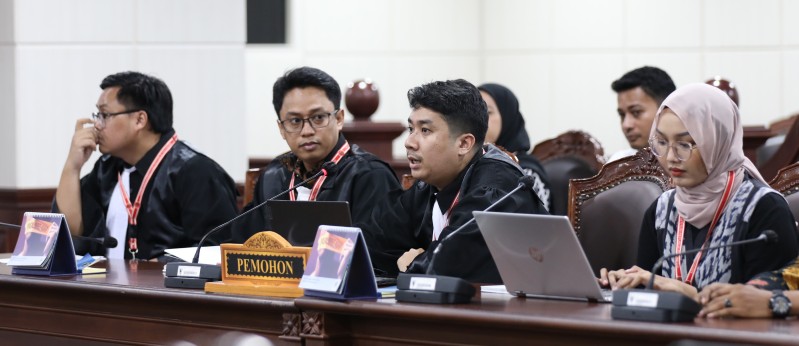
Petitioners’ legal counsel delivering the petition’s subject matter during the judicial review preliminary hearing of Law No. 3 of 2025 on the Indonesian National Armed Forces, Wednesday (14/05), at the Courtroom. Photo by MKRI/Ifa.
Jakarta (MKRI) – Foundation of the Indonesian Legal Aid Agency (Yayasan Lembaga Bantuan Hukum Indonesia – YLBHI), Association for Participatory Community Initiatives for Just Transition (Perkumpulan Inisiatif Masyarakat Partisipatif untuk Transisi Berkeadilan – Imparsial), Association of the Commission for Missing Persons and Victims of Violence (Perkumpulan Komisi untuk Orang Hilang dan Korban Tindak Kekerasan – Kontras), along with individuals, among others are, Inayah WD Rahman, Eva Nurcahyani, and Fatiah Maulidiyanty, filed a formal judicial review petition on law No. 3 of 2025 on the Indonesian National Armed Forces (Army Law). According to the Petitioners, the Law did not fulfill the lawmaking requirements stipulated in the 1945 Constitution of the Republic of Indonesia.
“The planning of the Army Law revision in the national legislation program priority of 2025 was carried out illegally,” legal counsel Hussein Ahmad stated during the preliminary hearing of Case No. 81/PUU-XXIII/2025 on Wednesday, May 14, 2025, at the Courtroom.
The Petitioners stated that the Army Law Revision was not listed under the national legislation program priority of 2025, and was not included in the government’s bill priority until 2029. The Army Law revision was not a carryover, because it needs to be agreed upon by the People’s Representatives Council (DPR), the President, and/or the Regional Representatives Council (DPD) to list the bill under the medium-term national legislation program and/or annual priority. Meanwhile, there was no Army Law revision in the DPR’s Decree, consisting of 12 carryover bills in the national legislation program of 2025 and 2025-2029.
The Petitioners argued that the Army Law revision discussion process was deliberately closed to public participation, not transparent, and unaccountable, which caused lawmaking failure. The public could not access all documents of the Army Law revision, starting from the academic paper, problem inventory list, and the bill itself.
“The Army Law revision formulation meeting by the DPR and the government was carried out secretly behind closed doors. It emphasized the abusive lawmaking in the Army Law revision formulation, and did not involve invaluable public participation,” other legal counsel, Bugivia Maharani Setiadji P, stated.
While the openness principle was not carried out, when asked by journalists, the Deputy of the First Commission stated that the lack of access was due to avoiding a heated debate within the society. Hence, it highlighted the procedural violation stipulated in the Lawmaking Law and the DPR’s Rules of Conduct.
The Petitioners believed that until now, the DPR and the president had deliberately withheld the Army Law revision after it was promulgated and had not immediately given the public access to the document. It violates Article 88 and Article 90 paragraph (1) of the Lawmaking Law, which states that the lawmakers must disseminate a promulgated law.
In their petitums, the Petitioners requested the Court to declare that the making of the Army Law revision on Law No. 34 of 2004 on the Indonesian National Armed Forces did not fulfill the lawmaking procedure based on the 1945 Constitution. They also requested that the Army Law be declared as not having a legally binding force, and Law No. 34 of 2004 is effective. Meanwhile, in the provision, the Petitioners requested the Court to declare the implementation of the Army Law to be postponed until the Court’s decision and order the President/DPR not to issue new implementing regulations or policies and/or strategic actions related to the new Army Law.
The provision was filed because, according to the Petitioners, the government and the armed forces had implemented the Army Law after its promulgation. For example, on May 1, 2025, the Armed Forces Chief of Naval Staff, Admiral Muhammad Ali, should have retired. Still, the retirement was postponed due to the enactment of Article 53 paragraph (4) of the Army Law. Then, on April 16, 2025, the Army’s Head of Information, Brigadier General Wahyu Yudhayana, issued an official statement, stating that the Army was actively involved in the management of 71 kitchens for the Free Nutritious Food program because of the enactment of Article 7 paragraph (2) letter b of the Army Law.
The case was heard by a Panel of Justices presided over by Chief Justice Suhartoyo, accompanied by Justice Daniel Yusmic P. Foekh and Justice M. Guntur Hamzah. During the session, the justices highlighted the provision submitted by the Petitioners.
Chief Justice Suhartoyo stated that the Court applies a fast hearing for formal review. Meanwhile, the Court must also examine the petition’s substance, which needs a longer process before deciding on the provision. Hence, he asserted that the provision is not an easy request to be granted.
“Is it relevant to decide on the provision because it is part of the substance to examine,” Chief Justice Suhartoyo stated.
He added an example: the Court gave lawmakers two years to revise the Job Creation law. The provisional decision was made after the Court examined the petition’s substance on the material review, which the Petitioners also requested.
Before adjourning the hearing, Chief Justice Suhartoyo gave the Petitioners 14 days to revise the petition. The revision must be submitted to the Court on Tuesday, May 27, 2025, at the latest.
Author: Mimi Kartika
Editor: Lulu Anjarsari P.
PR: Andhini S.F.
Translator: Rizky Kurnia Chaesario
Disclaimer: The original version of the news is in Indonesian. In case of any differences between the English and the Indonesian versions, the Indonesian version will prevail.
Wednesday, May 14, 2025 | 13:24 WIB 216