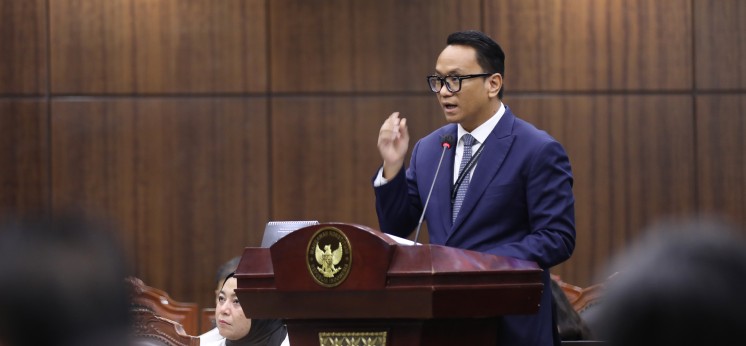
An expert presented by the government, Nien Rafles, delivering his statement during the continued hearing of the material review of Law No. 37 of 2004 on Bankruptcy and Postponement of Debt Payment Obligations on Wednesday (12/05) at the Courtroom. Photo by MKRI/Ifa.
Jakarta (MKRI) – A lecturer of Law Faculty from Universitas Gadjah Mada, Nien Rafles Siregar, attended the material review hearing of Articles 23 and 64 paragraph (1) of Law No. 37 of 2004 on Bankruptcy and Postponement of Debt Payment Obligations (Bankruptcy Law) as an expert presented by the government. According to Nien, the issue raised by the Petitioner in Petition No. 34/PUU-XXIV/2026 is not the unconstitutionality of a legal provision, but rather the legal consequences of a bankruptcy ruling on the assets of an individual debtor married under a community property regime.
“The issue raised by the Petitioner is not a contradiction between the norms in the Bankruptcy Law against the 1945 Constitution, but rather a legal consequence of a bankruptcy ruling on the assets of an individual debtor married under a community property regime,” Nien stated during the hearing scheduled to examine testimony from expert/witness presented by the president on Tuesday, May 13, 2026, at the Plenary Courtroom.
Article 23 of the Bankruptcy Law reads: “The term of Bankrupt Debtor as referred to in Article 21 and Article 22 shall include the spouse of the bankrupt debtor, who has been married under community property.” Article 64 paragraph (1) stipulates: “The bankruptcy of a husband or a wife who was married under a community property shall be considered as a bankruptcy of such community property.” Article 64 paragraph (2) provides: “Without prejudice to the exception provided in Article 25, the bankruptcy shall include anything in the community property and the bankruptcy shall be for the benefit of all Creditors who have a claim in respect of the community property.”
Nien explained that Articles 23 and 64, paragraph (1), of the Bankruptcy Law regulate the consequences for an individual bankrupt debtor who is married under a community property regime. Both articles clearly and strictly define the scope of an individual bankrupt debtor married under a community property regime’s assets, including joint assets, and treat them as the bankruptcy of that community property.
Because the Petitioner and her husband are married under the community property regime, the Supervising Judge ruled in her husband's bankruptcy case that the joint assets between the Petitioner and her husband were considered as the bankruptcy estate as a consequence of a marital bond pursuant to Article 23 in conjunction with Article 64 paragraph (1) of the Bankruptcy Law.
Legal Consequences of the Absence of Property Division Agreement
The Petitioner believes that the implementation of the phrase “community property” in Articles 23 and 64 paragraph (1) of the Bankruptcy Law automatically includes joint assets, including the Petitioner’s assets, in her husband’s bankrupt assets, has clearly infringed upon the Petitioner’s constitutional rights. The case referred to by the Petitioner is irrelevant to the formulation of Articles 23 and 64 paragraph (1) of the Bankruptcy Law, because the legal issue faced by the Petitioner is a legal consequence of the absence of a separation of property agreement.
In line with that, Article 36 of the Marriage Law does not provide that all forms of obligations between husband or wife must obtain the consent of their spouse, but only those obligations concerning joint assets. Therefore, Nien continued, normatively speaking, the debt obligations between the Petitioner’s husband and his creditors do not require the Petitioner’s consent because they do not constitute obligations concerning the joint assets of the Petitioner and her husband.
Moreover, based on the petition, the losses alleged by the Petitioner stem from the consequences of the implementation of Articles 23 and 64 paragraph (1) of the Bankruptcy Law, which resulted in the joint assets of the Petitioner and her husband becoming part of the bankruptcy estate, causing the Petitioner to feel that she lost her rights to the joint assets even though she had never consented to the debt agreement between her husband and his creditors. However, Nien said that there is essentially no causal relationship between the phrase “Community Property” in the wording of Articles 23 and 64 paragraph (1) of the Bankruptcy Law and the entirety of the losses alleged by the Petitioner.
Based on Article 29 of the Marriage Law, as further interpreted through the Constitutional Court Decision No. 69/PUU-XIII/2015 dated October 27, 2016, the Petitioner essentially has discretion to determine the matrimonial property regime through a prenuptial agreement at any time, whether before the marriage takes place or during the marriage. Thus, according to Nien, Articles 23 and 64 paragraph (1) of the Bankruptcy Law are, on the whole, clearly worded, do not create uncertainty, and are consistent with Article 28D paragraph (1), Article 28G paragraph (1), and Article 28H paragraph (4) of the 1945 Constitution of the Republic of Indonesia, so that these provisions do not conflict with the Constitution and remain legally binding.
“The Bankruptcy Law allows for the filing of lawsuits based on the Elucidation of Article 3 paragraph (1) of the Bankruptcy Law, which provides for an examination of matters concerning the bankrupt estate for parties who feel they have been wronged by the administration and liquidation of the bankrupt estate,” explained Nien.
Also read:
Husband Declared Bankrupt, Wife Challenges Community Property Bankruptcy Rules
Wife Refines Petition Challenging Community Property Bankruptcy Rules
DPR: Bankruptcy of Community Property Provides Legal Protection
Community Property Entering Bankruptcy Estate Is a Legal Consequence of Bankruptcy Law
Expert Explains Spouse Status Not Participating in Debt Agreement
The case was filed by Yuli Chandra Dewi, a wife whose husband was declared bankrupt by the Commercial Court. She argues that these provisions allow a debt agreement unilaterally made by one spouse to produce legal consequences for the couple’s community property.
In March 2023, however, the Commercial Court of the Surabaya District Court issued a ruling declaring Rachmat Agung Leonardi bankrupt, with all attendant legal consequences, and ordering a suspension of debt payment obligations. Yuli maintains that the debt in question was incurred without her consent and that she was neither named as a party in the proceedings nor mentioned in the operative part of the judgment as a bankrupt party.
In the supervising judge’s order, the community property within marriage was treated as part of the bankruptcy estate (the entirety of the bankrupt debtor’s assets—individual or corporate—declared bankrupt by the Commercial Court, which are subject to general seizure and administered and liquidated by a receiver to repay creditors). The debt itself, however, was incurred without the wife’s consent, leaving the Petitioner without any opportunity to defend herself or safeguard her constitutional rights.
The resulting loss took the form of deprivation of the Petitioner’s rights over community property due to the application of Article 23 and Article 64 paragraphs (1) and (2) of the Bankruptcy Law, which automatically draws community property, including the Petitioner’s share, into her husband’s bankruptcy estate. According to the Petitioner, prevailing legal norms in bank lending require spousal consent under the Marriage Law.
The curator has issued a list of fixed claims against the Petitioner’s husband in the bankruptcy case, totaling more than Rp514 billion. The curator has also assumed control of all of the husband’s assets, including communal property, and has announced a second auction of those assets.
In her petitum, the Petitioner requests that the Court declare Article 23 and Article 64 paragraphs (1) and (2) of Law No. 37 of 2004 on Bankruptcy and Suspension of Debt Payment Obligations to be inconsistent with Article 28D paragraph (1), Article 28G paragraph (1), and Article 28H paragraph (4) of the 1945 Constitution of the Republic of Indonesia, and to have no binding legal force insofar as they are not interpreted as: “The community property of husband and wife shall be treated as subject to bankruptcy only insofar as the debt of the husband or wife is agreed upon and legally proven on the basis of mutual consent of both parties.”
Case tracking: Petition No. 34/PUU-XIV/2026
Author: Mimi Kartika
Editor: Lulu Anjarsari P.
PR: Fauzan Febriyan
Translator: Rizky Kurnia Chaesario
Disclaimer: The original version of the news is in Indonesian. In case of any differences between the English and the Indonesian versions, the Indonesian version will prevail.
Wednesday, May 13, 2026 | 12:01 WIB 55