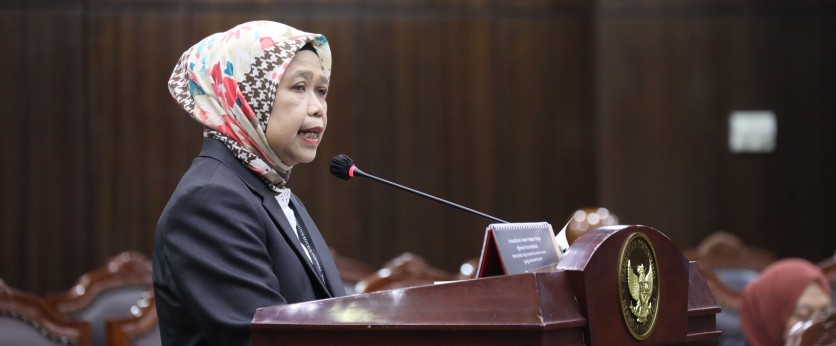
Civil Law expert from the Law Faculty of Universitas Padjajaran, Sonny Dewi, delivering her testimony during the judicial review hearing of Law No. 37 of 2004 on the Bankruptcy and Suspension of Debt Payment Obligations on Thursday (23/4). Photo by MKRI/Panji.
Jakarta (MKRI) – Petitioner of Case No. 34/PUU-XXIV/2026 presented a professor of Law Faculty from Univeritas Padjajaran, Sonny Dewi Judiasih, as an expert in civil law during the judicial review hearing of Law No. 37 of 2004 on the Bankruptcy and Suspension of Debt Payment Obligations (Bankruptcy Law) in the Constitutional Court (MK). She stated that the Bankruptcy Law in this case is a double-edged sword because Article treats spouses who are not parties to the debt agreement as bankrupt debtors, while Article 64 treats community property as bankrupt property during the hearing to hear testimony from experts/witnesses of the Petitioner in the Plenary Courtroom on Thursday, April 23, 2026.
She explained that in the case of a debt owed by an individual debtor to a creditor, where the debt agreement is unknown and has not been approved by the spouse, proving the existence of such a debt is clearly not straightforward. This is because, regarding community property, a husband and wife may act jointly, as provided for in Article 36 paragraph (1) of Law No. 16 of 2019 on the Amendment to Law No. 1 of 1974 on Marriage. Furthermore, Article 36 paragraph (2) explicitly states, “Regarding their respective separate property, the husband and wife have full rights to perform legal acts concerning their property.”
According to Sonny, in deciding on the bankruptcy estate, it must first be established whether the debtor’s spouse consented to the acquisition of the assets in question, whether the assets that are to be included in the bankruptcy estate include property brought into the marriage by the debtor’s spouse, and the debtor’s spouse must be granted the right to defend themselves and protect their rights. Therefore, a debt agreement entered into without the spouse’s knowledge or consent is no longer a matter of simple proof as provided for in Article 2 of the Bankruptcy Law, as further proof is required.
Sonny added that the Civil Procedure Code does not provide for a distinction between community property and property brought in before marriage. Therefore, any assets acquired in the future, for example, if a husband or wife receives an inheritance, will be included in the bankruptcy estate. This would not occur if the Bankruptcy Law adopted the provisions of the Marriage Law regarding the determination of assets, since inherited assets are considered separate property and are not included in the bankruptcy estate.
Sonny further stated that Article 23 does not explicitly explain regarding communal property. If referring to the provision of Article 36 paragraph (1) of the Marriage Law, which states that concerning communal property, a husband and wife may act upon agreement of both parties, then by law, the spouse who did not give consent cannot be designated as a bankrupt debtor. Thus, in principle, if a husband or wife enters into an agreement without the consent of the other spouse, that legal act is null and void.
“If the spouse does not bind themselves into an agreement, they cannot be held responsible for the joint debt. Designating a party as a bankrupt debtor must be held carefully because it will create legal consequences as stipulated in Article 24 paragraph (1) of the Bankruptcy Law,” Sonny stated.
Meanwhile, she contended that the Bankruptcy Law still reflects legal dualism. On the one hand, the law refers to community property as provided in the Civil Procedure Code; on the other hand, it still recognizes assets brought before marriage as provided in Article 62, paragraph (1).
“This stipulation is vague because it refers to Article 23, which contains the phrase ‘community property’, which includes property before marriage as part of the community property. It creates legal uncertainty guaranteed by the Bankruptcy Law,” she argued.
She noted that, in essence, marriage agreements agreed upon by both parties can serve as a solution to asset division within marriage, as intended in Article 23. However, it does not guarantee that all agreeable aspects are upheld. This is reflected in Article 63 of the Bankruptcy Law.
A husband and wife under community property, who have been declared as a bankrupt debtor according to Article 23, will be treated as the bankrupt of the community property. This will result in either the husband or the wife being disadvantaged, especially if an agreement is made without the other spouse’s consent.
All the more so when the agreement in question is entirely unknown to the spouse and is never used for the benefit of the family. The operation of Article 64 of the Bankruptcy Law ultimately results in a violation of human rights and the absence of legal protection for spouses who did not take part in that agreement.
Sonny believes the main focus should be on Articles 23 and 64 of the Bankruptcy Law, which categorically state that a husband or wife married under a community property regime is to be treated as a bankrupt debtor, and that bankruptcy encompasses all joint marital assets. In practice, these two articles are applied by curators as fixed rules, without regard to whether the agreement entered into by one spouse was made with the other spouse's knowledge and consent.
In light of this, Sonny argued that Articles 23 and 64 of the Bankruptcy Law ought to be declared incompatible with the 1945 Constitution of the Republic of Indonesia and to have no binding legal force. He maintains that the Court should revisit the meaning of these provisions so that they take into account each spouse’s separate property as well as the position of any husband or wife who did not give consent to the debt agreement at issue.
“If this petition is granted, it is expected that no husband or wife who has not given consent to a debt agreement will again become a victim by being declared a bankrupt debtor. In this way, the principles of equality, justice, and legal certainty between husband and wife in marriage can be realized,” Sonny said.
Also read:
Husband Declared Bankrupt, Wife Challenges Community Property Bankruptcy Rules
Wife Refines Petition Challenging Community Property Bankruptcy Rules
DPR: Bankruptcy of Community Property Provides Legal Protection
Community Property Entering Bankruptcy Estate Is a Legal Consequence of Bankruptcy Law
The case was filed by Yuli Chandra Dewi, a wife whose husband was declared bankrupt by the Commercial Court. She argues that these provisions allow a debt agreement unilaterally made by one spouse to produce legal consequences for the couple’s community property.
In March 2023, however, the Commercial Court of the Surabaya District Court issued a ruling declaring Rachmat Agung Leonardi bankrupt, with all attendant legal consequences, and ordering a suspension of debt payment obligations. Yuli maintains that the debt in question was incurred without her consent and that she was neither named as a party in the proceedings nor mentioned in the operative part of the judgment as a bankrupt party.
In the supervising judge’s order, the community property within marriage was treated as part of the bankruptcy estate (the entirety of the bankrupt debtor’s assets—individual or corporate—declared bankrupt by the Commercial Court, which are subject to general seizure and administered and liquidated by a receiver to repay creditors). The debt itself, however, was incurred without the wife’s consent, leaving the Petitioner without any opportunity to defend herself or safeguard her constitutional rights.
The resulting loss took the form of deprivation of the Petitioner’s rights over community property due to the application of Article 23 and Article 64 paragraphs (1) and (2) of the Bankruptcy Law, which automatically draws community property, including the Petitioner’s share, into her husband’s bankruptcy estate. According to the Petitioner, prevailing legal norms in bank lending require spousal consent under the Marriage Law.
The curator has issued a list of fixed claims against the Petitioner’s husband in the bankruptcy case, totaling more than Rp514 billion. The curator has also assumed control of all of the husband’s assets, including communal property, and has announced a second auction of those assets.
For reference, Article 23 of the Bankruptcy Law reads: “The term of Bankrupt Debtor as referred to in Article 21 and Article 22 shall include the spouse of the bankrupt debtor, who has been married in community property.” Article 64 paragraph (1) stipulates: “The bankruptcy of a husband or a wife who was married with community property shall be considered as a bankruptcy of such community property.” Article 64 paragraph (2) provides: “Without prejudice to the exception provided in Article 25, the bankruptcy shall include anything in the community property and the bankruptcy shall be for the benefit of all Creditors who have a claim in respect of the community property.”
Article 23 of the Bankruptcy Law reads: “The term of Bankrupt Debtor as referred to in Article 21 and Article 22 shall include the spouse of the bankrupt debtor, who has been married in community property.” Article 64 paragraph (1) stipulates: “The bankruptcy of a husband or a wife who was married with community property shall be considered as a bankruptcy of such community property.” Article 64 paragraph (2) provides: “Without prejudice to the exception provided in Article 25, the bankruptcy shall include anything in the community property and the bankruptcy shall be for the benefit of all Creditors who have a claim in respect of the community property.”
In her petitum, the Petitioner requests that the Court declare Article 23 and Article 64 paragraphs (1) and (2) of Law No. 37 of 2004 on Bankruptcy and Suspension of Debt Payment Obligations to be inconsistent with Article 28D paragraph (1), Article 28G paragraph (1), and Article 28H paragraph (4) of the 1945 Constitution of the Republic of Indonesia, and to have no binding legal force insofar as they are not interpreted as: “The community property of husband and wife shall be treated as subject to bankruptcy only insofar as the debt of the husband or wife is agreed upon and legally proven on the basis of mutual consent of both parties.”
Case tracking: Petition No. 34/PUU-XIV/2026
Author: Mimi Kartika
Editor: Lulu Anjarsari P.
PR: Fauzan Febriyan
Translator: Rizky Kurnia Chaesario
Disclaimer: The original version of the news is in Indonesian. In case of any differences between the English and the Indonesian versions, the Indonesian version will prevail.
Thursday, April 23, 2026 | 11:50 WIB 94