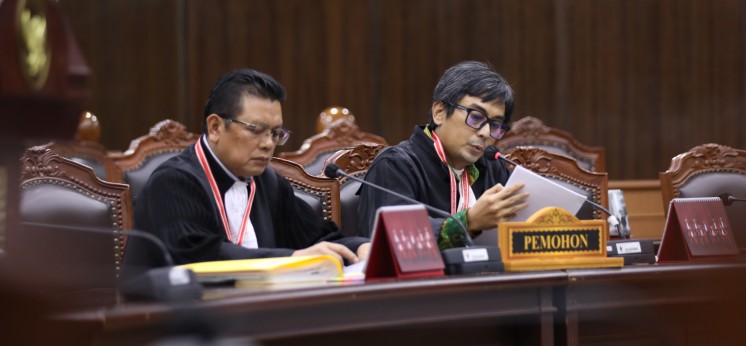
Legal counsel Virza Roy Hizzal delivering the main points of the petition during the preliminary hearing of the judicial review of Law No. 37 of 2004 on Bankruptcy and Suspension of Debt Payment Obligations, Wednesday (28/01). Photo by MKRI/Ifa.
Jakarta (MKRI) - Yuli Chandra Dewi, a wife whose husband was declared bankrupt by the Commercial Court, has filed a petition for judicial review of Article 23 and Article 64 paragraphs (1) and (2) of Law No. 37 of 2004 on Bankruptcy and Suspension of Debt Payment Obligations (Bankruptcy Law) to the Constitutional Court (MK). She argues that these provisions allow a debt agreement unilaterally made by one spouse to produce legal consequences for the couple’s community property.
Prior to marriage, Yuli had operated a foreign exchange business since 1983. After entering into marriage, Yuli, as the Petitioner in Case No. 34/PUU-XXIV/2026, continued the business with her husband, Rachmat Agung Leonardi, and the business grew to the extent that her assets and those of her husband were combined into community property.
In March 2023, however, the Commercial Court of the Surabaya District Court issued a ruling declaring Rachmat Agung Leonardi bankrupt, with all attendant legal consequences, and ordering a suspension of debt payment obligations. Yuli maintains that the debt in question was incurred without her consent and that she was neither named as a party in the proceedings nor mentioned in the operative part of the judgment as a bankrupt party.
“The Petitioner was never involved, never gave consent, and never signed or agreed, directly or indirectly, to any debt agreement entered into by her husband, which was then used as the basis for declaring the Petitioner’s husband bankrupt. The Petitioner has never been designated as a debtor, never been determined to be a party in any bankruptcy decision, and was never summoned or given the opportunity to defend her rights during the examination of the bankruptcy case. Therefore, the Petitioner’s constitutional rights have clearly and actually been impaired,” said the Petitioner’s legal counsel, Virza Royhizzal, during the preliminary hearing of the petition on Wednesday, January 28, 2026, in the Courtroom.
In the supervising judge’s order, the community property within marriage was treated as part of the bankruptcy estate (the entirety of the bankrupt debtor’s assets—individual or corporate—declared bankrupt by the Commercial Court, which are subject to general seizure and administered and liquidated by a receiver to repay creditors). The debt itself, however, was incurred without the wife’s consent, leaving the Petitioner without any opportunity to defend herself or safeguard her constitutional rights.
The resulting loss took the form of deprivation of the Petitioner’s rights over community property due to the application of Article 23 and Article 64 paragraphs (1) and (2) of the Bankruptcy Law, which automatically draws community property, including the Petitioner’s share, into her husband’s bankruptcy estate. According to the Petitioner, prevailing legal norms in bank lending require spousal consent under the Marriage Law.
The curator has issued a list of fixed claims against the Petitioner’s husband in the bankruptcy case, totaling more than Rp514 billion. The curator has also assumed control of all of the husband’s assets, including community property, and has announced a second auction of those assets.
For reference, Article 23 of the Bankruptcy Law reads: “The term of Bankrupt Debtor as referred to in Article 21 and Article 22 shall include the spouse of the bankrupt debtor, who has been married in community property.” Article 64 paragraph (1) stipulates: “The bankruptcy of a husband or a wife who was married with community property shall be considered as a bankruptcy of such community property.” Article 64 paragraph (2) provides: “Without prejudice to the exception provided in Article 25, the bankruptcy shall include anything in the community property and the bankruptcy shall be for the benefit of all Creditors who have a claim in respect of the community property.”
In her petitum, the Petitioner requests that the Court declare Article 23 and Article 64 paragraphs (1) and (2) of Law No. 37 of 2004 on Bankruptcy and Suspension of Debt Payment Obligations to be inconsistent with Article 28D paragraph (1), Article 28G paragraph (1), and Article 28H paragraph (4) of the 1945 Constitution of the Republic of Indonesia, and to have no binding legal force insofar as they are not interpreted as: “The community property of husband and wife shall be treated as subject to bankruptcy only insofar as the debt of the husband or wife is agreed upon and legally proven on the basis of mutual consent of both parties.”
The case was heard by a Panel of Justices chaired by Chief Justice Suhartoyo, accompanied by Justices Daniel Yusmic P. Foekh and M. Guntur Hamzah. In his advisory remarks, Guntur highlighted the formulation of the relief sought in the petitum, which he considered inconsistent with procedural requirements, since the Petitioner is challenging three separate provisions with different normative content while requesting a single interpretive formulation for all three.
“So which one exactly is to be given an interpretation? There are three provisions here, this will be quite extensive,” Justice Guntur remarked.
Before adjourning the hearing, Chief Justice Suhartoyo stated that the Petitioner has 14 days to revise the petition. The revised petition, in both softcopy and hardcopy form, must be received by the Court no later than Tuesday, February 10, 2026, at 12.00 Western Indonesian Time.
Case tracking: Petition No. 34/PUU-XIV/2026
Author: Mimi Kartika
Editor: Lulu Anjarsari P.
PR: Fauzan Febriyan
Translator: Rizky Kurnia Chaesario
Disclaimer: The original version of the news is in Indonesian. In case of any differences between the English and the Indonesian versions, the Indonesian version will prevail.
Wednesday, January 28, 2026 | 15:43 WIB 158