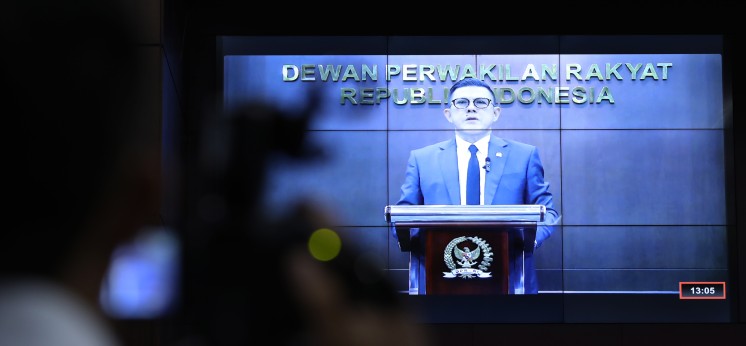
Member of Commission III of the House of Representatives (DPR), Soedeson Tandra, delivering his statement online during the continued hearing on the material judicial review of Law No. 37 of 2004 on Bankruptcy and Postponement of Debt Payment Obligations on Tuesday (10/03). Photo by MKRI/Ifa.
Jakarta (MKRI) - The Constitutional Court (MK) held a hearing in Case No. 34/PUU-XXIV/2026 to examine the judicial review of Article 23 and Article 64 paragraph (1) of Law No. 37 of 2004 on Bankruptcy and Postponement of Debt Payment Obligations (Bankruptcy Law), with the agenda of hearing statements from the DPR and the President on Tuesday, March 6, 2026. Commission III member Soedeson Tandra said that declaring Community property bankrupt actually provides legal protection and fair legal certainty for both debtors and creditors.
“This is because all assets which by law form a single pool of wealth are placed under a single, transparent settlement mechanism that is centralized and supervised by the court pursuant to Law No. 37 of 2004,” Soedeson said on Tuesday, March 10, 2026, online.
He explained that the phrase “joint marital property” in Article 23 and Article 64 paragraph (1) of Law 37/2004 cannot be regarded as a norm that conflicts with the principle of spousal consent or the validity requirements of a contract, but is instead a systemic consequence of the marital property regime that automatically applies under legislation. The provision, he said, ensures coherence in the legal system between family law, civil law, and bankruptcy law.
“The regulation of bankruptcy of community property is a legal consequence of the status of community property that attaches to the debtor by virtue of the marital bond he has entered into,” Soedeson said.
Soedeson went on to say that the legal framework treating the assets of husband and wife in a marriage as community property, unless otherwise agreed in a prenuptial separation-of-assets contract, means that, by operation of law, the assets of both spouses must be treated as community property in bankruptcy proceedings. Certain legal acts involving community property do indeed require the consent of both spouses to safeguard the balance and protection of family interests.
“The requirement of spousal consent for certain legal acts concerning community property relates more to the management of assets,” he added.
The bankruptcy mechanism set out in Law 37/2004 functions as a general attachment over all of a debtor’s assets. Soedeson noted that the phrase “community property” in Article 23 and Article 64 paragraph (1) of Law 37/2004 is a norm that affirms the logical consequence of the marital property regime already enshrined in the Civil Code and Law No. 1 of 1974 on Marriage.
He stressed that the law must strike a balance between protecting family interests and protecting the interests of good-faith third parties. In his view, the challenged provisions reflect this balance because, on the one hand, they allow spouses to enter into a separation-of-assets agreement as a form of preventive protection, while, on the other hand, they guarantee legal certainty for creditors under the generally applicable property regime.
Abuse of authority within the household, he continued, does not negate the existence of community property as a single unit of wealth before the law. Accordingly, the requirement of spousal consent in certain contexts does not erase the legal fact that the property forms one pool of assets that underpins liability to third parties. Meanwhile, the President/Government was unable to deliver its statement at this hearing and submitted a letter requesting postponement.
This petition was filed by Yuli Chandra Dewi, a wife whose husband was declared bankrupt by the Commercial Court. Yuli argues that the contested provisions allow the legal consequences of a loan agreement made unilaterally by one spouse to be charged to the community property.
Prior to marriage, Yuli had operated a foreign exchange business since 1983. After entering into marriage, Yuli continued the business with her husband, Rachmat Agung Leonardi, and it grew to the point that her assets and those of her husband were combined into community property.
In March 2023, however, the Commercial Court of the Surabaya District Court issued a ruling declaring Rachmat Agung Leonardi bankrupt, with all attendant legal consequences, and ordering a suspension of debt payment obligations. Yuli maintains that the debt in question was incurred without her consent and that she was neither named as a party in the proceedings nor mentioned in the verdict of the judgment as a bankrupt party.
In the supervising judge’s order, the community property within marriage was treated as part of the bankruptcy estate (the entirety of the bankrupt debtor’s assets—individual or corporate—declared bankrupt by the Commercial Court, which are subject to general seizure and administered and liquidated by a receiver to repay creditors). The debt itself, however, was incurred without the wife’s consent, leaving the Petitioner without any opportunity to defend herself or safeguard her constitutional rights.
The resulting loss took the form of deprivation of the Petitioner’s rights over communal property due to the application of Article 23 and Article 64 paragraphs (1) and (2) of the Bankruptcy Law, which automatically draws community property, including the Petitioner’s share, into her husband’s bankruptcy estate. According to the Petitioner, prevailing legal norms in bank lending require spousal consent under the Marriage Law.
The curator has issued a list of fixed claims against the Petitioner’s husband in the bankruptcy case, totaling more than Rp514 billion. The curator has also assumed control of all of the husband’s assets, including joint marital property, and has announced a second auction of those assets.
Also read:
Husband Declared Bankrupt, Wife Challenges Community Property Bankruptcy Rules
Wife Refines Petition Challenging Community Property Bankruptcy Rules
Article 23 of the Bankruptcy Law reads: “The term of Bankrupt Debtor as referred to in Article 21 and Article 22 shall include the spouse of the bankrupt debtor, who has been married in community property.” Article 64 paragraph (1) stipulates: “The bankruptcy of a husband or a wife who was married with community property shall be considered as a bankruptcy of such community property.” Article 64 paragraph (2) provides: “Without prejudice to the exception provided in Article 25, the bankruptcy shall include anything in the community property and the bankruptcy shall be for the benefit of all Creditors who have a claim in respect of the community property.”
In her petitum, the Petitioner requests that the Court declare Article 23 and Article 64 paragraphs (1) and (2) of Law No. 37 of 2004 on Bankruptcy and Suspension of Debt Payment Obligations to be inconsistent with Article 28D paragraph (1), Article 28G paragraph (1), and Article 28H paragraph (4) of the 1945 Constitution of the Republic of Indonesia, and to have no binding legal force insofar as they are not interpreted as: “The community property of husband and wife shall be treated as subject to bankruptcy only insofar as the debt of the husband or wife is agreed upon and legally proven on the basis of mutual consent of both parties.”
Case tracking: Petition No. 34/PUU-XIV/2026
Author: Mimi Kartika
Editor: Lulu Anjarsari P.
PR: Fauzan Febriyan
Translator: Rizky Kurnia Chaesario
Disclaimer: The original version of the news is in Indonesian. In case of any differences between the English and the Indonesian versions, the Indonesian version will prevail.
Tuesday, March 10, 2026 | 14:18 WIB 167