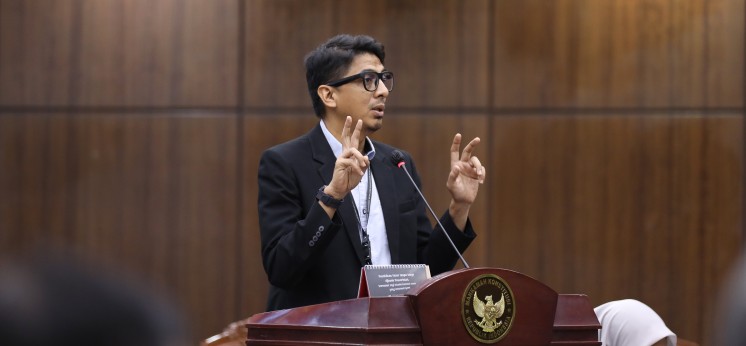
Zainal Arifin Mochtar, an expert for Petitioner, delivering a statement at hearing of judicial review of Law No. 31 of 1997 on Military Justice, Tuesday (4/14/2026). Photo by MKRI/Ifa.
JAKARTA (MKRI) – The judicial review hearing for Law No. 31 of 1997 on Military Justice (Military Justice Law) was held again at the Constitutional Court (MK) on Tuesday, April 14, 2026. Petition No. 260/PUU-XXIII/2025 was filed by Lenny Damanik and Eva Meliani Br. Pasaribu.
The hearing was presided over by Chief Justice Suhartoyo and the other Constitutional Justices. The hearing's agenda included testimony from the Petitioner's experts, Zainal Arifin Mochtar and Al Araf. Zainal Arifin Mochtar, familiarly known as Uceng, stated that various fundamental problems remain within Indonesia's military justice system. Uceng noted that Law No. 31 of 1997, enacted during the New Order era, granted significant privileges to the regime, leaving a number of problems that persist to this day.
"Many issues have emerged, ranging from dual jurisdictions, a lack of synchronization with the spirit of reform, the absence of detailed regulations regarding connectivity, to the issue of independence and accountability of military justice, which is often discussed as a form of legal exceptionalism," said Uceng.
According to him, post-reform changes have occurred in legal policy, including the strengthening of the provisions on judicial power in Article 24 of the 1945 Constitution, which defines four judicial bodies under the Supreme Court: general courts, religious courts, military courts, and state administrative courts. Uceng believes the judicial review of Articles 9, 43, and 127 of the Military Court Law is constitutionally reasonable. These provisions are considered to have the potential to grant military courts excessive jurisdiction, including in handling general crimes.
He emphasized that these norms don’t clearly differentiate between military crimes and general crimes, so they have the potential to conflict with the principle of equality before the law and the principle of the rule of law guaranteed in the 1945 Constitution.
"From a constitutional perspective, these norms need to be interpreted in a limited way, meaning that the jurisdiction of military justice only applies to military crimes directly related to military functions and discipline," he explained.
New Law
Uceng urged the Constitutional Court not only to interpret the norms being reviewed, but also to urge the President and the House of Representatives (DPR) to immediately draft a new law on military justice. This was deemed crucial for completing the pending homework.
"In my opinion, this is a major challenge for the Constitutional Court. I believe it would be wise for the Constitutional Court to carefully consider the matter and push for completion of the outstanding issues that have been left unfinished for 20 years. We have let this matter hang in the balance, and in my opinion, it has reproduced repeated injustices, such as those that occurred to the two victims who are the petitioners in this room," Uceng emphasized.
Rule By Law
The next expert, Al Araf, stated that the Military Justice Law was not created in a vacuum, but rather emerged within the framework of an authoritarian political regime that at the time ignored the principles of the rule of law and human rights. "During the New Order era, the legal products enacted in the form of statutes tended to be repressive and merely served as instruments of control for those in power. The state enacted laws not within the framework of the rule of law, but solely to fulfill the needs of the rule by law," he explained before the Panel of Justices.
According to Araf, when the reforms rolled out in 1998, and democracy was made the political system of choice adopted, the people through their mandate in the MPR urged that the Military Court Law be improved and corrected. This process was also parallel and in line with the constitutional reform agenda, which was outlined in four rounds of amendments to the 1945 Constitution of the Republic of Indonesia. In these constitutional amendments, one of the aspects accommodated and agreed upon was related to the affirmation of the principle of the rule of law and human rights. Furthermore, the direction of legal policy regarding military court reform has been formulated explicitly in MPR Decree No. VII/MPR/2000 and Law No. 34 of 2004 on the Indonesian National Armed Forces (UU TNI). The provisions of Article 3 paragraph (4) letter a of TAP MPR No. VII/MPR/2000.
"This norm systematically demonstrates that lawmakers have consciously constructed a restrictive jurisdictional design. Within this framework, there are at least two legal consequences that cannot be interpreted otherwise. First, the absolute competence of military justice is strictly limited to violations of military criminal law. Second, any violation of general criminal law committed by military personnel is constitutionally transferred to the authority of general justice. Thus, the expansion of military justice jurisdiction into the general criminal realm actually contradicts the established normative and constitutional design," Araf explained.
He also explained that the affirmation of this construction is also reflected in the Constitutional Court Decision No. 87/PUU-XXI/2023. The Court explicitly affirmed that the military is subject to military justice only in the context of violations of military criminal law, and is subject to general justice in cases of violations of general criminal law. The limitation of the jurisdiction of military justice is actually an instrument to guarantee the independence of judicial power as regulated in Article 24 paragraph (1) of the 1945 Constitution of the Republic of Indonesia. At the same time, the state's commitment to ensuring the principle of equality before the law as guaranteed in Article 27 paragraph (1) of the 1945 Constitution of the Republic of Indonesia.
Currently, he continued, more than 20 years after MPR Decree No. VII/MPR/2000 and the enactment of Law No. 34 of 2004 on the Indonesian National Armed Forces, which mandated improvements and amendments to the Military Court Law, the lawmakers, in this case the House of Representatives and the President, haven’t yet implemented this constitutional mandate. Therefore, the Court needs to remind the lawmakers to immediately implement amendments to the Military Court Law. From a legal and political perspective, the need for change has long been recognized, but has not been followed up, so it is appropriate for lawmakers to immediately take concrete steps to realize these revisions in order to create a military justice system that is more accountable, transparent, and in line with modern legal principles.
Also read:
Petition Challenges Military Court Jurisdiction over General Courts
Petitioners Revise Judicial Review on Military Court Jurisdiction
Government: Military Justice System is Constitutional
House of Representatives States that Changes to the Authority of Military Courts Cannot be Implemented Partially
TNI Commander Emphasizes the Independence and Transparency of Military Court
For information, Petition No. 260/PUU-XXIII/2025 was filed by Lenny Damanik and Eva Meliani Br. Pasaribu. The Petitioners are challenging Article 9 No. 1 insofar as the criminal act of Article 43 paragraph (3) and Article 127 of the Military Courts Law.
In the first hearing at the Constitutional Court on Thursday, January 8, 2025, the Petitioners, represented by their legal counsel, Ibnu Syamsu Hidayat, emphasized that the soldiers' impunity contradicts the principles of the rule of law and equality before the law. The Petitioners also highlighted the broader consequences, namely the weakening of civilian supremacy in a democratic system of government. The dominance of the Military Court's jurisdiction over the General Court is considered contrary to the principle of a constitutional democracy that places civilian power above military power.
According to the Petitioners, this dual jurisdiction stems from Article 9, paragraph 1, of the Military Courts Law, which grants active-duty TNI soldiers’ special status, allowing them to be adjudicated exclusively in Military Courts, even if they commit general crimes. This provision is considered to have the potential to create impunity and violate the principle of equality before the law.
"The phrase "adjudicate criminal acts" in Article 9 No. 1 of Law No. 31 of 1997 opens up opportunities and broad interpretations regarding the authority of military courts which can not only adjudicate soldiers or those equated to soldiers who commit military crimes and violations of military discipline but also provide the authority to adjudicate other criminal cases such as corruption, traffic, domestic violence, narcotics, psychotropics and child protection," stressed Ibnu Syamsu Hidayat.
Track case No. 260/PUU-XXIII/2025
Author : Utami Argawati
Editor : N. Rosi.
Translator : Donny Yuniarto
Disclaimer: The original version of the news is in Indonesian. In case of any differences between the English and the Indonesian versions, the Indonesian version will prevail.
Tuesday, April 14, 2026 | 16:23 WIB 135