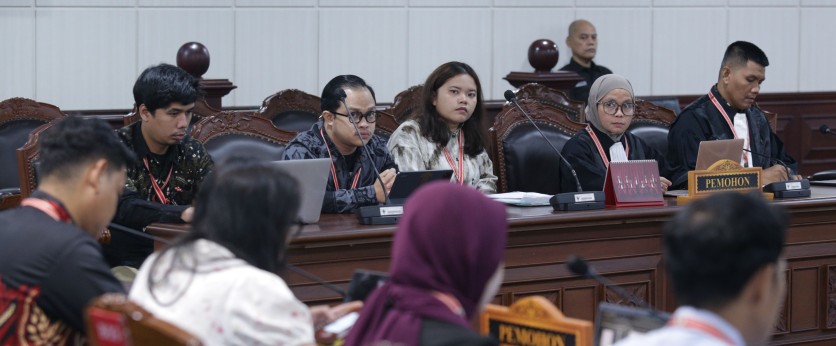
The Petitioners attending the petition revision hearing for Case No. 260/PUU-XXIII/2025 on the material judicial review of Law No. 31 of 1997 on Military Courts, Wednesday (1/21/2026). Photo by MKRI/Bay.
JAKARTA (MKRI) — The Constitutional Court of the Republic of Indonesia (MKRI) held another hearing on the material judicial review of Law No. 31 of 1997 on Military Courts on Wednesday (1/21/2026). The petition, registered as Case No. 260/PUU-XXIII/2025, was filed by Lenny Damanik (Petitioner I) and Eva Meliani Br. Pasaribu (Petitioner II).
The hearing was presided over by Constitutional Justice Enny Nurbaningsih, with Constitutional Justices Anwar Usman and Daniel Yusmic P. Foekh in attendance, to hear the revision of the petition. During the hearing, the Petitioners, represented by legal counsel Sri Afrianis, explained that the revision concerned the “subject matter” section of the petition. The revision was intended to clarify that the judicial review did not challenge the entirety of Article 9 point (1), but was limited to the phrase concerning criminal offenses.
“We have revised the petition. The subject matter now specifically concerns the material judicial review of Article 9 point (1), insofar as it relates to criminal offenses under Article 43 paragraph (3) and Article 127 of Law No. 31 of 1997 on Military Courts, against Article 1 paragraph (3), Article 24 paragraph (1), Article 27 paragraph (1), and Article 28D paragraph (1) of the 1945 Constitution,” Sri explained.
In addition, the Petitioners added three more legal counsels, bringing the total number of counsels to thirteen. Revisions were also made to the section on legal standing, particularly regarding the Petitioners’ constitutional rights, in accordance with the Panel’s advice at the previous hearing.
“On pages 10 to 12, we have set out, in tabular form, the Petitioners’ constitutional losses, both factual and potential, arising from the enforcement of the challenged provisions and the constitutional benchmarks,” she added.
Also read:
Petition Challenges Military Court Jurisdiction over General Courts
The Case No. 260/PUU-XXIII/2025 challenges Article 9 point (1), insofar as it relates to criminal offenses under Article 43 paragraph (3) and Article 127 of the Military Courts Law. At the preliminary hearing held on Thursday (1/8/2025), the Petitioners, represented by legal counsel Ibnu Syamsul Hidayat, asserted that impunity for military personnel contradicts the principle of the rule of law and equality before the law. They also highlighted broader implications, namely the weakening of civilian supremacy within a democratic system of governance.
According to the Petitioners, the dualism of jurisdiction stems from Article 9 point (1) of the Military Courts Law, which grants active Indonesian National Armed Forces (TNI) personnel a special position to be tried exclusively before military courts, even when committing ordinary criminal offenses. Such arrangements, they argued, potentially give rise to impunity and violate the principle of equality before the law.
“The phrase ‘adjudicating criminal offenses’ in Article 9 point (1) of Law No. 31 of 1997 opens broad interpretive space regarding the authority of military courts. It not only allows military courts to try soldiers or those equated with soldiers for military crimes and disciplinary violations, but also extends jurisdiction to other criminal cases, such as corruption, traffic offenses, domestic violence, narcotics, psychotropics, and child protection,” the Petitioners emphasized.
Explore the Case: Case No. 260/PUU-XXIII/2025
Author : Utami Argawati
Editor : N. Rosi
Translator : Yuanna Sisilia
Disclaimer: The original version of the news is in Indonesian. In case of any differences between the English and the Indonesian versions, the Indonesian version will prevail.
Wednesday, January 21, 2026 | 19:04 WIB 112