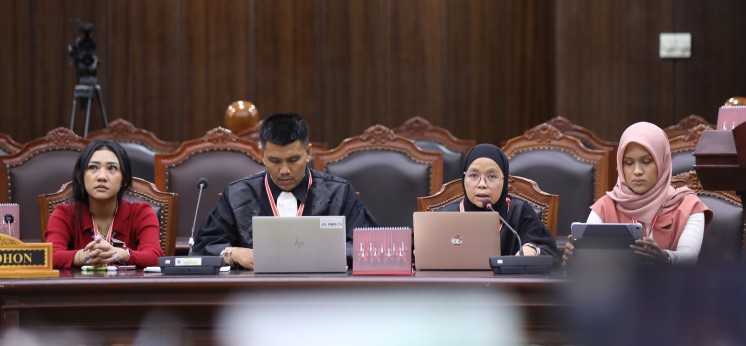
The Petitioner’s legal counsel and the principal Petitioner presenting the main points of the petition at the first hearing of the material judicial review of Law No. 31 of 1997 on Military Courts, Thursday (1/8/2025). Photo by MKRI/Ifa.
JAKARTA (MKRI) — The Constitutional Court of the Republic of Indonesia held a hearing on the material judicial review of Law No. 31 of 1997 on Military Courts on Thursday, January 8, 2025. The petition, registered as Case No. 260/PUU-XXIII/2025, was filed by Lenny Damanik and Eva Meliani Br. Pasaribu. The Petitioners are challenging Article 9 point 1, Article 43 paragraph (3), and Article 127 of the Military Courts Law against Article 1 paragraph (3), Article 24 paragraph (1), Article 27 paragraph (1), and Article 28D paragraph (1) of the 1945 Constitution.
The hearing was presided over by Arief Hidayat, accompanied by Enny Nurbaningsih and M. Guntur Hamzah. The agenda was to hear the main points of the Petitioners’ arguments.
Represented by their legal counsel, Ibnu Syamsul Hidayat, the Petitioners asserted that impunity for members of the armed forces runs counter to the principles of the rule of law and equality before the law. “Indonesia is a state based on law (rechtsstaat),” Ibnu emphasized during the hearing.
The Petitioners further highlighted broader implications, particularly the erosion of civilian supremacy within a democratic system of governance. The dominance of military court jurisdiction over general courts was deemed inconsistent with the principles of a constitutional democracy that places civilian authority above military power.
“The more significant consequence of this situation is the weakening of civilian supremacy in democratic governance. The dominance of Military Courts over General Courts, even when the crimes committed by military personnel are ordinary criminal offenses, has clearly resulted in military supremacy over civilian authority, which is contrary to the principles of democratic and constitutional governance,” Ibnu stated.
According to the Petitioners, this dualism of jurisdiction stems from Article 9 point 1 of the Military Courts Law, which grants special status to active members of the Indonesian National Armed Forces to be tried exclusively before military courts, even when they commit ordinary criminal offenses. Such regulation, they argued, may foster impunity and violate the principle of equality before the law.
“The phrase ‘to adjudicate criminal acts’ in Article 9 point 1 of Law No. 31 of 1997 opens broad interpretative space regarding the authority of military courts. It allows them not only to try military personnel or those equated with them for military crimes and disciplinary violations, but also to adjudicate other criminal cases such as corruption, traffic offenses, domestic violence, narcotics, psychotropics, and child protection cases,” he stressed.
Practices in Other Countries
In their petition, the Petitioners also referred to comparative practices in several other countries. In the United States, for instance, although military courts retain jurisdiction over service members, there are clear limitations on when cases must be transferred to civilian courts, particularly when offenses are committed outside military installations or involve civilian victims.
Comparisons were also drawn with South Africa and the Netherlands. Both countries strictly limit or have abolished the jurisdiction of military courts over ordinary criminal offenses in order to safeguard civilian legal supremacy and protect human rights.
The Petitioners contended that differential legal treatment based solely on one’s status as a member of the armed forces has created systemic injustice and undermined public trust in the judiciary. Such practices were deemed incompatible with the principles of the rule of law, equality before the law, and the guarantee of fair legal certainty as enshrined in the 1945 Constitution.
Judges’ Advice
Responding to the petition, Constitutional Justice M. Guntur Hamzah noted that the petition was well-structured and systematically prepared in accordance with Constitutional Court Regulation No. 7 of 2025 on Procedures for Judicial Review Cases. Nevertheless, he advised the Petitioners to strengthen several arguments with factual evidence demonstrating actual constitutional harm arising from the contested norms. Justice Guntur observed that the challenge to Article 9 appeared strong with respect to legal standing, whereas the other provisions would require further reinforcement.
The Panel of Constitutional Justices subsequently granted the Petitioners 14 days to revise their petition. The revised petition must be submitted to the Court no later than Wednesday, January 21, 2026, at 12:00 p.m. Jakarta time.
Explore the Case: Case No. 260/PUU-XXIII/2025
Author : Utami Argawati
Editor : N. Rosi
Translator : Yuanna Sisilia
Disclaimer: The original version of the news is in Indonesian. In case of any differences between the English and the Indonesian versions, the Indonesian version will prevail.
Thursday, January 08, 2026 | 10:33 WIB 150