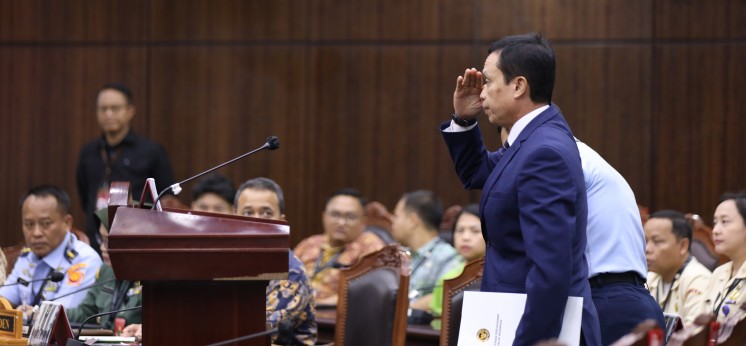
Director General of Defense Forces of the Ministry of Defense Marshal H. Haris Haryanto representing the Government delivering a statement at the judicial review hearing of Law No. 31 of 1997 on Military Justice, Thursday (2/12/2026). Photo by MKRI/Ifa.
JAKARTA (MKRI) – The Constitutional Court (MK) held another judicial review hearing on Law No. 31 of 1997 on Military Justice (Military Justice Law) on Thursday, February 12, 2026. Petition No. 260/PUU-XXIII/2025 was filed by Lenny Damanik and Eva Meliani Br. Pasaribu.
The hearing, presided over by Chief Justice Suhartoyo and the Constitutional Justices, was scheduled to hear the President's (Government's) testimony. In his statement, the Government, represented by the Director General of Defense Forces at the Ministry of Defense, Marshal H. Haris Haryanto, explained that Article 9 of the Military Justice Law aims to maintain discipline, hierarchy, and effectiveness of the Indonesian National Armed Forces (TNI) as a national defense instrument. Military discipline is considered not merely an administrative norm, but rather the foundation for the successful implementation of defense duties. Criminal violations committed by TNI soldiers not only have individual impacts but can also affect the solidarity and readiness of the military institution.
"Military courts are designed to understand these characteristics so they can deliver decisions that satisfy a sense of justice while also taking into account the interests of national defense," he said.
The Government also stated that Article 9 of the Military Court Law is a norm of absolute authority attribution that operationalizes Article 24 paragraph (2) of the 1945 Constitution of the Republic of Indonesia. The Constitution explicitly recognizes military courts as one of the judicial environments under the Supreme Court (MA), so that the regulation of the scope of authority of military courts is a constitutional consequence.
Article 9 of the Military Justice Law stipulates that military courts have the authority to adjudicate crimes committed by soldiers or those equated with soldiers. According to the government, this determination of authority based on the legal subject is based on the belief that every soldier's actions, both on and off duty, have a military dimension related to discipline, hierarchy, and the honor of the military institution.
In response to the Petitioner's argument regarding the phrase "adjudicate criminal acts," the Government believes that Article 9, paragraph 1 of the Military Courts Law, has been clearly formulated and therefore requires no further interpretation. Criminal law adheres to the principle of lex stricta, meaning there are no criminal acts or punishments without a strictly defined law, so analogies are not permitted. The Elucidation of the article stating "sufficiently clear" is considered the official interpretation of the lawmakers.
Furthermore, the Government emphasized that the existence of military courts, as one of the judicial bodies under the Supreme Court, holds equal standing with the other three judicial bodies and does not create impunity for TNI soldiers. Soldiers who commit crimes will still be prosecuted and punished through military justice mechanisms.
The Government believes that differentiating judicial authority based on military status does not constitute constitutional discrimination, but rather justifiable differentiation as long as it is expressly regulated by law. Therefore, the military justice system is considered constitutionally valid and does not conflict with the principles of the rule of law or the principle of legal certainty as stipulated in the 1945 Constitution of the Republic of Indonesia.
Also read:
Petition Challenges Military Court Jurisdiction over General Courts
Petitioners Revise Judicial Review on Military Court Jurisdiction
For information, Petition No. 260/PUU-XXIII/2025 challenges Article 9 point 1 throughout the criminal act of Article 43 paragraph (3) and Article 127 of the Military Court Law. In the first hearing at the Constitutional Court on Thursday January 8, 2025, the Petitioners, represented by their Legal Counsel Ibnu Syamsu Hidayat, emphasized that the impunity of soldiers is contrary to the principles of the rule of law and equality before the law. The Petitioners also highlighted the broader consequences, namely the weakening of civilian supremacy in a democratic system of government. The dominance of the jurisdiction of the Military Court over the General Court is considered contrary to the principles of a constitutional democratic state which places civilian power above military power.
According to the Petitioners, this dual jurisdiction stems from Article 9, paragraph 1, of the Military Courts Law, which grants active-duty TNI soldiers special status, allowing them to be adjudicated exclusively in Military Courts, even if they commit general crimes. This provision is considered to have the potential to create impunity and violate the principle of equality before the law.
"The phrase "adjudicate criminal acts" in Article 9 No. 1 of Law No. 31 of 1997 opens up opportunities and broad interpretations regarding the authority of military courts which can not only adjudicate soldiers or those equated to soldiers who commit military crimes and violations of military discipline but also provide the authority to adjudicate other criminal cases such as corruption, traffic, domestic violence, narcotics, psychotropics and child protection," stressed Ibnu Syamsu Hidayat.
Track case No. 260/PUU-XXIII/2025
Author : Utami Argawati
Editor : N. Rosi.
Translator : Donny Yuniarto
Disclaimer: The original version of the news is in Indonesian. In case of any differences between the English and the Indonesian versions, the Indonesian version will prevail.
Thursday, February 12, 2026 | 12:47 WIB 333