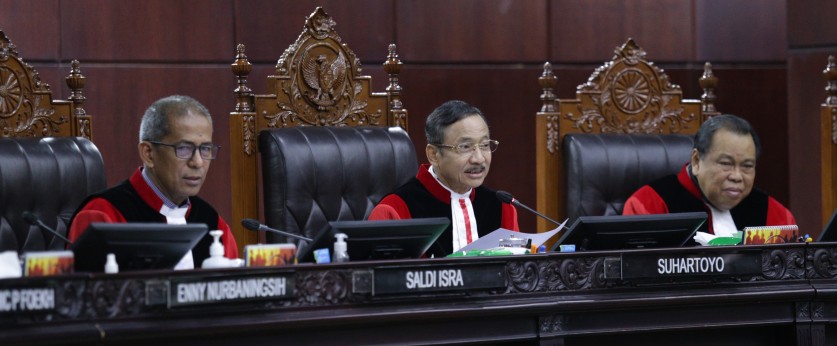
Hearing on Case No. 160/PUU-XXIII/2025 on the material judicial review hearing of Law No. 2 of 2025 on the Fourth Amendment to Law No. 4 of 2009 on Mineral and Coal Mining (Minerba Law) posponed, Wednesday, November 19, 2025. Photo by MKRI/Bay.
Jakarta (MKRI) – The Constitutional Court (MK) postponed the hearing of Case No. 160/PUU-XXIII/2025 on the material judicial review hearing of Law No. 2 of 2025 on the Fourth Amendment to Law No. 4 of 2009 on Mineral and Coal Mining (Minerba Law) to hear the Petitioners’ experts on Wednesday, November 19, 2025. The Court declared that it would examine the case along with Case No. 202/PUU-XXIII/2025, as the same norms were being tested.
“Accordingly, the Justices decided to have the examination of this case (Case No. 160/PUU-XXIII/2025) together with Case No. 202/PUU-XXIII/2025,” Chief Justice Suhartoyo stated in the Plenary Courtroom.
He explained that the agenda to hear the Petitioners’ experts in Case No. 160/PUU-XXIII/2025 would be held jointly with Case No. 202/PUU-XXIII/2025. However, the Court would hear testimony from the House of Representatives and the President for Case No. 202/PUU-XXIII/2025 on Wednesday, November 26, 2025, at 13.30 local time.
Also read:
Provisions on Priority-Based Mining Permits Challenged
Petitioners Revise Petition to Priority-Based Mining Permit Provisions
Rationale for Priority Granting of Mining Licenses to Universities
Priority Mining Licenses as an Instrument of State Control
Two Company Directors File for Judicial Review of Priority Mining Permit Provisions
Two Contract Teachers Join as Petitioners in Judicial Review of Minerba Law
The petitioners of Case No. 160/PUU-XXIII/2025 comprise private sector businesspeople, MSME entrepreneurs, students, and the chairperson of the National Student Forum of Pagar Nusa (FMPSN). They challenge Article 51 paragraphs (1), (3), (4), (5), (6); Article 51A paragraphs (1), (3), (5); Article 51B paragraphs (1), (2) letter (d); Article 60 paragraphs (1), (3), (4), (5), (6); Article 60A paragraphs (1), (2), (3), (5); Article 60B paragraphs (1), (2) letter (d); Article 75 paragraphs (3), (5), (7); and Article 75A paragraphs (1), (2), (3), (5)—arguing that these harm their right to equitable management of mining resources.Article 51 paragraph (1) of the Minerba Law reads, “Metal mineral WIUPs are granted to Business Entities, cooperatives, sole proprietorships, small and medium enterprises, or enterprises owned by religious organizations by auction or by means of priority granting.” Meanwhile, Article 60 paragraph (1) of the Minerba Law reads, “Coal WIUPs are granted to Business Entities, cooperatives, sole proprietorships, small and medium enterprises, or enterprises owned by religious organizations by auction or by means of priority granting.”
The petitioners divided the issue into two clusters: the first focuses on granting priority IUPs/IUPKs to business entities, MSMEs, cooperatives, and businesses owned by religious organizations; the second concerns priority IUPs/IUPKs for private business entities related to university independence and excellence. According to the petitioners, granting IUPs on a priority basis risks creating favoritism and clientelism in the licensing process.
In their petitums, the Petitioners ask the Court to declare the term “priority” in the challenged articles unconstitutional and not legally binding unless interpreted to mean “auction with priority bidding.” They also seek to have particular articles interpreted to require specific prerequisites and considerations in granting priority permits. Furthermore, they request that the phrases “private enterprises” and “and/or global” in several provisions be declared unconstitutional and unenforceable.
Case No. 202/PUU-XXIII/2025 was filed by the Director of PT Pinter Hukum Indonesia, Ilham Fariduz Zaman; the Director of PT Cipta Kemenangan Nusantara, Imam Rohmatullah; and two contract teachers, Iqro’ Katsir and Alif Alvian Mawaddi Hamid. The Petitioners challenged the provisions of the Mining Business License Areas (WIUP) for metallic minerals and coal, which allocate these areas to state-owned enterprises and private companies through a priority mechanism. The equal treatment given to SOEs and private companies in the article allows specific private companies to be granted a mining permit (IUP) without going through an open, competitive, and transparent auction process, as should be required.
Therefore, in the petitums, the Petitioners requested the Court to declare the phrase “and private companies” in Article 51B paragraph (1) and Article 60B paragraph (1) of the Mineraba Law contrary to the 1945 Constitution and has no legally binding force. In addition, the Petitioner also asked the Court to declare the phrase “and/or global” in Article 51B paragraph (2) letter d and Article 60B paragraph (2) letter d of the Minerba Law contradicts the 1945 Constitution and has no legally binding power. (*)
Author: Mimi Kartika
Editor: Lulu Anjarsari P.
Public Relations: Raisa Ayuditha M.
Translator: Rizky Kurnia Chaesario
Disclaimer: The original version of the news is in Indonesian. In case of any differences between the English and the Indonesian versions, the Indonesian version will prevail.
Wednesday, November 19, 2025 | 15:17 WIB 225