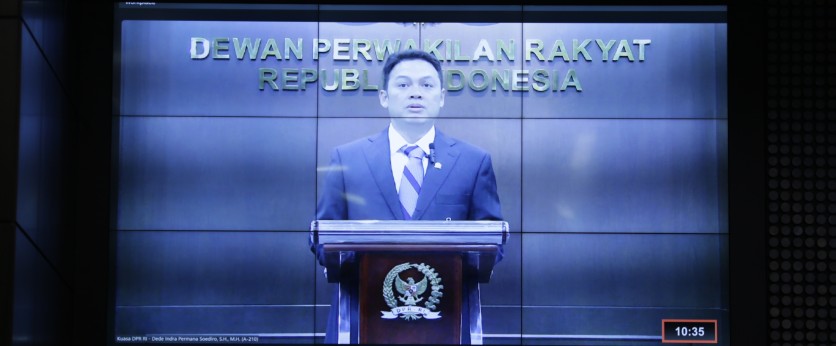
The House testifying on Case No. 160/PUU-XXIII/2025 on the material judicial review of Law No. 2 of 2025 on the Fourth Amendment to Law No. 4 of 2009 on Mineral and Coal Mining, Tuesday (28/10/2025). Photo by MKRI/Bay.
Jakarta (MKRI) – The Constitutional Court (MK) resumed the material judicial review of several articles of Law No. 2 of 2025 on the Fourth Amendment to Law No. 4 of 2009 on Mineral and Coal Mining (Minerba Law) to hear testimony from the House of Representatives and the President on Tuesday, October 28, 2025. The House’s testimony was delivered by Deputy Chair of the Third Commission of the House, Dede Indra Permana, online. Meanwhile, the President’s delegate indicated that they were not yet ready to provide a statement.
Dede explained that the granting of mining business licenses – namely WIUP (Mining Business License Area) and WIUPK (Special Mining Business License Area) – continues to be conducted through the auction mechanism. At the same time, the priority granting of mining licenses serves as an affirmative instrument to promote economic equality.
“Among other things, it opens access for small-scale economic actors and other social entities that have historically played an active role in Indonesia’s development,” Dede said in response to Case No. 160/PUU-XXIII/2025.
He added that this interpretation is in line with the academic manuscript of the Draft of Minerba Law, which emphasizes the principle of substantive justice in natural resources management. Additionally, the priority licensing for cooperatives, MSMEs, and enterprises owned by religious organizations embodies the principle of social justice outlined in the fourth paragraph of the Preamble to the 1945 Constitution.
The affirmative policy is intended to address disparities in economic access and resource management without compromising efficiency and healthy competition. Over time, it is expected to enhance the management of natural resources beyond the control of large corporations.
The petitioners comprise private sector businesspeople, MSME entrepreneurs, students, and the chairperson of the National Student Forum of Pagar Nusa (FMPSN). They challenge Article 51 paragraphs (1), (3), (4), (5), (6); Article 51A paragraphs (1), (3), (5); Article 51B paragraphs (1), (2) letter (d); Article 60 paragraphs (1), (3), (4), (5), (6); Article 60A paragraphs (1), (2), (3), (5); Article 60B paragraphs (1), (2) letter (d); Article 75 paragraphs (3), (5), (7); and Article 75A paragraphs (1), (2), (3), (5)—arguing that these harm their right to equitable management of mining resources.
Article 51 paragraph (1) of the Minerba Law reads, “Metal mineral WIUPs are granted to Business Entities, cooperatives, sole proprietorships, small and medium enterprises, or enterprises owned by religious organizations by auction or by means of priority granting.” Meanwhile, Article 60 paragraph (1) of the Minerba Law reads, “Coal WIUPs are granted to Business Entities, cooperatives, sole proprietorships, small and medium enterprises, or enterprises owned by religious organizations by auction or by means of preferential granting.”
Nevertheless, Dede clarified that the legislature has established regulations to ensure that both priority and auction mechanisms for WIUP/WIUPK are subject to specific qualifying criteria as further defined by the Government. This is further regulated under Government Regulation No. 39 of 2025 on the Implementation of Mineral and Coal Mining Activities, dated September 11, 2025.
“Priority granting of WIUPK is only permissible after all requirements and criteria are fully and propertly met,” Dede said.
He further emphasized that priority mining license grants to universities, implemented through cooperation with private enterprises, do not alter the function of universites. Rather, the policies aims to strengthen collaboration between academia and industry in research and innovation, supporting mineral and coal downstream processing while ensuring accountability and social responsibility.
Universities are not directly involved in mining activities. Dede mentioned that they benefir only from research partnerships and technology transfer. “To prevent misuse, Article 75 paragraph (4) of the law regulates mandatory reporting of partnership outcomes to the government (through relevant ministries) and the Audit Board, ensuring that partnership funds are truly used for research and educational quality improvement,” Dede stated.
Also read:
Provisions on Priority-Based Mining Permits Challenged
Petitioners Revise Petition to Priority-Based Mining Permit Provisions
The petitioners question articles in the Minerba Law that grant Mining Business Permits (IUP) on a priority basis to business entities, MSMEs, cooperatives, privately owned enterprises, and university interests. The petitioners divided the issue into two clusters: the first focuses on granting priority IUPs/IUPKs to business entities, MSMEs, cooperatives, and businesses owned by religious organizations; the second concerns priority IUPs/IUPKs for private business entities related to university independence and excellence. “In total, there are 25 articles that we are challenging, Your Honors, but the issues are divided into those two clusters,” said A Fahrur Rozi, the petitioners’ counsel, during the revision hearing on Monday, October 6, 2025.
According to the petitioners, granting IUPs on a priority basis risks creating favoritism and clientelism in the licensing process. There are millions of MSMEs, cooperatives, religious organizations, and universities vying for IUPs, but only around 4,000 permits are available. Logically, the priority given fairly among such a vast pool of candidates is questionable, unless it is still done through a fair and prioritized auction mechanism.
The petition also argues that these articles cause harm by disregarding fundamental considerations in the priority-based permit-granting process. This omission not only results in legal uncertainty but also poses a threat to the sustainability of both human and natural ecosystems.
They emphasize that prioritization cannot come at the cost of critical requirements such as administrative and managerial capacity, technical and environmental competence, and financial capability—all of which are indispensable in responsible mining practices. As a result, they argue, these provisions pave the way for mining activities that disregard the public interest. Instead of delivering benefits, the law generates legal uncertainty and endangers the livelihood of the wider community.
In their petitums, the Petitioners ask the Court to declare the term “priority” in the challenged articles unconstitutional and not legally binding unless interpreted to mean “auction with priority bidding.” They also seek to have particular articles interpreted to require specific prerequisites and considerations in granting priority permits. Furthermore, they request that the phrases “private enterprises” and “and/or global” in several provisions be declared unconstitutional and not legally binding.
Author : Mimi Kartika
Editor : Lulu Anjarsari P.
PR : Raisa Ayuditha Marsaulina
Translator : Rizky Kurnia Chaesario/Yuniar Widiastuti
Disclaimer: The original version of the news is in Indonesian. In case of any differences between the English and the Indonesian versions, the Indonesian version will prevail.
Tuesday, October 28, 2025 | 13:18 WIB 308