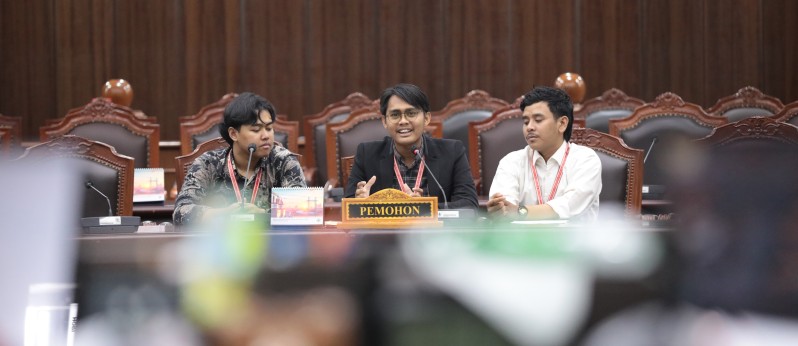
The Petitioners’ counsel conveying the petition’s merits at the preliminary hearing for the judicial review of Law No. 2 of 2025 on Mineral and Coal Mining, Monday (9/22/2025). Photo by MKRI/Ilham W.M.
JAKARTA (MKRI) — Five individual citizens have filed a material judicial review petition of several articles under Law No. 2 of 2025 on the Fourth Amendment to Law No. 4 of 2009 on Mineral and Coal Mining (Minerba Law) to the Constitutional Court (MK). They argue that those articles have allowed business entities, MSMEs, cooperatives, private enterprises, and higher education institutions to be granted priority of mining business permits (IUPs).
“We do not want the introduction of a priority instrument to eliminate the fundamental considerations inherent in the granting of mining permits,” said the Petitioners’ legal counsel A. Fahrur Rozi at the preliminary hearing for case No. 160/PUU-XXIII/2025 on Monday, September 22, 2025.
This petition was filed by Abdullah, Iqra’ Katsir, Alif Alvian Mawaddi Hamid, along with two students, Abdullah Faqih and Pendi. They are challenging the constitutionality of Articles 51 paragraphs (1), (3), (4), (5), (6); Article 51A paragraphs (1), (3), (5); Article 51B paragraphs (1), (2) letter d; Article 60 paragraphs (1), (3), (4), (5), (6); Article 60A paragraphs (1), (2), (3), (5); Article 60B paragraphs (1), (2) letter d; Article 75 paragraphs (3), (5), (7); and Article 75A paragraphs (1), (2), (3), and (5) of the Mineral and Coal Mining Law.
According to the Petitioners, these provisions undermine their right to a fair system of resource management. They argue that granting mining business permits on a priority basis fosters favoritism and clientelism in the licensing process. With millions of MSMEs, cooperatives, business entities, and universities competing for only around 4,000 permits, it is logically impossible to distribute them equitably through “priority” unless such allocation is carried out via a fair and transparent auction mechanism.
The Petitioners further contend that these provisions remove essential considerations in the issuance of priority permits. Such omissions not only create legal uncertainty but also pose serious threats to both human and environmental sustainability. They emphasize that prioritization cannot come at the cost of critical requirements such as administrative and managerial capacity, technical and environmental competence, and financial capability—all of which are indispensable in responsible mining practices.
As a result, they argue, these provisions pave the way for mining activities that disregard the public interest. Instead of delivering benefits, the law generates legal uncertainty and endangers the livelihood of the wider community.
“We have seen the consequences before—for instance, in Cirebon, where a mining operation by a cooperative ended up causing a disaster,” said Fahrur.
In their petitums, the Petitioners ask the Court to declare the term “priority” in the challenged articles unconstitutional and not legally binding unless interpreted to mean “auction with priority bidding.” They also seek to have certain articles interpreted to require specific prerequisites and considerations in granting priority permits. Furthermore, they request that the phrases “private enterprises” and “and/or global” in several provisions be declared unconstitutional and not legally binding.
Constitutional Justice Enny Nurbaningsih presided over the hearing alongside panel members Constitutional Justices Anwar Usman and Daniel Yusmic P. Foekh. Justice Foekh noted that a total of 29 provisions are being challenged. He stressed that the Petitioners must demonstrate how each provision directly relates to the alleged violation of their constitutional rights.
“For instance, one provision might only be relevant to Petitioner I or Petitioner IV. But if all the provisions are linked to the alleged harms of all four Petitioners, that would strengthen the case. The petitioners here include a private employee and a non-tenured teacher, so it is important to clarify exactly where the harm lies in order to substantiate their legal standing,” he explained.
He further underlined that legal standing is crucial as the gateway for the Court to examine the merits of the petition. The Petitioners must also ensure that none of the 29 provisions have been previously reviewed by the Court, or if they have, provide arguments explaining why the present case should not be barred under the principle of ne bis in idem.
Before adjourning the session, Justice Enny announced that the Petitioners would have 14 days to revise their petition, which must be received by the Court no later than 12:00 WIB on October 6.
Author : Mimi Kartika
Editor : Lulu Anjarsari P.
PR : Raisa Ayuditha Marsaulina
Translator : Yuniar Widiastuti (NL)
Disclaimer: The original version of the news is in Indonesian. In case of any differences between the English and the Indonesian versions, the Indonesian version will prevail.
Monday, September 22, 2025 | 15:49 WIB 210