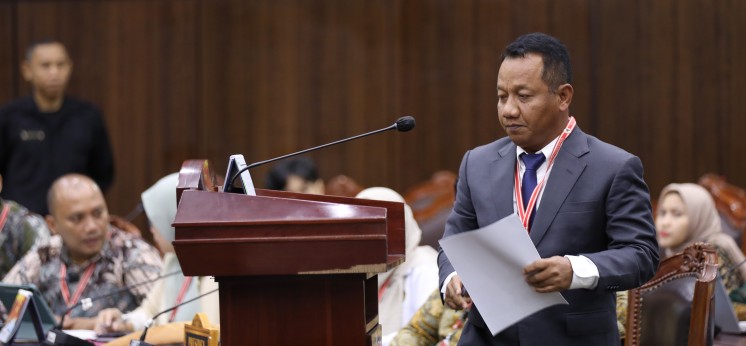
Director General of Minerals and Coal, Tri Winarno, representing the government in delivering a statement during the resumed hearing of the material judicial review of Law No. 2 of 2025 on Mineral and Coal Mining, Thursday (06/11). Photo by MKRI/Ifa.
Jakarta (MKRI) – Director General of Minerals and Coal, Ministry of Energy and Mineral Resources (ESDM), Tri Winarno, stated that the policy of granting Mining Business License Areas (WIUP) and Special Mining Business License Areas (WIUPK) on a priority basis to small and medium-sized enterprises, sole proprietorships, cooperatives, business entities owned by religious organizations, and for university interests through state-owned, region-owned, or private companies constitutes an instrument of the State’s controlling right (Hak menguasai negara). This statement was made during the hearing for Case No. 160/PUU-XXIII/2025 at the Constitutional Court (MK).
“The State is not only authorized to regulate and supervise, but also to determine who is entitled to receive priority access to the utilization of national natural resources,” Tri said during the material judicial review hearing of several articles of Law No. 2 of 2025 on the Fourth Amendment to Law No. 4 of 2009 on Mineral and Coal Mining (Minerba Law), during a session to hear the President’s testimony on Thursday, November 6, 2025.
He added that under this mechanism, the State ensures that the benefit of natural resources are not concentrated among large capital groups, but are distributed equitably to strengthen the economic distribution and increase public participation in strategic sectors. Provisions regarding the granting of WIUP and WIUPK by priority to SMEs, sole proprietorships, cooperatives, and religious organization business entities, as regulated in the Minerba Law, are a manifestation of constitutional affirmative policy, not a form of discrimination or favoritism contrary to equality.
Tri described such affirmative action as a manifestation of distributive justice, in line with classical legal philosophy and modern constitutional thought: inequality may be justified when it benefits the most vulnerable groups. Therefore, prioritizing small businesses and cooperatives is a constitutionally legitimate corrective step to address disparities in access and broaden the sharing of natural resource benefits nationally.
He further asserted that involving business entities owned by religious organizations is a legal innovation grounded in Indonesia’s social and constitutional values. Religious organizations play a broad range of socio-economic roles, particularly in education, welfare, and community empowerment. Their participation in mining activities, Tri argued, enhances the redistribution of economic benefit to the grassroots and strengthens civil society’s role in just national development.
The contested norms, Tri added, do not subordinate universities to business interests. Instead, they provide structural support for universities to access national natural resources lawfully, transparently, and accountably, strengthening academic independence and institutional capacity. These provisions do not directly regulate research, funding, or commercial partnerships; however, they provide a normative legal basis for universities to participate in natural resource utilization legitimately and responsibly.
Auction Mechanism Still Applies
Tri also emphasized that the granting of WIUP and WIUPK by priority should not be equated with direct appointment. It is an affirmative mechanism conducted within the framework of transparent administrative law. All licensing stages must adhere to principles of openness, objectivity, and accountability as stipulated in Government Regulation No. 39 of 2025.
The auction system remains in force within the national mining licensing framework. Government Regulation No. 39 of 2025 affirms that the granting of WIUP and WIUPK by priority is a distinct mechanism reserved for recipients of affirmative policy, not an elimination of selection; those recipients must still meet all eligibility criteria, including environmental, financial, and operational standards. Competitive mechanisms are thus preserved, in accordance with the principle of fair, efficiency mandated by Article 33 paragraph (4) of the 1945 Constitution.
“Government Regulation No. 39 of 2025 details procedures for granting WIUP and WIUPK by priority through the Electronic Business Licensing System (Online Single Submission/OSS). This system allows all applications, evaluations, and permits to be submitted, documented, and audited digitally by the public and oversight bodies,” Tri explained.
Also read:
Provisions on Priority-Based Mining Permits Challenged
Petitioners Revise Petition to Priority-Based Mining Permit Provisions
Rationale for Priority Granting of Mining Licenses to Universities
The petitioners comprise private sector businesspeople, MSME entrepreneurs, students, and the chairperson of the National Student Forum of Pagar Nusa (FMPSN). They challenge Article 51 paragraphs (1), (3), (4), (5), (6); Article 51A paragraphs (1), (3), (5); Article 51B paragraphs (1), (2) letter (d); Article 60 paragraphs (1), (3), (4), (5), (6); Article 60A paragraphs (1), (2), (3), (5); Article 60B paragraphs (1), (2) letter (d); Article 75 paragraphs (3), (5), (7); and Article 75A paragraphs (1), (2), (3), (5)—arguing that these harm their right to equitable management of mining resources.
Article 51 paragraph (1) of the Minerba Law reads, “Metal mineral WIUPs are granted to Business Entities, cooperatives, sole proprietorships, small and medium enterprises, or enterprises owned by religious organizations by auction or by means of priority granting.” Meanwhile, Article 60 paragraph (1) of the Minerba Law reads, “Coal WIUPs are granted to Business Entities, cooperatives, sole proprietorships, small and medium enterprises, or enterprises owned by religious organizations by auction or by means of priority granting.”
The petitioners divided the issue into two clusters: the first focuses on granting priority IUPs/IUPKs to business entities, MSMEs, cooperatives, and businesses owned by religious organizations; the second concerns priority IUPs/IUPKs for private business entities related to university independence and excellence. According to the petitioners, granting IUPs on a priority basis risks creating favoritism and clientelism in the licensing process.
There are millions of MSMEs, cooperatives, religious organizations, and universities vying for IUPs, but only around 4,000 permits are available. Logically, the priority given fairly among such a vast pool of candidates is questionable, unless it is still done through a fair and prioritized auction mechanism.
The petition also argues that these articles cause harm by disregarding fundamental considerations in the priority-based permit-granting process. This omission not only results in legal uncertainty but also poses a threat to the sustainability of both human and natural ecosystems.
In their petitums, the Petitioners ask the Court to declare the term “priority” in the challenged articles unconstitutional and not legally binding unless interpreted to mean “auction with priority bidding.” They also seek to have particular articles interpreted to require specific prerequisites and considerations in granting priority permits. Furthermore, they request that the phrases “private enterprises” and “and/or global” in several provisions be declared unconstitutional and not legally binding.
Author : Mimi Kartika
Editor : Lulu Anjarsari P.
PR : Raisa Ayuditha Marsaulina
Translator : Rizky Kurnia Chaesario/Yuniar Widiastuti
Disclaimer: The original version of the news is in Indonesian. In case of any differences between the English and the Indonesian versions, the Indonesian version will prevail.
Thursday, November 06, 2025 | 13:42 WIB 2462