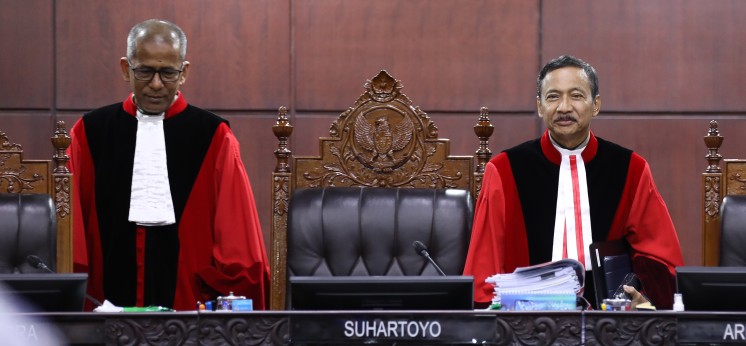
Chief Justice Suhartoyo and Deputy Chief Justice Saldi Isra during the hearing of Law No. 17 of 2023 on Health, Tuesday (14/10). Photo by MKRI/Ifa.
JAKARTA (MKRI) – The Constitutional Court (MK) held the ninth hearing in the judicial review of Law No. 17 of 2023 on Health (Health Law) for Cases 156/PUU-XXII/2024 and 182/PUU-XXII/2024 on Tuesday, October 14, 2025, starting at 13.30 WIB. The agenda was to hear the testimony from experts summoned by the Court, including dr. Iqbal Mochtar and Prof. Gandes Retno Rahayu, Professor of Medical and Health Education at Gadjah Mada University (UGM).
Iqbal noted that the government, through the Ministry of Health (Kemenkes), has established collegia for various disciplines, effectively dissolving those previously set up by professional organizations. He stated that these Ministerial collegia are problematic not only in structure but also pose serious risks, such as allowing standards for education and competence to be manipulated for political programs and targets.
“As an example, there have been proposals for general practitioners to install cardiac stents after only several months of training, granting them competency certification for such a procedure. This is clearly hazardous for patient safety,” Iqbal explained via video from Qatar.
The collegia formed under the Ministry, Iqbal continued, can also lead to structural conflicts, since the Ministry functions both as a regulator and service provider. This dual role, he said, fosters unilateral decisions driven by political and bureaucratic interests.
Iqbal pointed out that in countries such as the UK, the US, and Canada, collegia serve as independent bodies, not government agencies. In most jurisdictions, oversight of medical ethics and discipline is not conducted directly by the government but by professional bodies or independent councils.
In Indonesia, however, the new Health Law grants the government authority to supervise professional ethics and discipline. From a scientific standpoint, Iqbal argued that such oversight should not be performed by administrative officials or bureaucrats who lack clinical competence or ethical expertise.
“Professional ethics and discipline stem from moral values, professional oaths, and scientific norms. These are internal standards that can only be assessed by peers who understand the context of medical practice, clinical dilemmas, and professional benchmarks,” said Iqbal, who chairs the Association of Indonesian Doctors in the Middle East (PDITT).
Examining practices abroad, Iqbal said, most mature professional regulatory systems segregate medical councils from those for other health professions—as seen in the UK, Australia, Singapore, and Canada. Previously in Indonesia, before the new Health Law, the system was also divided: the Indonesian Medical Council (KKI) regulated doctors and dentists. At the same time, the Indonesian Health Professions Council (KTKI) oversaw non-physician professions.
The government, by Article 268 of the Health Law, has established the Indonesian Health Professions Council (KTKI) to upgrade technical proficiency across all health professions. Iqbal warned that merging councils, as in the current KTKI, marginalizes doctors’ voices among the many professions gathered under one body.
“An overly broad and bureaucratic structure risks obscuring the distinct ethical and clinical responsibilities doctors bear,” Iqbal said.
Potential Risk of Conflict and Abuse in Professional Discipline Boards
Iqbal also highlighted the risk of conflicts of interest and misuse of authority within the Professional Discipline Board (MDP). According to Article 708 paragraph (1) of the Health Law, medical professionals suspected of legal violations may face criminal sanctions only after the MDP’s recommendation.
Iqbal acknowledged that special courts exist for certain professions, such as military courts and advocate honor boards, but noted technical challenges remain: the MDP's 14-day window for recommendations, geographic barriers, and the composition of board members.
Earlier that day, at 9:00 WIB, the Court convened its eighth hearing to hear testimony from the Ministry of Higher Education, Science and Technology (Kemdiktisaintek) and the Association of Indonesian Dental and Oral Teaching Hospitals (ARSGMPI).
Before adjourning, Deputy Chief Justice Saldi Isra informed attendees that this was the final hearing. The Court will now deliberate on all presented evidence. Parties have until seven working days from today—by October 22, 2025—to submit responses or conclusions.
Also read:
IDI Board and 52 Citizens of Various Professional Backgrounds to Test 24 Articles in the Health Law
IDI Board and 52 Citizens Question the Dismissal of Collegium in Health Law
House: Medical Workers Mentoring and Supervision Under Government Authority
Health Minister: Collegium Under Professional Organizations Creates Conflict of Interest
Petitioners’ Expert Talks Conflation of Medical, Health Workers in Health Law
Perdesti Never Officially Recognized Under IDI
AFDOKGI: Current Collegium Vulnerable to Executive Interference
Ministry: Collegium Formulates Competency Standards
The Petitioners of case No. 182/PUU-XXII/202 comprise of the executive board of the Indonesian Doctors Association (PB IDI) represented by chairman Adib Khumaidi and secretary-general Ulul Albab, along with 52 individuals consisting of doctors, civil servants, lecturers, employees of state-owned enterprises, police officers, military officers, students, retirees, and housewives. They challenge Article 311 paragraph (1), Article 268 paragraph (1), Article 270, Article 272 paragraphs (1), Article 272 paragraph (3), Article 258 paragraph (2), Article 264 paragraphs (1) and (5), Article 291 paragraph (2), Article 421 paragraph (1), Article 442, and Article 454 letter c of the Health Law.
At the preliminary hearing, the Petitioners argued that the Minister of Health had direct intervention and control over the collegium. The minister now has authority to receive a review of the decisions by the professional disciplinary council, to manage the fulfillment of professional credit units (SKP) for medical workers. The minister also has intervention and full control over the implementation of medical education and training.
The Petitioners submitted at least 14 petitums, including a request for the Court to grant the petition in its entirety. They request the Court to make the following interpretations of articles in Law No. 17 of 2023: Article 311 paragraph (1) as “Medical and Health Workers shall form a professional organization for doctors, namely the Indonesian Medical Association, and a professional organization for dentists, namely the Indonesian Dental Association;” Article 268 paragraph (1) as “To improve the quality and technical competence of Medical Workers and Health Workers, and to provide protection and legal certainty for the public, an Indonesian Medical Council shall be established for Medical Workers and for Health Workers an Indonesian Health Council;” Article 270 as “The membership of the Council for Medical Workers shall consist of: a. the Central Government; b. professional organizations of Medical Workers and Health Workers; c. the collegium of professional organizations; and d. the community;” Article 272 paragraph (1) as “To develop disciplines and educational standards for Medical Workers and Health Workers, expert groups from each professional organization in each medical discipline may form a collegium established by the respective professional organizations;” interpret Article 272 paragraph (3) as “The Collegium for Medical Workers shall have the functions of: a. drafting competency standards for Medical Workers; and b. drafting curriculum standards for continuing education for Medical Workers, to be implemented by professional organizations;” and interpret Article 258 paragraph (2) as “Training and/or competency development activities as referred to in paragraph (1) shall be organized by professional organizations and/or training institutions accredited by professional organizations.” They also request the interpretation of Article 264 paragraph (1) letter b, Article 264 paragraph (5), Article 291 paragraph (2), Article 421 paragraph (1), Article 442, and Article 454 letter c of the Health Law.
Meanwhile, the case No. 156/PUU-XXII/2024 was filed by the Association of Medical and Health Law Consultants (PKHMK) and two advocates. They challenge Article 304 of the Health Law, which concerns provision on disciplinary actions for the profession to support the professionalism of medical and health personnel. The minister formed an assembly that deals with the profession’s discipline. The permanent or ad hoc assembly determines whether a professional disciplinary violation has been committed. The regulation is then delegated to the Government Regulation (PP) No. 28 of 2024 on Health as the implementing provisions, which regulates the establishment, duties, functions, and membership of the Professional Disciplinary Council (MDP).
The Petitioners believe it would be inappropriate for an ethics council to be given authority to recommend and examine any violation of criminal or civil law. In their petitums, they request that the Court declare the phrase “a recommendation from the assembly must first be requested as referred to in Article 304” in Article 308 paragraphs (1), (2), (3), (4), (5), (6), (7), (8), and (9) of the Health Law unconstitutional and not legally binding.
Author : Mimi Kartika
Editor : Lulu Anjarsari P.
PR : Raisa Ayuditha Marsaulina
Translator : Rizky Kurnia Chaesario/Yuniar Widiastuti (NL)
Disclaimer: The original version of the news is in Indonesian. In case of any differences between the English and the Indonesian versions, the Indonesian version will prevail.
Tuesday, October 14, 2025 | 16:06 WIB 305