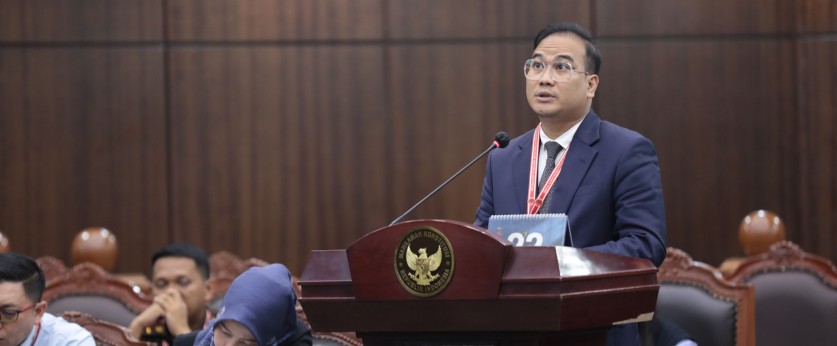
Ahmad Redi giving his testimony at the evidentiary hearing for case No. 71/PUU-XXIII/2025 on the Anti-Corruption Law, Thursday (8/28/2025). Photo by MKRI/Ifa.
JAKARTA (MKRI) — Ahmad Redi, a lecturer at the Doctor of Law program of Universitas Borobudur Jakarta and Director of the Collegium Jurist Institute, stated that advances in technology and the complexity of socio-political systems have opened up new ways of obstructing law enforcement that cannot be captured if the concept of “indirect” actions is removed. He cited, among others, the use of social media or other digital platforms to spread information that shapes public opinion, potentially influencing court proceedings, or the use of encryption technology to conceal evidence in corruption cases.
Redi delivered this opinion as an expert presented by the President/Government at the evidentiary hearing of the judicial review of Article 21 and its elucidation of Law No. 31 of 1999 on the Eradication of Corruption Crimes, as amended by Law No. 20 of 2001 (Anti-Corruption Law), in case No. 71/PUU-XXIII/2025 at the Constitutional Court. He asserted that without the phrase “indirectly,” it would be difficult to reach such acts, even though they clearly aim to hinder or disrupt law enforcement in corruption cases.
“We once heard the hashtag, if I may, Your Honor, ‘Dark Indonesia.’ It turned out that when investigated by the Attorney General’s Office, it was part of an effort to obstruct, hinder, and thwart the prosecution of corruption in various cases, such as the tin case and others,” Redi testified in the plenary courtroom on Thursday, August 28, 2025.
He explained that this was revealed during the investigation and inquiry processes, which even led to suspects being named. These suspects admitted creating the hashtag “Dark Indonesia” to provoke through social media, attack prosecutors personally, and target officials at the Attorney General’s Office, thereby obstructing and weakening corruption law enforcement.
“So, information that shapes public opinion, the hashtag ‘Dark Indonesia’ influenced the public. Information regarding the special crimes attorney was then made viral, continuously spun on social media,” Redi elaborated.
He continued that such actors could not be prosecuted if the phrase “indirectly” in Article 21 of the Anti-Corruption Law were removed, as sought by the Petitioners. According to him, the phrase “indirectly” serves a deterrent function against attempts to obstruct corruption law enforcement.
By imposing strict criminal sanctions on acts that intentionally prevent, hinder, or thwart the legal process in corruption cases, whether directly or indirectly, the law is expected to deter those intending to obstruct justice. From an impact analysis perspective, he added, the phrase “indirectly” in Article 21 has a positive and significant effect on anti-corruption efforts in Indonesia.
“The deletion of the phrase may weaken the effectiveness of anti-corruption enforcement and create loopholes exploitable by those who wish to obstruct corruption law enforcement,” Redi stressed.
He further explained that although the phrase “indirectly” has a broad scope, it is sufficiently clear in the legal context. Grammatically, “indirectly” means through intermediaries or not in a direct manner. In the context of Article 21, it refers to preventing, hindering, or thwarting law enforcement through indirect or mediated means.
Strengthening Anti-Corruption Efforts
Professor Suparji of Universitas Al Azhar Indonesia, also presented by the President/Government, explained that Article 1 paragraph (1) and the phrase “corruption crimes” in Article 6 letter e of the Corruption Eradication Commission (KPK) Law serve as instruments of legal certainty in anti-corruption efforts, particularly in addressing obstruction of justice.
He underlined that combating corruption must be comprehensive, practical, and conclusive, because corruption rarely stands alone; it often involves other crimes that serve as support, complement, or camouflage for illicit gains. Therefore, anti-corruption enforcement should not only punish perpetrators of corruption itself, but also those committing related offenses such as obstructing investigation, prosecution, or trial proceedings.
Regulations concerning corruption-related offenses in Article 1 paragraph (1), Article 6 letter e of the KPK Law, and Chapters II and III of the Anti-Corruption Law serve as the legal basis for certainty in eradicating corruption, both for law enforcement, especially the KPK, and for the public. They ensure the effective eradication of corruption, break down systemic and organized corruption networks, tackle corruption in broader networks, prevent impunity for obstruction, and align with the principles of the UNCAC. Thus, the phrase “corruption crimes” in Article 1 paragraph (1) and Article 6 letter e of the KPK Law must not be narrowly interpreted as covering only Chapter II of the Anti-Corruption Law. Otherwise, it would create legal gaps and uncertainty, undermining the very purpose of establishing the KPK under Article 43 of the Anti-Corruption Law.
For reference, Article 21 of the Anti-Corruption Law stipulates: “Any person who intentionally prevents, obstructs, or thwarts, directly or indirectly, investigation, prosecution, and trial hearings of suspects, defendants, or witnesses in corruption cases shall be punished with imprisonment of not less than 3 (three) years and not more than 12 (twelve) years and/or a fine of not less than Rp150,000,000.00 (one hundred fifty million rupiahs) and not more than Rp600,000,000.00 (six hundred million rupiahs).” The elucidation simply states: “Article 21 is sufficiently clear.”
The Petitioners argued that the phrase “or indirectly” in this provision and its elucidation potentially criminalize any citizen expressing public opinion or exercising social control through the mass media, seminars, campus discussions, demonstrations, press conferences, and so on. If such public expressions were deemed by investigators, based on subjective assessment, to “obstruct investigation, prosecution, or trial” because they indirectly influence law enforcement, it would threaten freedom of expression and security in expressing opinions. Meanwhile, the Constitution affirms that freedom of expression is a fundamental element of democracy.
Also read:
Limit to KPK’s Authority Questioned
Petitioners Reinforce Grounds for Challenging KPK’s Scope of Authority
Government, House Require More Time to Respond to KPK Judicial Review
Breaking the Chain of Organized and Systemic Corruption
Response of DPR and KPK on Judicial Review of KPK’s Authority Limitation
This hearing was also held for the material judicial review of Article 1 paragraph (1) and Article 6 letter e of Law No. 19 of 2019 on the Second Amendment to Law No. 30 of 2002 on the Corruption Eradication Commission, case No. 106/PUU-XXIII/2025, filed by Idalorita Daeli (Petitioner I), Haerul Kusuma (Petitioner II), and Andika Firmanta Sitepu (Petitioner III). The Petitioners argued that the KPK is mandated to conduct investigations, inquiries, and prosecutions of corruption crimes, but not of other related offenses. Nevertheless, the KPK has acted as if vested with such lawful authority, despite the law providing no explicit mandate.
According to the Petitioners, the KPK’s mandate should be confined to corruption offenses in Chapter II of the Anti-Corruption Law, comprising 22 articles (Articles 2–20). Its conduct otherwise constitutes abuse of power or excess of power by a law enforcement institution, in violation of the rule of law principle under Article 1 paragraph (3) of the 1945 Constitution, setting a dangerous precedent in Indonesia’s legal system, and thus must be curtailed.
Also read:
Lawyer Challenges Anti-Corruption Law for Potentially Restricting Public Participation
Lawyer Challenges Anti-Corruption Law over Clause on Obstruction of Investigation
House: Arbitrary Prosecution Under Article 21 of Anti-Corruption Law Unjustifiable
Government: Obstructive Acts Must Be Proven to Involve Criminal Intent
Police Refute Allegation of Authority Abuse in Anti-Corruption Law
Author: Mimi Kartika
Editor: N. Rosi
PR: Andhini SF
Translator: Yuanna Sisilia
Disclaimer: The original version of the news is in Indonesian. In case of any differences between the English and the Indonesian versions, the Indonesian version will prevail.
Thursday, August 28, 2025 | 13:51 WIB 574