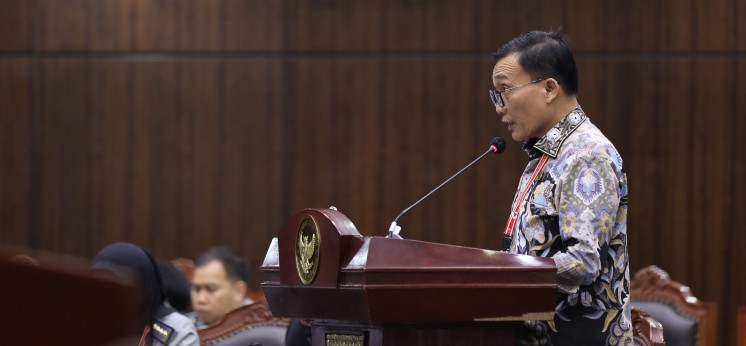
Head of the Education and Training Agency of the Attorney General’s Office Leonard Eben Ezer Simanjuntak testifying on behalf of the Government at the judicial review hearing of Law No. 31 of 1999 on the Eradication of Corruption Crimes, Tuesday (8/12/2025. Photo by MKRI/Ifa.
JAKARTA (MKRI) — The Constitutional Court (MK) continued the judicial review hearing of Article 1 point 1 and Article 6 letter e of Law No. 19 of 2019 on the Second Amendment to Law No. 30 of 2002 on the Corruption Eradication Commission (KPK Law) and Article 21 of Law No. 31 of 1999 on the Eradication of Corruption Crimes (Anti-Corruption Law) on Tuesday, August 12, 2025. The petition for Case No. 106/PUU-XXIII/2025 was filed by Idalorita Daeli (Petitioner I), Haerul Kusuma (Petitioner II), and Andika Firmanta Sitepu (Petitioner III).
The fourth hearing was scheduled to hear the statements of the House of Representatives (DPR), the President/Government, as well as the relevant parties from the Corruption Eradication Commission (KPK), the Police, and the Supreme Court (MA). However, the relevant parties requested a postponement, while the DPR, still in recess, had not yet notified the Court when it would deliver its statement.
Meanwhile, representing the Government, Head of the Education and Training Agency of the Attorney General’s Office Leonard Eben Ezer Simanjuntak explained that efforts to eradicate corruption must be comprehensive, effective, and decisive. Corruption, he stressed, does not stand alone but often involves other criminal acts that serve to conceal or support it. Therefore, law enforcement must not only prosecute the perpetrators of corruption per se, but also those committing related offenses, such as obstruction of investigation, prosecution, or trial.
He emphasized that the provisions in Article 1 point 1 and Article 6 letter e of the KPK Law as well as Chapters II and III of the Anti-Corruption Law are the legal foundation that ensures certainty in combating corruption. For the KPK in particular, these provisions are instrumental in breaking the chain of organized and systemic corruption, addressing corruption within broad networks, preventing impunity for those who obstruct justice, and upholding consistency with the United Nations Convention Against Corruption (UNCAC).
“The phrase ‘Corruption Crimes’ in Article 1 point 1 and Article 6 letter e of Law No. 19 of 2019 must not be narrowly interpreted as limited to Chapter II of the Anti-Corruption Law. Otherwise, this would create a legal vacuum and uncertainty, thereby weakening optimal, professional, and sustainable corruption eradication, the very mandate of Article 43 of the Anti-Corruption Law,” Eben asserted.
Differentiation of Criminal Sanctions
The Government further argued that the existence of Article 1 point 1, the phrase “Corruption Crimes” in Article 6 letter e of the KPK Law, and the phrase “directly or indirectly” in Article 21 of the Anti-Corruption Law do not contradict Article 28D paragraph (1) of the 1945 Constitution. This is because the classification of offenses in the Anti-Corruption Law provides systematic order, legal certainty, and specificity in defining offenses, while differentiating sanctions between corruption itself, such as abuse of authority, bribery, or embezzlement, and related crimes such as obstruction of justice, false testimony, or retaliation against whistleblowers.
Such differentiation, Eben continued, ensures that the eradication of corruption targets not only the principal offenders but also those attempting to obstruct justice. This approach aims to create a deterrent effect and prevent systemic impunity, while also maintaining consistency with the UNCAC, which Indonesia ratified through Law No. 7 of 2006.
“In essence, the provisions being challenged actually reinforce comprehensive, effective, and conclusive efforts against conduct that hinders ongoing legal processes. These norms are not specific to any profession but are general in nature and apply equally to all,” he explained.
“All individuals committing offenses under the Anti-Corruption Law, whether corruption itself or related crimes, are subject to the same procedures and standards of justice. There is no discriminatory or preferential treatment,” Eben affirmed.
For reference, Case No. 106/PUU-XXIII/2025 was filed by Idalorita Daeli, Haerul Kusuma, and Andika Firmanta Sitepu. The Petitioners argued that the provisions under review contradict Article 1 paragraph (3), Article 28D paragraph (1), and Article 28I paragraph (4) of the 1945 Constitution.
At the preliminary hearing on Thursday, July 10, 2025, Idalorita contended that while the KPK is mandated to investigate, prosecute, and adjudicate corruption crimes, it is not explicitly authorized by law to handle other related offenses. Nevertheless, the KPK has acted as though it had such authority.
“The KPK can be said to have unilaterally interpreted Article 1 point 1, Article 1 point 3, and the phrase ‘Corruption Crimes’ in Article 6 letter e of Law No. 19 of 2019. In fact, the KPK considers Article 21 of Law No. 31 of 1999 as part of corruption crimes, even though it is categorized as ‘Other Crimes Related to Corruption,’” said Idalorita, who also works as an advocate.
The Petitioners reiterated that the KPK’s authority should be limited to corruption crimes under Chapter II of the Anti-Corruption Law, which comprises 22 articles (Articles 2–20). They argued that the KPK’s actions constitute abuse of power and set a dangerous precedent that violates the rule of law under Article 1 paragraph (3) of the Constitution.
On these grounds, the Petitioners requested the Court to declare Article 1 point 1 of the KPK Law unconstitutional and not legally binding insofar as it is not interpreted as: “Corruption Crimes are the crimes as referred to in the Chapter entitled CORRUPTION CRIMES in the law on the Eradication of Corruption Crimes.”
They also petitioned the Court to declare the phrase “Corruption Crimes” in Article 6 letter e of the KPK Law unconstitutional and not legally binding unless interpreted as: “Corruption Crimes as referred to in the Chapter entitled CORRUPTION CRIMES in the law on the Eradication of Corruption Crimes.” Likewise, they requested the Court to strike down the phrase “directly or indirectly” in Article 21 of the Anti-Corruption Law.
Author: Sri Pujianti
Editor: N. Rosi
PR: Fauzan
Translator: Yuanna Sisilia
Disclaimer: The original version of the news is in Indonesian. In case of any differences between the English and the Indonesian versions, the Indonesian version will prevail.
Tuesday, August 12, 2025 | 16:38 WIB 382