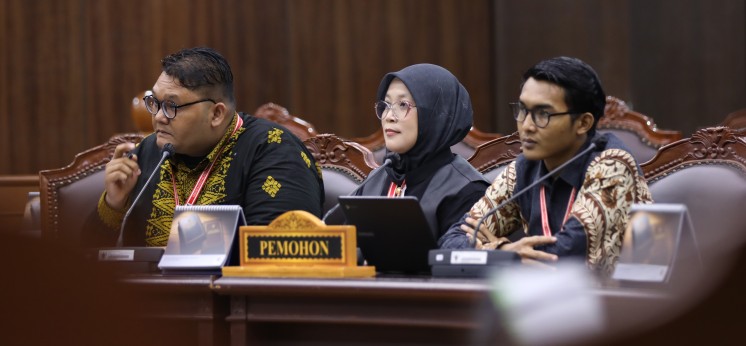
The Petitioners at the preliminary hearing for the judicial review of the Anti-Corruption Law for case No. 106/PUU-XXIII/2025, Thursday (7/10/2025). Photo by MKRI/Ifa.
JAKARTA (MKRI) — Idalorita Daeli, Haerul Kusuma, and Andika Firmanta Sitepu have filed for the material judicial review of Article 1 point 1, Article 1 point 3, and Article 6 letter e of Law No. 19 of 2019 on the Second Amendment to Law No. 30 of 2002 on the Eradication of the Criminal Acts of Corruption and Article 21 of Law No. 31 of 1999 on the Eradication of the Criminal Acts of Corruption to the Constitutional Court (MK). The preliminary hearing for case No. 106/PUU-XXIII/2025 on Thursday, July 10, 2025 in the plenary courtroom was chaired by Chief Justice Suhartoyo.
At the hearing, Daeli argued that the articles are in conflict with Article 1 paragraph (3), Article 28D paragraph (1), Article 28I paragraph (4) of the 1945 Constitution. The Petitioners argued that experts define a state governed by law, there is recognition and guarantee of human rights, and that government institutions—including the Corruption Eradication Commission (KPK)—must carry out their duties and responsibilities based on statutory laws and regulations. This implies that a state governed by law requires limitations on power through legislation that clearly defines the duties and authorities of government institutions, while also establishing boundaries to prevent abuse of power lawfully, explicitly, and specifically assigned by statute.
As a state institution, the KPK is tasked with conducting investigations, inquiries, and prosecutions of corruption crimes. However, it has not been lawfully, specifically, and clearly mandated by statute to act on other crimes falling within this scope that only related to corruption. Nevertheless, it has acted as if it holds lawful authority under statute to pursue such cases.
“The KPK has effectively made a unilateral interpretation of the provisions set out in Article 1 item 1, Article 1 item 3, and the phrase ‘Corruption Crimes’ in Article 6 letter e of Law No. 19 of 2019. In reality, Article 21 of Law No. 31 of 1999 has been treated by the KPK as a corruption crime, even though it actually belongs to the category of Other Crimes Related to Corruption,” explained Daeli, who is also a practicing advocate, representing the Petitioners.
The Petitioners further emphasized that the KPK should only act against corruption crimes regulated under Chapter II on Corruption Crimes, which consists of 22 articles, i.e. Articles 2–20 of Law No. 31 of 1999 as amended by Law No. 20 of 2001. They, this demonstrates an abuse of power, or excess of power, deliberately committed by law enforcement institutions. Such actions are deemed in contradiction with the principle of the rule of law enshrined in Article 1 paragraph (3) of the 1945 Constitution and set a dangerous precedent for law enforcement in Indonesia, and therefore must be stopped.
Based on these arguments, the Petitioners requested the Court to declare that Article 1 point 3 of Law No. 19 of 2019 unconstitutional and not legally binding insofar as it is not interpreted as follows: “The Corruption Eradication Commission, hereinafter referred to as the KPK, shall be a state institution within the executive branch tasked with the prevention and eradication of corruption crimes as set out in the Chapter titled Corruption Crimes in the law governing the eradication of corruption crimes in accordance with this Law.”
They also requested the Court to declare that the phrase “Corruption Crimes” in Article 6 letter e of Law No. 19 of 2019 unconstitutional and not legally binding insofar as it is not interpreted as: “Corruption Crimes as set out in the Chapter titled Corruption Crimes in the law governing the eradication of corruption crimes.” Additionally, they sought the Court’s declaration that the phrase “or indirectly” in Article 21 of Law No. 31 of 1999 unconstitutional and not legally binding.
Legal Standing and Previous Decisions
Offering his advice, Constitutional Justice Daniel Yusmic P. Foekh reminded the Petitioners to carefully consider the Constitutional Court’s previous decisions that examined Article 1 paragraph (3) and Article 6 letter e of the KPK Law. “A new petition must present different grounds for review and different legal arguments; otherwise, it may be rejected. Regarding legal standing, the constitutional loss claimed must be clearly described to convince the panel,” he explained.
Constitutional Justice M. Guntur Hamzah also highlighted the importance of strengthening the Petitioners’ legal standing and explaining the connection between the norms under review and the actual events they experienced. “If [the connection] is lacking, previous petitions may be observed to better understand the essence of legal standing as the entry point to the substance of this case. Elaborate this clearly before the Court as the foundation for examining the petition’s merits,” he concluded.
After the panel offered their advice, Chief Justice Suhartoyo informed the Petitioners that they would have 14 days to revise their petition. The revised petition is to be submitted by Wednesday, July 23, 2025 to the Registrar’s Office. The Court will then schedule the next session to hear the petition’s revisions.
Author : Sri Pujianti
Editor : N. Rosi
PR : Fauzan F.
Translators : Yuniar Widiastuti (NL)
Disclaimer: The original version of the news is in Indonesian. In case of any differences between the English and the Indonesian versions, the Indonesian version will prevail.
Thursday, July 10, 2025 | 15:48 WIB 402