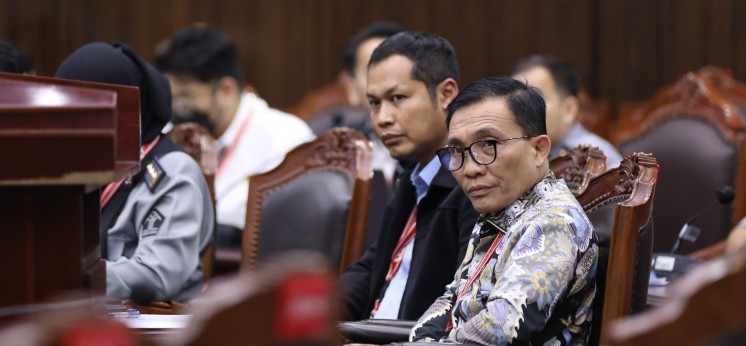
Head of the Prosecutors’ Training Agency Leonard Eben Ezer Simanjuntak representing the government attending the judicial review hearing of Law No. 31 of 1999 on the Eradication of Corruption, Tuesday (8/12/2025). Photo by MKRI/Ifa.
JAKARTA (MKRI) — Head of the Prosecutors’ Training Agency of the Republic of Indonesia Leonard Eben Ezer Simanjuntak asserted that the imposition of punishment for indirect acts remains subject to the principle of culpa (fault) and requires the fulfillment of the element of intent (dolus). He conveyed this statement on behalf of the President/Government at the judicial review hearing of Article 21 and its elucidation of Law No. 31 of 1999 on the Eradication of Corruption (Anti-Corruption Law) as amended by Law No. 20 of 2001 in case No. 71/PUU-XXIII/2025 at the Constitutional Court on Tuesday, August 12, 2025.
“Thus, not every act that appears to ‘obstruct’ may automatically be subject to criminal sanction; it must be proven that there exists criminal intent, knowledge of the ongoing legal process, and a tangible contribution to the obstruction of justice,” Leonard said before the plenary justices.
He continued that this is consistent with the doctrine of obstruction of justice as explained by Kendall, which classifies conduct as obstruction if it results in delaying the judicial process, if the perpetrator is aware of such process, and if the act is carried out corruptly with intent. Such requirements are also recognized in many legal systems, including the Anglo-Saxon tradition.
Leonard further explained that in the United States, for instance, the Supreme Court has ruled that actions such as providing false testimony or misleading statements may only constitute obstruction if there is specific intent to influence an official proceeding, such as a court trial or a grand jury.
Accordingly, even when the act is committed indirectly, the element of obstruction may still be fulfilled as long as a causal nexus with the legal process and intent to interfere can be proven. Such reasoning, he said, is aligned with Article 21 of the Anti-Corruption Law, which underscores the necessity of proving the perpetrator’s intent even when the act is not committed directly.
He noted that in Indonesia, obstruction of justice has become prevalent, creating legal dynamics in law enforcement, particularly in the fight against corruption. He cited the electronic ID card (e-KTP) procurement corruption case involving former DPR Speaker Setya Novanto, where the suspect repeatedly refused summons from the Corruption Eradication Commission (KPK) under the pretext of illness. Later, after forced attempts were made, he evaded KPK officers seeking to arrest him, staging a series of “dramas” in an effort to escape the reach of justice.
Therefore, Leonard emphasized, there is no constitutional issue with the phrase “…or indirectly” in Article 21 of the Anti-Corruption Law, as its formulation already satisfies the three principles of legal norms, lex scripta (written), lex certa (clear), and lex stricta (precise), thus providing legal certainty in substance. The Petitioner’s argument that the phrase lacks a standard of measurement is, according to him, legally groundless.
“The phrase ‘…or indirectly’ in Article 21 of the Anti-Corruption Law is already very clear, namely the element of intent,” he stressed.
Regarding the Petitioner’s concern that the phrase “…or indirectly” in Article 21 threatens the immunity and safety of lawyers in performing their duties, Leonard reminded that Constitutional Court Decision No. 7/PUU-XVI/2018 has affirmed that Article 21 does not eliminate lawyers’ immunity when they act in good faith.
He clarified that such immunity remains valid as long as the actions of lawyers are conducted within the boundaries of law and professional ethics. However, when a lawyer deliberately acts to obstruct the judicial process, including indirectly, they can no longer claim protection under immunity. This underscores that Article 21 of the Anti-Corruption Law does not target professions but rather criminal conduct based on mens rea and evidence.
Previously, advocate Hermawanto had submitted a revision to his petition for the judicial review of Article 21 and its elucidation of the Anti-Corruption Law, as amended by Law No. 20 of 2001. He argued that the provisions in question contravene Article 28D paragraph (1) of the 1945 Constitution.
The Petitioner considered that the phrase “or indirectly” could potentially criminalize citizens expressing public opinion or exercising social control through mass media, seminars, academic discussions, demonstrations, press conferences, and so forth. If such voices were deemed by law enforcement officers, based on subjective judgment as obstructing investigation, prosecution, or trial by indirectly influencing the process, then freedom of expression and the sense of security in a democracy would be at risk.
According to the Petitioner, the scope and degree of “indirect” influence remain highly subjective to law enforcement officers, which is dangerous for civil liberties and could discourage public participation in upholding the law in a democratic society.
This opens the possibility of broad interpretations of Article 21 by law enforcement, potentially leading to repressive practices or even misuse to criminalize certain parties without clear legal basis. Therefore, in his petitum, the Petitioner requested that the Court declare the phrase “or indirectly” in Article 21 and its elucidation unconstitutional and not legally binding.
Author: Mimi Kartika
Editor: Lulu Anjarsari P.
PR: Andhini S. F.
Translator: Yuanna Sisilia
Disclaimer: The original version of the news is in Indonesian. In case of any differences between the English and the Indonesian versions, the Indonesian version will prevail.
Tuesday, August 12, 2025 | 16:37 WIB 156