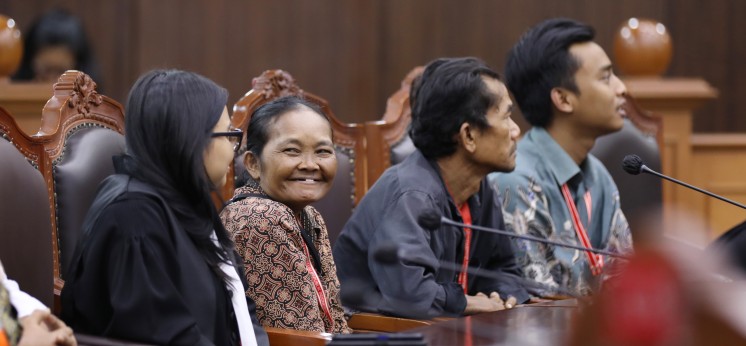
Petitioners attending the Decision Pronouncement Hearing of the material judicial review of Law No. 7 of 2021 on the Harmonization of Taxation Regulations, Thursday (14/8). Photo by MKRI/Ifa.
Jakarta (MKRI) – The Constitutional Court rejects Case No. 11/PUU-XXIII/2025 on the material judicial review of Law No. 7 of 2021 on the Harmonization of Taxation Regulations (HPP Law) on Thursday, August 14, 2025, at the Plenary Courtroom. The Petitioners come from various backgrounds, being housewives, university students, private-sector workers, micro-entrepreneurs, online motorcycle taxi drivers, and mental health organizations.
In its legal considerations delivered by Justice Ridwan Mansyur, the Court declares that the Petitioners questioned the provisions of Article 4A paragraph (2) letter b and paragraph (3) letter a, letter g, and letter j in Article 4 point 1 of Law No. 7 of 2021. The petitioners argued that these provisions do not provide legal certainty and guarantee a decent living due to the difficulty in fulfilling basic necessities, obtaining educational services, medical health services, as well as domestic land, water, and air transportation services that are an inseparable part of international air transportation services because these goods and services are subject to VAT, is an unfounded argument and must be declared legally unfounded.
Petitioners further argued, questioning the determination of the 12% tariff increase as stipulated in the norm of Article 7 paragraph (1) letter b in Article 4 number 2 of Law No. 7 of 2021, which, according to the Petitioners, causes inconsistency among regulations. Regarding this argument, after carefully examining the norm of Article 7 paragraph (1) letter b in Article 4 number 2 of Law No. 7 of 2021 which determines a VAT rate of 11% (eleven percent) effective from April 1, 2022, and 12% (twelve percent) effective no later than January 1, 2025, this constitutes a change from the VAT rate regulation of 10% that has not changed since the enactment of Law No. 8 of 1983. Such a change is necessary to meet the state's financing needs from consistently increasing tax revenues.
The imposition of VAT rates from 5% to 15%, as regulated in the provisions of the article, is a flexible fiscal policy that allows the Government to adjust the rates based on the national economic conditions and the state's fiscal needs while still considering the socio-economic conditions of society. Meanwhile, the determination of VAT rates within the range of 5% to 15%, regulated by Government Regulation, can only be determined by the government after being submitted to the House of Representatives (DPR RI) for discussion and agreement in the preparation of the State Budget Draft (RAPBN). Therefore, the formation of government regulations as a delegation of laws is carried out while still operating within the constitutional function of the DPR because it can still be considered to fulfill the principle of no taxation without representation.
Based on the legal considerations above, the Petitioners’ argument questioning the norm of Article 7 paragraphs (3) and (4) in Article 4 number 2 of Law No. 7 of 2021, which according to the Petitioners does not provide legal certainty and a guarantee of a decent living and therefore contradicts the 1945 Constitution of the Republic of Indonesia, is an unfounded argument and must therefore be declared legally unfounded.
Also read:
VAT Increase Under Scrutiny in Judicial Review
12 Percent VAT Hike Triggers Price Surge
VAT Increase Will Not Affect Basic Necessities, Says Tax Director General
House, Expert Talk VAT Rates at Hearing of HPP Law
Yustinus Prastowo: HPP Law Embodies Equitable Tax Reform
The petition concerns the constitutionality of Article 4A paragraph (2) letter b; Article 4A paragraph (3) letters a, g, and j; and Article 7 paragraphs (1), (3), and (4) of the HPP Law. The Petitioners—who come from various backgrounds, being housewives, university students, private-sector workers, micro-entrepreneurs, online motorcycle taxi drivers, and mental health organizations—argue that these provisions effectively remove staple goods, public healthcare and education services, and public transportation from the list of non-taxable items. The HPP Law also introduces new provisions on VAT rate adjustments and the procedures for implementing such changes.
According to the Petitioners, Article 4A paragraph (2) violates Article 27 paragraph (2) as well as Article 28H paragraphs (1) and (2) of the 1945 Constitution. They contend that the increase to a 12 percent VAT rate has led to price hikes in basic necessities, while citizens’ incomes have remained stagnant or even declined. As a result, people are being forced to reduce the quality of their consumption or can no longer afford the same standard of goods.
In their petitums, the Petitioners request the Court to declare the challenged provisions unconstitutional and not legally binding. The also ask that Article 7 paragraph (3) be declared conditionally constitutional, on the condition that future VAT rate adjustments be based on clear economic, social, and environmental indicators. As for Article 7 paragraph (4), they requested that VAT rate adjustments only be made through statutory laws, not government regulations.
Decision No. 11/PUU-XXIII/2025 in Indonesian
Author : Utami Argawati
Editor : N. Rosi
PR : Raisa Ayuditha Marsaulina
Translators : Rizky Kurnia Chaesario/Yuniar Widiastuti
Disclaimer: The original version of the news is in Indonesian. In case of any differences between the English and the Indonesian versions, the Indonesian version will prevail.
Thursday, August 14, 2025 | 18:05 WIB 440