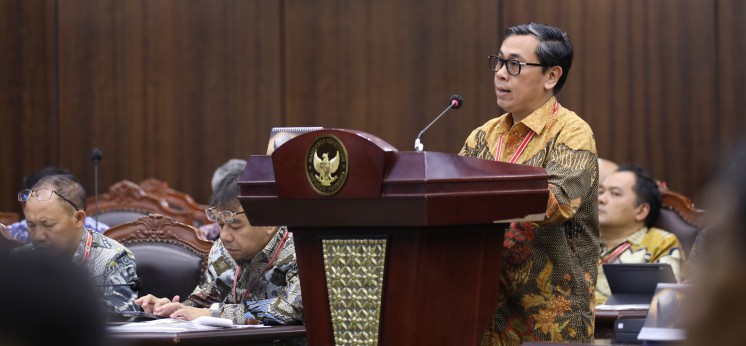
Yustinus Prastowo testifying as an expert for the President at a judicial review hearing of the Law on Harmonization of Taxation Regulations for case No. 11/PUU-XXIII/2025, Tuesday (7/22/2025). Photo by MKRI/Ifa.
JAKARTA (MKRI) — The Constitutional Court (MK) held the another hearing for the material judicial review of Law No. 7 of 2021 on the Harmonization of Taxation Regulations (HPP Law) on Tuesday, July 22, 2025 in the plenary courtroom. The fifth hearing for case No. 11/PUU-XXIII/2025 had been scheduled for the testimony of an expert for the President, Yustinus Prastowo.
He explained that the value added tax (VAT) constitutes a central pillar of Indonesia’s state revenue, contributing 43 percent, or Rp1,014.47 trillion, to total national tax receipts. He emphasized that VAT’s neutral, efficient, and consumption-based characteristics make it a fiscal instrument that aligns with global taxation practices, while also supporting a robust and diversified tax structure.
He also said the HPP Law promotes equitable tax reform through several breakthroughs. These include the gradual increase of the VAT rate (11 percent in 2022 and 12 percent in 2025), the provision of tax facilities for micro, small, and medium enterprises (MSMEs) and low-income individuals, the implementation of in-kind tax, the integration of the national identification number (NIK) with the taxpayer identification number (NPWP), and the introduction of a carbon tax. These reforms, he stated, are designed to uphold the principle of fairness by taking into account the ability to pay while safeguarding the lower-middle income group.
“Law No. 7 of 2021 introduces fair taxation reforms through a phased VAT rate (11 percent in 2022 and 12 percent in 2025), tax facilities for MSMEs and low-income taxpayers, as well as innovations such as in-kind taxation, NIK-NPWP integration, and a carbon tax. These reforms ensure the application of the ability-to-pay principle and protect the lower-middle class,” Prastowo explained before Chief Justice Suhartoyo and the eight other constitutional justices.
He further highlighted the reclassification of strategic goods and services, which were previously exempt from VAT (non-taxable goods/services or non-BKP/JKP), to being subject to VAT with exemption facilities under Article 16B of the HPP Law. He described this move as a way to expand the tax database while ensuring that fiscal incentives remain well-targeted.
“The reclassification of strategic goods and services from non-BKP/JKP under Article 4A to BKP/JKP with VAT exemption under Article 16B ensures that incentives are well-targeted, supports public needs, and expands the tax base to promote both vertical and horizontal equity,” he noted.
Regarding the technical implementation, Prastowo emphasized that Minister of Finance Regulation (PMK) No. 131 of 2024 regulates the alternative tax base (DPP) to ensure that the effective VAT remains at 11 percent for non-luxury goods. Consequently, the 12 percent VAT rate increase applies exclusively to luxury goods. This policy, he argued, is not in conflict with the HPP Law and in fact contributes to economic stability and protects the purchasing power of vulnerable groups.
“PMK No. 131 of 2024 regulates the alternative tax base to ensure that the effective VAT burden remains 11 percent for non-luxury goods, so that the 12 percent increase only applies to luxury goods. This policy supports economic stability and protects lower-income groups without contradicting the HPP Law,” he added.
Nevertheless, Prastowo emphasized that VAT policy must be regularly evaluated to ensure it remains fair, efficient, and responsive to evolving economic conditions. He stressed that VAT facilities should be limited to strategic goods and services that meet broad public needs.
“VAT policy recommendations must be continuously reviewed to ensure fairness, efficiency, and responsiveness to economic dynamics, with VAT facilities reserved only for strategic goods and services essential to the wider population,” he concluded.
Also read:
VAT Increase Under Scrutiny in Judicial Review
12 Percent VAT Hike Triggers Price Surge
VAT Increase Will Not Affect Basic Necessities, Says Tax Director General
House, Expert Talk VAT Rates at Hearing of HPP Law
The petition concerns the constitutionality of Article 4A paragraph (2) letter b; Article 4A paragraph (3) letters a, g, and j; and Article 7 paragraphs (1), (3), and (4) of the HPP Law. The Petitioners—who come from various backgrounds, being housewives, university students, private-sector workers, micro-entrepreneurs, online motorcycle taxi drivers, and mental health organizations—argue that these provisions effectively remove staple goods, public healthcare and education services, and public transportation from the list of non-taxable items. The HPP Law also introduces new provisions on VAT rate adjustments and the procedures for implementing such changes.
According to the Petitioners, Article 4A paragraph (2) violates Article 27 paragraph (2) as well as Article 28H paragraphs (1) and (2) of the 1945 Constitution. They contend that the increase to a 12 percent VAT rate has led to price hikes in basic necessities, while citizens’ incomes have remained stagnant or even declined. As a result, people are being forced to reduce the quality of their consumption or can no longer afford the same standard of goods.
In their petitums, the Petitioners request the Court to declare the challenged provisions unconstitutional and not legally binding. The also ask that Article 7 paragraph (3) be declared conditionally constitutional, on the condition that future VAT rate adjustments be based on clear economic, social, and environmental indicators. As for Article 7 paragraph (4), they requested that VAT rate adjustments only be made through statutory laws, not government regulations.
Read the petition No. 11/PUU-XXIII/2025 here (in Indonesian).
Author : Utami Argawati
Editor : N. Rosi
PR : Raisa Ayuditha Marsaulina
Translators : Yuniar Widiastuti (NL)
Disclaimer: The original version of the news is in Indonesian. In case of any differences between the English and the Indonesian versions, the Indonesian version will prevail.
Tuesday, July 22, 2025 | 15:51 WIB 1091