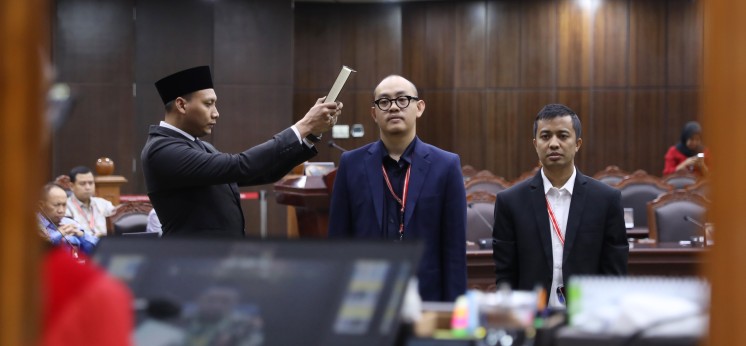
A judicial review hearing of the Law on Harmonization of Taxation Regulations for case No. 1/PUU-XXIII/2025, Wednesday (7/9/2025). Photo by MKRI/Ifa.
JAKARTA (MKRI) — The Constitutional Court (MK) held the another hearing for the material judicial review of Law No. 7 of 2021 on the Harmonization of Taxation Regulations (HPP Law) on Wednesday, July 9, 2025. The hearing had been scheduled for the statements of the House of Representatives (DPR) as well as experts and witnesses for the Petitioners in case No. 11/PUU-XXIII/2025. The Petitioners come from various backgrounds, being housewives, university students, private-sector workers, micro-entrepreneurs, online motorcycle taxi drivers, and mental health organizations.
Before Chief Justice Suhartoyo and the other eight constitutional justices, Abdullah explained on behalf of the House that the HPP Law is part of a consolidative fiscal policy aimed at improving the budget deficit and increasing the tax ratio through administrative reform, broadening the tax base, and strengthening legal certainty and fairness within the tax system.
“Based on the 2025 macroeconomic framework and the 2025 key points of fiscal policy (PPKF) document, Indonesia’s tax ratio is projected to reach only around 10.09 to 10.29 percent of gross domestic product, which remains lower than Thailand at 17.18 percent and Vietnam at 16.21 percent. Increasing the VAT rate to 12 percent is a rational measure to maintain the stability of tax revenues so as not to lag further behind and to ensure the sustainability of state finances,” he explained.
Abdullah further noted that one of the fundamental changes under the HPP Law is the reclassification of goods and services subject to value added tax (VAT). Through the revision of Article 4A and the application of Article 16B of the PPN (VAT) Law, goods such as basic necessities, educational services, healthcare, and public transportation—which were previously excluded from VAT objects—have now been reclassified as taxable goods (BKP) and taxable services (JKP) with the provision on VAT exemptions.
According to the House, VAT relief is granted through three mechanisms: exemption from VAT (Article 4A), VAT not collected, and VAT exempted (Article 16B). Abdullah emphasized that granting VAT exemption should not affect the prices of goods or services, as no VAT is imposed.
Burden on Low-Income Communities
Meanwhile, the Petitioners’ expert, Director of Fiscal Justice at the Center of Economic and Law Studies (Celios) Media Wahyudi Askar argued that an overly complex tax system could reduce taxpayer compliance. He highlighted that the application of Article 16B potentially leads to multiple interpretations and creates opportunities for misuse. In his view, a sound tax system should remain simple to ensure high taxpayer compliance.
“VAT and consumption taxes are imposed on everyone, making them regressive in economic terms. Meanwhile, income tax only applies to individuals with income above a certain threshold. Many studies classify this by showing that roughly 90 percent of society bears the burden of income tax. Ideally, the wealthiest 10 percent should also be subject to capital income tax and wealth taxes. The argument that VAT significantly impacts society is therefore quite valid,” he explained.
Media also stressed that VAT is inherently regressive, as it is imposed uniformly across all income groups, regardless of income level. “In many studies, it is shown that VAT disproportionately burdens low-income groups compared to the wealthy,” he added.
Weakening Purchasing Power
Another expert for the Petitioners, economist and Director at Celios Bhima Yudhistira Adhinegara, noted that raising the VAT rate to 12 percent would further weaken household purchasing power. Based on his calculations, low-income households would face an additional annual burden of up to 1.22 million rupiah due to the VAT increase.
Bhima also pointed out that Indonesia’s economic growth in the first quarter of 2025 reached only 4.87 percent year-on-year, despite coinciding with the Ramadan and Eid al-Fitr periods—reflecting weak domestic demand. He further cited Bank Indonesia data showing a year-on-year decline in individual bank deposits of -1.8 percent as of February 2025 and -3.4 percent as of January 2025.
Moreover, Bhima argued that the VAT rate hike has not positively impacted state revenues. According to the June 2025 edition of APBN Kita, tax revenue realization actually decreased by 10.14 percent year-on-year, amounting to 683.3 trillion rupiah. He believes the core problem in Indonesia’s tax system lies not in the rate itself, but rather in low compliance and weak enforcement. “Without comprehensive administrative tax reform, raising tax rates will only encourage underground economic activities that ultimately harm the state,” he concluded.
Also read:
VAT Increase Under Scrutiny in Judicial Review
12 Percent VAT Hike Triggers Price Surge
VAT Increase Will Not Affect Basic Necessities, Says Tax Director General
The petition concerns the constitutionality of Article 4A paragraph (2) letter b; Article 4A paragraph (3) letters a, g, and j; and Article 7 paragraphs (1), (3), and (4) of the HPP Law. The Petitioners argue that these provisions effectively remove staple goods, public healthcare and education services, and public transportation from the list of non-taxable items. The HPP Law also introduces new provisions on VAT rate adjustments and the procedures for implementing such changes.
According to the Petitioners, Article 4A paragraph (2) violates Article 27 paragraph (2) as well as Article 28H paragraphs (1) and (2) of the 1945 Constitution. They contend that the increase to a 12 percent VAT rate has led to price hikes in basic necessities, while citizens’ incomes have remained stagnant or even declined. As a result, people are being forced to reduce the quality of their consumption or can no longer afford the same standard of goods.
In their petitums, the Petitioners request the Court to declare the challenged provisions unconstitutional and not legally binding. The also ask that Article 7 paragraph (3) be declared conditionally constitutional, on the condition that future VAT rate adjustments be based on clear economic, social, and environmental indicators. As for Article 7 paragraph (4), they requested that VAT rate adjustments only be made through statutory laws, not government regulations.
Read the petition No. 11/PUU-XXIII/2025 here (in Indonesian).
Author : Utami Argawati
Editor : N. Rosi
PR : Raisa Ayuditha Marsaulina
Translators : Yuniar Widiastuti, Yuanna Sisilia (NL)
Disclaimer: The original version of the news is in Indonesian. In case of any differences between the English and the Indonesian versions, the Indonesian version will prevail.
Wednesday, July 09, 2025 | 16:19 WIB 446