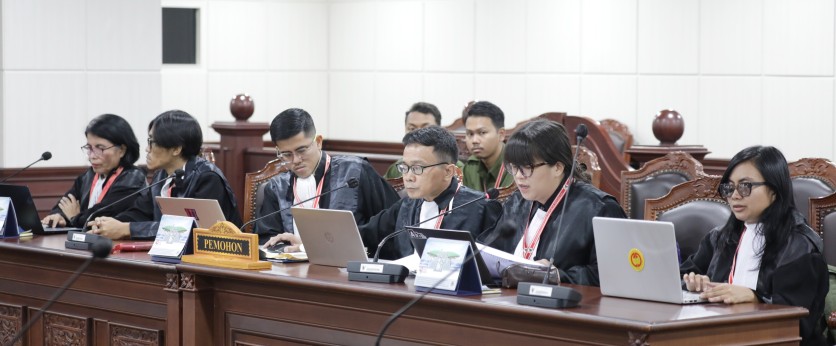
The Petitioners’ legal counsels presenting the main points of the petition at the judicial review hearing of Law No. 7 of 2021 on the Harmonization of Tax Regulations (UU HPP) on Monday (3/10/2025). Photo by MKRI/Panji.
JAKARTA (MKRI) — The Constitutional Court (MK) held a preliminary hearing for the judicial review of Law No. 7 of 2021 on the Harmonization of Tax Regulations (UU HPP) on Monday, March 10, 2025, in the Courtroom. The petitioners in Case No. 11/PUU-XXIII/2025 come from various backgrounds, including housewives, university students, private employees, micro-business owners, online motorcycle taxi drivers, and organizations focused on mental health.
The petitioners challenged the constitutionality of Article 4A paragraph (2) letter b and paragraph (3) letters a, g, and j, as well as Article 7 paragraphs (1), (3), and (4) of the UU HPP. These provisions regulate the removal of essential goods, healthcare services, education, and public transportation from the list of goods and services exempted from Value-Added Tax (VAT). Additionally, the UU HPP has established new provisions on VAT rates and a mechanism for their adjustment.
The petitioners’ legal counsel, Novia Sari, argued that the provisions in Article 4A paragraph (2) of the UU HPP contradict Articles 27 paragraph (2), 28H paragraph (1), and 28H paragraph (2) of the 1945 Constitution. “The VAT increase to 12% on essential goods needed by the public has led to price surges amid stagnant, declining, or even nonexistent incomes. As a result, the petitioners have been forced to lower the quality of their essential goods or are unable to afford goods of the same quality,” Novia stated during the hearing, which was chaired by Constitutional Justice Arief Hidayat.
Furthermore, Novia highlighted the impact of the 12% VAT implementation on various necessities, including fuel prices, which are essential for both online and conventional motorcycle taxi drivers. The cost of internet data for digital sector workers and electricity bills has also increased, further burdening the public.
“The petitioners are also struggling to access clean and healthy living environments due to rising rental costs,” Novia added.
In their petition, the petitioners requested that the Court declare the contested provisions unconstitutional and not legally binding. Specifically for Article 7 paragraph (3) of the UU HPP, the petitioners asked the Court to rule it conditionally constitutional, provided that the VAT rate is determined based on precise economic, social, or environmental indicators. Additionally, they requested that Article 7 paragraph (4) be declared conditionally constitutional, requiring that VAT rate adjustments be made solely through law, not through government regulations.
Responding to the petition, Constitutional Justice Enny Nurbaningsih pointed out the drafting of the petitioners’ legal standing. “Why do you elaborate on the legal standing again in the posita section?” Enny remarked during the hearing.
The panel of justices granted the petitioners 14 days to revise their petition, which must be submitted to the Court no later than Monday, March 24, 2025.
Read the petition No. 11/PUU-XXIII/2025 here (in Indonesian).
Author: Utami Argawati
Editor: N. Rosi
PR: Raisa Ayuditha Marsaulina
Translator: Yuanna Sisilia (NL)
Disclaimer: The original version of the news is in Indonesian. In case of any differences between the English and the Indonesian versions, the Indonesian version will prevail.
Monday, March 10, 2025 | 12:32 WIB 274