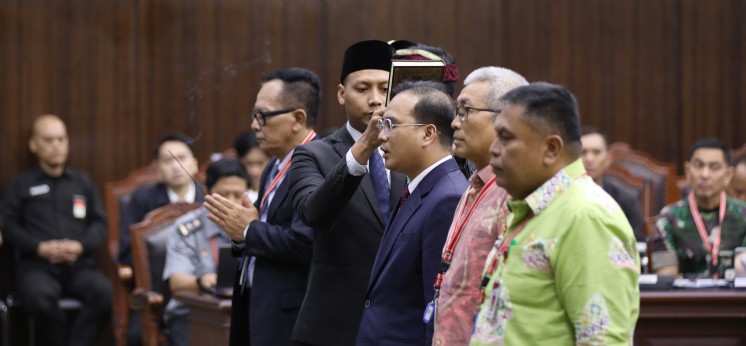
Experts and witnesses for the Government taking oat before testifying for the formal and material judicial review of Law No. 3 of 2025 on the Armed Forces, Monday (7/28/2025). Photo by MKRI/Ifa.
JAKARTA (MKRI) — Law No. 3 of 2025 on the Amendment to Law No. 34 of 2004 on the Indonesian Armed Forces (TNI Law) fulfills the principles of utility and effectiveness from historical, systematic, and teleological perspectives. The original law (Law No. 34 of 2004) has been in effect for over 20 years and is no longer adequate to address the complexity of modern national defense challenges, including geopolitical dynamics, domestic and international security stability, as well as military, non-military, and hybrid threats.
The statement was made by law expert of Borobudur University Ahmad Redi, who was presented by the President/Government as an expert at a hearing for the formal and material judicial review of Law No. 3 of 2025 on the Amendment to Law No. 34 of 2004 on the Indonesian Armed Forces (TNI Law) on Monday, July 28, 2025. This eighth hearing was set for cases No. 56/PUU-XXIII/2025 and No. 75/PUU-XXIII/2025 to hear the President/Government’s experts and witnesses.
The Petitioners for case No. 56/PUU-XXIII/2025 are Muhammad Bagir Shadr, Muhammad Fawwaz Farhan Farabi, and Thariq Qudsi Al Fahd (Petitioners I-III). Meanwhile, the Petitioners of case No. 75/PUU-XXIII/2025 are Muhammad Imam Maulana, Mariana Sri Rahayu Yohana Silaban, Nathan Radot Zudika Parasian Sidabutar, and Ursula Lara Pagitta Tarigan (Petitioners I-IV).
Redi further explained that the revised TNI Law is essential for implementing national sovereignty policies, territorial defense, ensuring the safety of the nation, conducting military operations for war and military operations other than war (MOOTW or OMSP in Indonesian), and contributing actively to global peacekeeping efforts. He added that the Indonesian Armed Forces (TNI) must be developed professionally in alignment with the state’s political interests, democratic values and principles, civilian supremacy, human rights, and both national and ratified international legal norms, all supported by a transparently and accountably managed state budget.
“These matters are clearly reflected in the substance of the TNI Law. When viewed objectively and in light of historical, systematic, and teleological considerations, the TNI Law satisfies the principle of utility and effectiveness,” he explained.
Redi asserted that the requirement for compliance with the principle of clarity in formulation can be evaluated based on the Elucidation to Article 5 letter f of the Lawmaking Law. Every piece of legislation must meet the technical requirements of legislative drafting, including structure, choice of terms, and the use of clear and comprehensible legal language to avoid multiple interpretations in its implementation.
“In my expert opinion, the TNI Law meets the technical requirements for legislative drafting. The normative construction of each article, paragraph, letter, and number is consistent with the guidelines set forth in Annex II of the Lawmaking Law. This includes a clear structure, terminology, and legal language. For example, Article 53 of the TNI Law meets the criteria for clarity in word choice and legal language,” he explained.
Discussion on Military Operations Other Than War
Meanwhile, international relations and diplomacy advisor for the National Resilience Institute (Lemhannas) Edy Prasetyono provided testimony regarding his involvement in the legislative process of Law No. 3 of 2025. He stated that he had served as a speaker during a focus group discussion (FGD) on July 11, 2024 at Borobudur Hotel in Jakarta, as well as in several other meetings and forums.
Edy recounted that the topic of MOOTW had been raised by the Democratic Party’s parliamentary faction in 2015. At that time, there were no ambiguities or blurred boundaries regarding MOOTW. The TNI could be deployed in special circumstances that other institutions could not handle. MOOTW by the TNI could even include deterrence. The discussion later extended to the use of the TNI in counter-terrorism operations. Edy attended the meeting alongside University of Indonesia (UI) law associate professor Ali Wibisono. During that period, many inquiries arose about the legitimacy of involving the TNI in counter-terrorism as part of MOOTW.
“At the time, I asserted that military force could indeed be deployed to counter terrorism, as practiced by many other countries. The main issue lies in how the state defines and determines the degrees of threats and the appropriate instruments to deploy in response,” Edy said before the constitutional justices.
In 2019, Edy was invited as a speaker in discussions on retirement age at the Ministry of Defense. Then in 2024, he again served as a speaker during retirement age discussions at the Center for Strategic Studies (Pusjianstra), alongside Rear Admiral Kresno Buntoro. That same year, another discussion took place at Borobudur Hotel on extending retirement age and assigning TNI personnel to posts outside the military institution. Edy was present at the event alongside fellow UI law professor Hikmahanto Juwana and another speaker from the NGO Imparsial.
“I emphasized the fundamental values that must underpin the philosophical basis for amending the TNI Law: identity, values, democracy, professionalism, and the need to develop a robust defense posture. I also outlined the requirements for placing TNI personnel in non-military positions and considerations surrounding retirement age policies, including the possibility of extending them,” Edy concluded.
Also read:
Students Question Army Law’s Lack of Public Participation and Abuse of Power
Students Revise Legal Arguments for Formal and Material Petition of Army Law
Govt, House: Army Law’s Formation Involved the Public
Expert Highlights Pressure on Petitioners of Army Law
Expert, Witness: New Army Law Lacked Deliberation and Public Oversight
Fast-Track Legislation Unrelated to Army Law’s Constitutionality
At the preliminary hearing on Friday, May 9, the Petitioners of case No. 56/PUU-XXIII/2025 argued that the elucidation to the Law stated that the Armed Forces (TNI) is the main force in the defense and security of the people. It is tasked with defending, protecting, and maintaining the integrity and sovereignty of the country, so it is necessary to strengthen it to perform its tasks and functions. They further argued that in order to support the optimal implementation of its tasks and functions, certain ministries/institutions may involve soldiers in accordance with their specificities. This is what the Petitioners question. The legislature, they asserted, has not provided a logical correlation between the connection between the state’s integrity and sovereignty and the Army’s involvement in certain ministries/institutions, as well as for the increase of the retirement age of Army personnel.
They cited the principle of clarity of purpose based on the National Law Development Agency’s (BPHN) Guidelines for Evaluation of Legislation No. PHN-HN. 01.03-07. The parameters of clarity of purpose in the effectiveness of the legislation include ratio of burdens and benefits, institutional/organizational coordination, and access to public information. Therefore, the Petitioners believe the drafting of the TNI Law did not demonstrate the effectiveness of legislation, so it does not meet the indicators for clarity of purpose as mandated by the Lawmaking Law.
The formation of the TNI Law, they argued, used the ends-means approach that characterizes autocratic regimes. It was formed very hastily and excluded public participation. Instead, it became a means to achieve the goal of extending the retirement age of high-ranking officers. In addition, the poor quality of the academic paper and the receipt of public feedback has drawn public backlash.
Meanwhile, the Petitioners of case No. 75/PUU-XXIII/2025 believe the formation of the Law was against Article 1 paragraphs (2) and (3), Article 22A, and Article 28D of the 1945 Constitution and disregarded the principles of the effective lawmaking.
They stressed that effective lawmaking is not limited to the formality in all stages, but must also include public participation as the mandate of popular sovereignty. However, the formation of the TNI Law did not allow for public participation, which would have meant upholding popular sovereignty and preventing arbitrariness in the lawmaking process.
On that basis, the Petitioners requested that the Court declare the formation of Law No. 3 of 2025 contrary to the lawmaking provisions in the 1945 Constitution and has no binding legal force; and declare the provisions in Law No. 34 of 2004 on the Indonesian National Armed Forces that have been amended or revoked by the provisions of Law No. 3 of 2025 remain in effect.
Author : Sri Pujianti
Editor : Lulu Anjarsari P.
PR : Raisa Ayuditha M.
Translator : Yuniar Widiastuti (NL)
Disclaimer: The original version of the news is in Indonesian. In case of any differences between the English and the Indonesian versions, the Indonesian version will prevail.
Monday, July 28, 2025 | 15:21 WIB 1459