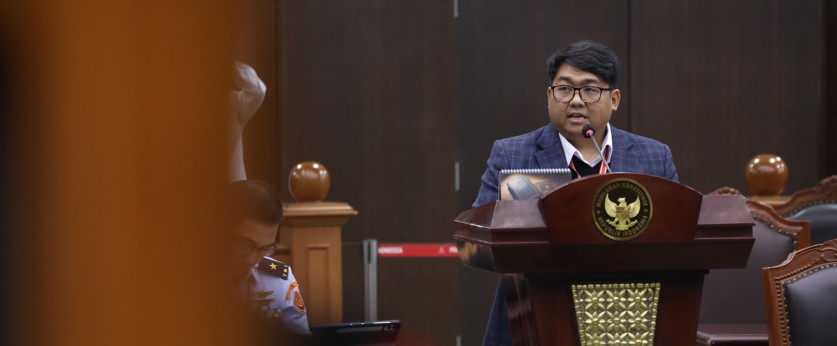
Ibnu Sina Chandranegara testifying as an expert for the House for the formal and material judicial review of Law No. 3 of 2025 on the Armed Forces to hear the House’s experts, Monday (7/21/2025). Photo by MKRI/Panji.
JAKARTA (MKRI) — Indonesia does not have a fast-track legislation mechanism, nor has it developed an official or analogous concept of such a framework. In the absence of a legal structure regulating or adopting the concept of fast-track legislation—as is generally recognized in the legislative systems of certain other countries—there is no objective time-based standard by which the passage of a law in Indonesia can be classified as having occurred through a fast-track procedure.
“The need for a formal regulation on fast-track procedures that could serve as a basis to justify whether a law may be legitimately passed through an expedited process is a separate issue and does not constitute a constitutional matter in the case a quo,” said law professor Ibnu Sina Chandranegara, who was presented by the House of Representatives (DPR) as an expert at a formal and material judicial review hearing of Law No. 3 of 2025 on the Amendment to Law No. 34 of 2004 on the Indonesian Armed Forces (TNI Law) on Monday, July 21, 2025. This seventh hearing was set for cases No. 56/PUU-XXIII/2025 and No. 75/PUU-XXIII/2025 to hear the House’s experts.
In his statement, Ibnu explained that, conceptually, the issuance of a government regulation in lieu of law (perppu) in Indonesia is the closest existing mechanism to fast-track legislation, although by nature it aligns more closely with the model of constitutional decree authority. He further explained that a fast-track mechanism may only be said to exist if the legislative stages it applies to—such as planning, drafting, deliberation, enactment, and promulgation—are clearly defined. Therefore, each stage or the entire legislative process must be subject to both maximum and minimum time limits. Without such regulation, a fast-track mechanism cannot be considered legally applicable.
Ibnu added that a fast-track mechanism must also be accompanied by specific criteria, including the justification for its use, the identity of the authorized initiator, the procedures for submitting a fast-track motion, and the timeframe within which the legislative counterparts must respond to the motion. In the absence of these established standards, the possibility of passing a law through a “fast-track” process remains unregulated rather than prohibited. Accordingly, a formal framework for fast-track legislation should be developed, potentially replacing the current reliance on the perppu mechanism.
“As a result, labeling a law as being enacted hastily or instantly becomes a legal-political reality. However, there remains no statutory provision that defines the timeframe for drafting and passing a law. The TNI Law and its amendments do not specify any definitive deadline for completing a bill once it has been included in the National Legislative Program (Prolegnas). Thus, the practice that is alleged to have employed a fast-track process lacks clear legal standing as long as the fast-track mechanism is not legally defined in terms of when and how it may be applied,” Ibnu explained at the plenary hearing before Chief Justice Suhartoyo and the other constitutional justices.
Differences in Academic Paper
Meanwhile, Faisal Santiago, another expert presented by the House, stated in his testimony that under legislative theory, an academic paper (naskah akademik, or NA) essentially serves to present the results of scientific research that form the basis for the proposed content of a bill submitted to and deliberated by the House. The paper also functions as a guide for lawmakers in formulating and determining the substantive content appropriate for inclusion in legislation.
Thus, any difference in regulatory substance between the academic paper and the enacted law is permissible and does not render the legislative process unconstitutional. Legislative theory also holds that high-quality legislation can be achieved when drafters prioritize the integrity of the drafting process itself, rather than insisting on strict conformity between the academic paper and the final statute.
“The factors that cause a law to be inconsistent with the 1945 Constitution of the Republic of Indonesia are not rooted in discrepancies between the academic paper and the enacted statute. Rather, they stem from the lack of professionalism among the human resources involved in lawmaking, the highly elitist and interest-driven nature of the process, and further exacerbated by weak inter-sectoral coordination in drafting legislative content,” Santiago stated.
Also read:
Students Question Army Law’s Lack of Public Participation and Abuse of Power
Students Revise Legal Arguments for Formal and Material Petition of Army Law
Govt, House: Army Law’s Formation Involved the Public
Expert Highlights Pressure on Petitioners of Army Law
Expert, Witness: New Army Law Lacked Deliberation and Public Oversight
The Petitioners for case No. 56/PUU-XXIII/2025 are Muhammad Bagir Shadr, Muhammad Fawwaz Farhan Farabi, and Thariq Qudsi Al Fahd (Petitioners I-III). Meanwhile, the Petitioners of case No. 75/PUU-XXIII/2025 are Muhammad Imam Maulana, Mariana Sri Rahayu Yohana Silaban, Nathan Radot Zudika Parasian Sidabutar, and Ursula Lara Pagitta Tarigan (Petitioners I-IV).
At the preliminary hearing on Friday, May 9, the Petitioners of case No. 56/PUU-XXIII/2025 argued that the elucidation to the Law stated that the Armed Forces (TNI) is the main force in the defense and security of the people. It is tasked with defending, protecting, and maintaining the integrity and sovereignty of the country, so it is necessary to strengthen it to perform its tasks and functions. They further argued that in order to support the optimal implementation of its tasks and functions, certain ministries/institutions may involve soldiers in accordance with their specificities. This is what the Petitioners question. The legislature, they asserted, has not provided a logical correlation between the connection between the state’s integrity and sovereignty and the Army’s involvement in certain ministries/institutions, as well as for the increase of the retirement age of Army personnel.
They cited the principle of clarity of purpose based on the National Law Development Agency’s (BPHN) Guidelines for Evaluation of Legislation No. PHN-HN. 01.03-07. The parameters of clarity of purpose in the effectiveness of the legislation include ratio of burdens and benefits, institutional/organizational coordination, and access to public information. Therefore, the Petitioners believe the drafting of the TNI Law did not demonstrate the effectiveness of legislation, so it does not meet the indicators for clarity of purpose as mandated by the Lawmaking Law.
The formation of the TNI Law, they argued, used the ends-means approach that characterizes autocratic regimes. It was formed very hastily and excluded public participation. Instead, it became a means to achieve the goal of extending the retirement age of high-ranking officers. In addition, the poor quality of the academic paper and the receipt of public feedback has drawn public backlash.
Meanwhile, the Petitioners of case No. 75/PUU-XXIII/2025 believe the formation of the Law was against Article 1 paragraphs (2) and (3), Article 22A, and Article 28D of the 1945 Constitution and disregarded the principles of the effective lawmaking.
They stressed that effective lawmaking is not limited to the formality in all stages, but must also include public participation as the mandate of popular sovereignty. However, the formation of the TNI Law did not allow for public participation, which would have meant upholding popular sovereignty and preventing arbitrariness in the lawmaking process.
On that basis, the Petitioners requested that the Court declare the formation of Law No. 3 of 2025 contrary to the lawmaking provisions in the 1945 Constitution and has no binding legal force; and declare the provisions in Law No. 34 of 2004 on the Indonesian National Armed Forces that have been amended or revoked by the provisions of Law No. 3 of 2025 remain in effect.
Author : Sri Pujianti
Editor : Lulu Anjarsari P.
PR : Raisa Ayuditha M.
Translator : Yuniar Widiastuti (NL)
Disclaimer: The original version of the news is in Indonesian. In case of any differences between the English and the Indonesian versions, the Indonesian version will prevail.
Monday, July 21, 2025 | 14:33 WIB 304