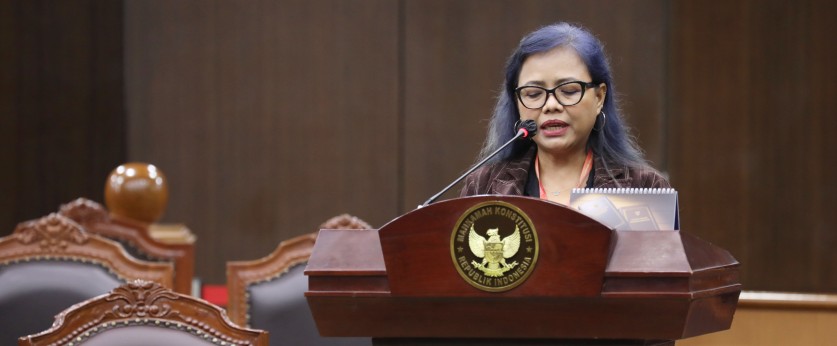
Lecturer at the Jentera School of Law Bivitri Susanti highlighting the legislative process at a formal and material judicial review hearing of Law No. 3 of 2025 on the Armed Forces, Tuesday (7/1/2025). Photo by MKRI/Panji.
JAKARTA (MKRI) — Lecturer at the Jentera School of Law Bivitri Susanti highlighted concerns regarding the legislative process of Law No. 3 of 2025 on the Amendment to Law No. 34 of 2004 on the Indonesian Armed Forces (TNI Law). She argued that the legislative process in Indonesia reflects the concept of “autocratic legalism,” as described by Javier Corrales, who noted that the law is twisted to serve the interests of those in power.
Bivitri appeared before the Court on Tuesday, July 1, 2025 as an expert for the Petitioners of case No. 56/PUU-XXIII/2025. At the fourth formal and material judicial review hearing for cases No. 56/PUU-XXIII/2025 and No. 75/PUU-XXIII/2025, the Court heard the testimonies of experts and witnesses for the Petitioners of case No. 56/PUU-XXIII/2025.
“Corrales describes this in the context of the ‘executive branch,’ but within Indonesia’s multiparty presidential system, we must understand it in light of how executive power has extended its reach into the House of Representatives (DPR) through excessively large coalitions, thereby undermining the legislature’s ability to oversee the executive. Meanwhile, under the 1945 Constitution, the lawmakers consist not only of the legislature but also the president and the House,” Bivitri said before Deputy Chief Justice Saldi Isra and the other constitutional justices.
Pressure on Petitioners
Bivitri further explained that, ultimately, the power to “check” or oversee the executive and legislative branches remains only within the judiciary—specifically the Constitutional Court—as the last branch of power, in line with Montesquieu’s theory of separation of powers. She added that another pillar of democracy that functions as oversight is the citizens themselves—the public within a republic—who have brought this case to the Constitutional Court. However, in a country experiencing democratic backsliding, the power of public oversight has also been diminished. “From the pressure faced by these students as Petitioners to labeling NGOs as foreign agents,” Bivitri remarked.
When protests arise, she continued, the narrative offered is always: “If you’re dissatisfied, bring it to the Constitutional Court.” While constitutionally correct, this narrative illustrates a legislative paradigm that sees the lawmaking process as something that can be conducted arbitrarily, leaving the Court merely as an institution for correction.
Meanwhile, when the Court exercises its constitutional duties, complaints arise from the House, such as: “After all our hard work in making the law, the Constitutional Court cancels it.” Just recently, there were even calls from one political party to “correct” the Court through their constitutional authority. According to Bivitri, this reflects a mindset among lawmakers that they do not wish to be subject to oversight. “This is a clear marker of authoritarian tendencies, because democracy requires accountability to citizens,” she explained.
Furthermore, Bivitri emphasized that restoring the concept of legis within a state governed by law means the legislative process itself must not be treated lightly. Legislation is the product of policy or political decision-making that must be accountable. It should not consist merely of empty provisions serving the whims of those in power; it must also contain a ratio legis—a rational justification.
“That is why the role of academic papers, which serve as the basis for drafting a law and as a guide to decide ‘what legislation should be proposed today,’ becomes crucial as a parameter of legitimacy in the legislative process,” Bivitri clarified.
Role of Academic Papers
In the context of reviewing the TNI Law, Bivitri elaborated on the role of academic papers as the foundation for a legal policy product. The term “academic paper” has become a legal term under Law No. 12 of 2011 on Lawmaking. However, this has led to two common misconceptions: first, that the academic paper is merely a document required for formality; and second, that it can only be prepared by academics or approached solely from an academic perspective.
“The first appendix to the law already provides detailed guidelines on the format of the academic papers, so that lawmakers can prepare one as required. Yet in practice, the paper is often drafted merely to fulfill procedural requirements, even if its content does not reflect the norms ultimately incorporated into the law,” Bivitri explained.
As a policy paper, an academic paper should not merely follow the prescribed outline in the appendix of Law No. 12 of 2011; it must, at a minimum, meet three substantive criteria showing its connection to the norms contained in the draft bill. This connection can be seen in how its contents relate to the provisions proposed in the draft bill.
While political negotiations and public consultations may later introduce differences between the initial academic paper and the draft bill, Bivitri added that the paper must always be prepared before the draft bill is created—not added afterward simply to tick a procedural checklist. Finally, she stressed the importance of publication: the academic paper should be made public alongside the draft bill’s release.
Legislative Priorities
Bivitri also addressed the need for clear legislative priorities as a measure of legitimacy. She explained that the legislative process must include justification linking current societal issues to the laws intended to address them. Although it is not easy in practice to determine precisely what legislation society needs, a legal framework already exists.
She acknowledged that, so far, legislative priorities have been determined through a procedure linked to development and budget planning, resulting in a national legislative program (prolegnas), which is then broken down into annual priorities. Despite criticisms of this paradigm, legislative priorities are typically aligned with the government’s political agenda, reflected in the medium-term development plan (RPJM) based on the president’s vision and mission. Within the logic of a presidential system, this is acceptable; the problem, however, is that these priorities are still often violated.
“The loophole that allows bills not included in the annual priorities to enter the process lies in the exception set out in Article 23 of Law No. 12 of 2011. The justification provided by lawmakers in this case was Constitutional Court Decision No. 62/PUU-XIX/2021 and the ‘carry over’ mechanism from the previous House. Yet, the elucidation to Law No. 12 of 2011 does not specify what kind of Constitutional Court ruling can justify placing a bill into the cumulative open category. Logically, only bills whose content is directly ordered by the Court should qualify. Decision No. 62/PUU-XIX/2021, issued on March 8, 2022, did indeed instruct lawmakers to discuss the revision of the TNI Law, as it had already been included in the prolegnas at that time,” Bivitri concluded.
Also read:
Students Question Army Law’s Lack of Public Participation and Abuse of Power
Students Revise Legal Arguments for Formal and Material Petition of Army Law
Govt, House: Army Law’s Formation Involved the Public
The Petitioners for case No. 56/PUU-XXIII/2025 are Muhammad Bagir Shadr, Muhammad Fawwaz Farhan Farabi, and Thariq Qudsi Al Fahd (Petitioners I-III). Meanwhile, the Petitioners of case No. 75/PUU-XXIII/2025 are Muhammad Imam Maulana, Mariana Sri Rahayu Yohana Silaban, Nathan Radot Zudika Parasian Sidabutar, and Ursula Lara Pagitta Tarigan (Petitioners I-IV).
At the preliminary hearing on Friday, May 9, the Petitioners of case No. 56/PUU-XXIII/2025 argued that the elucidation to the Law stated that the Armed Forces (TNI) is the main force in the defense and security of the people. It is tasked with defending, protecting, and maintaining the integrity and sovereignty of the country, so it is necessary to strengthen it to perform its tasks and functions. They further argued that in order to support the optimal implementation of its tasks and functions, certain ministries/institutions may involve soldiers in accordance with their specificities. This is what the Petitioners question. The legislature, they asserted, has not provided a logical correlation between the connection between the state’s integrity and sovereignty and the Army’s involvement in certain ministries/institutions, as well as for the increase of the retirement age of Army personnel.
They cited the principle of clarity of purpose based on the National Law Development Agency’s (BPHN) Guidelines for Evaluation of Legislation No. PHN-HN. 01.03-07. The parameters of clarity of purpose in the effectiveness of the legislation include ratio of burdens and benefits, institutional/organizational coordination, and access to public information. Therefore, the Petitioners believe the drafting of the TNI Law did not demonstrate the effectiveness of legislation, so it does not meet the indicators for clarity of purpose as mandated by the Lawmaking Law.
The formation of the TNI Law, they argued, used the ends-means approach that characterizes autocratic regimes. It was formed very hastily and excluded public participation. Instead, it became a means to achieve the goal of extending the retirement age of high-ranking officers. In addition, the poor quality of the academic paper and the receipt of public feedback has drawn public backlash.
Meanwhile, the Petitioners of case No. 75/PUU-XXIII/2025 believe the formation of the Law was against Article 1 paragraphs (2) and (3), Article 22A, and Article 28D of the 1945 Constitution and disregarded the principles of the effective lawmaking.
They stressed that effective lawmaking is not limited to the formality in all stages, but must also include public participation as the mandate of popular sovereignty. However, the formation of the TNI Law did not allow for public participation, which would have meant upholding popular sovereignty and preventing arbitrariness in the lawmaking process.
On that basis, the Petitioners requested that the Court declare the formation of Law No. 3 of 2025 contrary to the lawmaking provisions in the 1945 Constitution and has no binding legal force; and declare the provisions in Law No. 34 of 2004 on the Indonesian National Armed Forces that have been amended or revoked by the provisions of Law No. 3 of 2025 remain in effect.
Author : Sri Pujianti
Editor : Lulu Anjarsari P.
PR : Raisa Ayuditha M.
Translator : Yuniar Widiastuti (NL)
Disclaimer: The original version of the news is in Indonesian. In case of any differences between the English and the Indonesian versions, the Indonesian version will prevail.
Tuesday, July 01, 2025 | 14:08 WIB 198