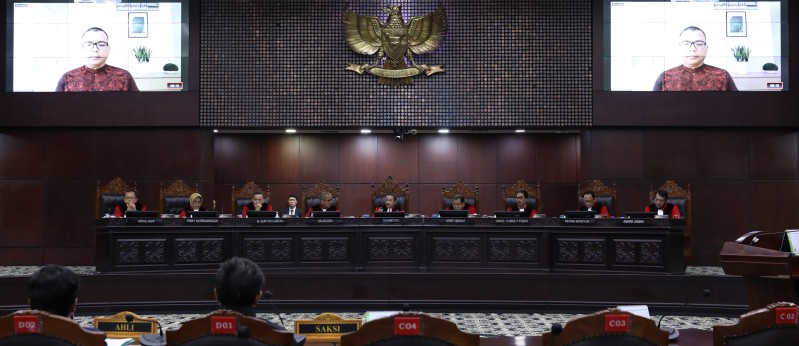
Another hearing for the formal and material judicial review of Law No. 3 of 2025 on the Armed Forces to hear the Petitioners’ expert and witness, Monday (7/7/2025). Photo by MKRI/Ifa.
JAKARTA (MKRI) — In the process of amending the Law on the Indonesian National Armed Forces (TNI Law), which is highly significant and strategic, there should have been dynamic and substantive debates and deliberations among political parties and parliamentary factions. It is a matter of concern and suspicion when a legislative act concerning the military has failed to generate such dynamic debate. If all political parties reached an agreement without substantive debate throughout all stages of discussion, this indicates that internal checks and balances were not functioning as they should have.
The statement was made by Denny Indrayana as an expert for the Petitioners of case No. 75/PUU-XXIII/2025 at the fifth hearing for the formal and material judicial review of Law No. 3 of 2025 on the Amendment to Law No. 34 of 2004 on the Indonesian Armed Forces (TNI Law) on Monday, July 7, 2025. The hearing was set for cases No. 56/PUU-XXIII/2025 and No. 75/PUU-XXIII/2025 to hear the expert and witness for the latter.
Previously, Denny explained that, based on Indonesia’s constitutional and legislative procedures, there are indicators that can be used to assess whether the legislative process of a law has complied with procedural rules. These include internal and external checks and balances. Internal control derives from the dynamics within parliament itself, while external oversight comes from inputs and critical scrutiny from outside parliament. The more robust these checks and balances, the more meaningful the legislative process.
He also stressed the importance of accessing the official transcripts of meetings at every stage of discussion in the House of Representatives (DPR), including those of the Steering Committee (Bamus), Legislative Committee (Baleg), and other relevant bodies involved in deliberating the amendment to the TNI Law.
“Without deliberative and substantive discussions among all parliamentary stakeholders, there was effectively no meaningful oversight in the deliberation of this amendment to the TNI Law. Such a situation constitutes a violation of the principles of the rule of law and popular sovereignty. Once again, every legislative deliberation—especially one related to the military—should naturally involve sharp and profound clashes and debates of interests,” Denny explained at the hearing, which he attended virtually.
Furthermore, meaningful public participation, or the presence of a strong and independent Constitutional Court, is an essential external control in the lawmaking process. With respect to the Court’s role as guardian of the Constitution and democracy, its independence and sense of justice are again being tested in assessing whether the process of amending the TNI Law was genuinely meaningful or merely symbolic. Indicators of meaningful participation include ease of access, process transparency, and adequate public awareness.
“The question is: how easily could the public obtain the academic paper and draft law? How transparent and accessible was the House’s deliberative process to the public? And how many Indonesians knew about, or even understood, the process of amending the TNI Law in question? If the answers to these three questions are positive, it means public participation was relatively ensured; otherwise, it was lacking,” he elaborated.
Lack of Public Access
Meanwhile, Amnesty International Indonesia’s executive director Usman Hamid, as a witness for the Petitioners in case No. 75/PUU-XXIII/2025, highlighted the lack of public access to the official draft. He explained that the controversy began when President Prabowo Subianto sent a presidential letter (Surpres) on February 18, 2025 to the House regarding the revision of the TNI Law No. 34/2004. The debate over the bill proceeded without the availability of an official draft accessible to the public, even after a month, including on the House’s official website, until it was eventually passed.
The coalition observed that the draft amendment to the TNI Law was a continuation of the House’s initiative submitted on May 28 of the previous year. Based on a version of the draft that had circulated at that time, the coalition criticized the expanded role of the military envisioned in the revision—from occupying civilian government positions to assuming law enforcement and internal security roles traditionally reserved for the police. Besides undermining civilian supremacy, this would also compromise the professionalism of the TNI as the state’s defense force and effectively revive the military’s dual function.
“The draft kept changing because it was still under discussion. If it is challenged based on a different version of the law, why were we not provided with the correct draft? Instead, we received just a few pages showing only three amended articles…. During that meeting, it was clear there was no academic paper, no complete draft law, let alone an inventory of issues,” Usman recounted, describing his dialogue at the House when questioning the lack of public participation in the process of amending the TNI Law.
Also read:
Students Question Army Law’s Lack of Public Participation and Abuse of Power
Students Revise Legal Arguments for Formal and Material Petition of Army Law
Govt, House: Army Law’s Formation Involved the Public
Expert Highlights Pressure on Petitioners of Army Law
The Petitioners for case No. 56/PUU-XXIII/2025 are Muhammad Bagir Shadr, Muhammad Fawwaz Farhan Farabi, and Thariq Qudsi Al Fahd (Petitioners I-III). Meanwhile, the Petitioners of case No. 75/PUU-XXIII/2025 are Muhammad Imam Maulana, Mariana Sri Rahayu Yohana Silaban, Nathan Radot Zudika Parasian Sidabutar, and Ursula Lara Pagitta Tarigan (Petitioners I-IV).
At the preliminary hearing on Friday, May 9, the Petitioners of case No. 56/PUU-XXIII/2025 argued that the elucidation to the Law stated that the Armed Forces (TNI) is the main force in the defense and security of the people. It is tasked with defending, protecting, and maintaining the integrity and sovereignty of the country, so it is necessary to strengthen it to perform its tasks and functions. They further argued that in order to support the optimal implementation of its tasks and functions, certain ministries/institutions may involve soldiers in accordance with their specificities. This is what the Petitioners question. The legislature, they asserted, has not provided a logical correlation between the connection between the state’s integrity and sovereignty and the Army’s involvement in certain ministries/institutions, as well as for the increase of the retirement age of Army personnel.
They cited the principle of clarity of purpose based on the National Law Development Agency’s (BPHN) Guidelines for Evaluation of Legislation No. PHN-HN. 01.03-07. The parameters of clarity of purpose in the effectiveness of the legislation include ratio of burdens and benefits, institutional/organizational coordination, and access to public information. Therefore, the Petitioners believe the drafting of the TNI Law did not demonstrate the effectiveness of legislation, so it does not meet the indicators for clarity of purpose as mandated by the Lawmaking Law.
The formation of the TNI Law, they argued, used the ends-means approach that characterizes autocratic regimes. It was formed very hastily and excluded public participation. Instead, it became a means to achieve the goal of extending the retirement age of high-ranking officers. In addition, the poor quality of the academic paper and the receipt of public feedback has drawn public backlash.
Meanwhile, the Petitioners of case No. 75/PUU-XXIII/2025 believe the formation of the Law was against Article 1 paragraphs (2) and (3), Article 22A, and Article 28D of the 1945 Constitution and disregarded the principles of the effective lawmaking.
They stressed that effective lawmaking is not limited to the formality in all stages, but must also include public participation as the mandate of popular sovereignty. However, the formation of the TNI Law did not allow for public participation, which would have meant upholding popular sovereignty and preventing arbitrariness in the lawmaking process.
On that basis, the Petitioners requested that the Court declare the formation of Law No. 3 of 2025 contrary to the lawmaking provisions in the 1945 Constitution and has no binding legal force; and declare the provisions in Law No. 34 of 2004 on the Indonesian National Armed Forces that have been amended or revoked by the provisions of Law No. 3 of 2025 remain in effect.
Author : Sri Pujianti
Editor : Lulu Anjarsari P.
PR : Raisa Ayuditha M.
Translator : Yuniar Widiastuti (NL)
Disclaimer: The original version of the news is in Indonesian. In case of any differences between the English and the Indonesian versions, the Indonesian version will prevail.
Monday, July 07, 2025 | 12:52 WIB 1100