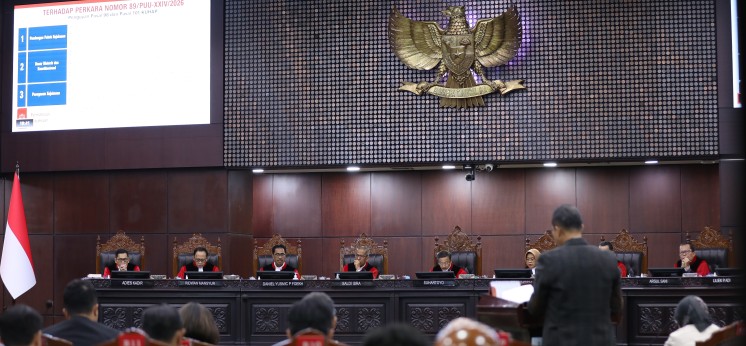
Resumed hearing in the judicial review of Law No. 20 of 2025 on the Criminal Procedure Code to hear testimony from the Attorney General’s Office as a related party on Wednesday (08/07) in the Courtroom. Photo by MKRI/Ifa.
Jakarta (MKRI) - Didik Farkhan Alisyahdi, Deputy Attorney General’s Secretary for Special Crimes at the Attorney General’s Office, stated that protection for judges may be maintained to safeguard the independence of the judicial function. However, such protection must not apply to conduct outside the exercise of judicial functions, particularly in cases involving corruption, special crimes, crimes against state security, or crimes punishable by severe penalties. Accordingly, if Article 8 paragraph (5) of Law on the Attorney General’s Office is limited so that it does not apply in cases of sting operations or certain criminal offenses, then Articles 98 and 101 of Law Number 20 of 2025 on the KUHAP should be construed within the same limitations.
The statement was delivered by the Attorney General’s Office during the seventh hearing on the judicial review of the KUHAP on Wednesday, July 8, 2026. Petition No. 89/PUU-XXIV/2026 was filed by Martin Maurer (Petitioner I) and Leonardo Olefins Hamonangan (Petitioner II).
Didik further stated that the argument asserting judges require protection to preserve judicial independence cannot serve as a basis for granting broader immunity than that afforded to other law enforcement officials. As reflected in the principles established by the Constitutional Court in Decision No. 15/PUU-XXIII/2025, judicial independence must be balanced with criminal accountability, which must continue to operate even in cases involving sting operations or in cases with sufficient preliminary evidence of a serious criminal offense.
“Accordingly, the constitutional interpretation of Articles 98 and 101 of the KUHAP must follow the same limiting approach so as not to create an official privilege that is inconsistent with the rule of law. Judicial independence must be protected insofar as it concerns the freedom to examine, adjudicate, deliberate upon, and decide cases. However, such independence cannot be invoked to shield judges suspected of corruption, bribery, gratuities, gifts, promises, or abuse of office from legal proceedings. Such conduct does not form part of the independent exercise of judicial functions but instead constitutes a deviation from those functions that undermines the dignity of and public trust in the judiciary,” Didik explained.
Functional Protection Mechanism
The Attorney General’s Office further expressed its views on the requirement to obtain the Chief Justice of the Supreme Court's approval before legal action may be taken against a judge. According to the Office, such a requirement may be regarded as constitutional if it is framed as a mechanism to protect the judicial function. The mechanism ensures that legal action against judges is not taken as a result of pressure, intimidation, or dissatisfaction with judicial decisions. Nevertheless, it must not become an absolute requirement that obstructs criminal law enforcement.
Didik explained that the mechanism must be subject to certain limitations in order to comply with the rule of law. First, approval should not be required for sting operations, as law enforcement in such circumstances must be immediate and objective. Second, approval should not be used to prevent legal proceedings where there is sufficient preliminary evidence of serious crimes, special crimes, corruption offenses, crimes punishable by severe penalties, or crimes against state security. Third, if the approval mechanism is maintained, a clear timeframe must be established within which the Chief Justice of the Supreme Court must grant or deny approval. Fourth, any refusal of approval must be based on objective and accountable reasons.
“Accordingly, the a quo provisions can only be maintained insofar as they are conditionally construed as an instrument of functional protection for judges, rather than as absolute immunity. Such an interpretation preserves consistency with Article 17 of Law Number 14 of 1985 on the Supreme Court, Article 26 of Law Number 8 of 2004, Article 6 paragraph (3) of Law Number 8 of 2011, the principle of judicial independence, and the need for effective law enforcement,” Didik emphasized.
Also read:
Supreme Court Chief Justice’s Approval to Arrest, Detain Judges Challenged Again
Petitioners in Criminal Procedure Code Case Strengthen Legal Standing
DPR: Arrest and Detention of Judges Based on Supreme Court Chief Justice Permission Uphold Judiciary Independence
Removing Permission Mechanism from Supreme Court Chief Justice May Lead to Judges’ Criminalization
Supreme Court Talks “Judicial Immunity” Necessary to Protect Judges
KPK Explains Sting Operations on Judges
During the preliminary hearing on Monday, March 9, 2026, the Petitioners argued that Articles 98 and 101 of the Criminal Procedure Code are inconsistent with the 1945 Constitution. Martin explained that arrest and detention are two of the nine forms of coercive measures regulated in the KUHAP. Coercive measures, in essence, constitute legal actions that restrict an individual’s freedom, not because of the position that person has, and must be based on objective and subjective requirements that serve as benchmarks for determining whether such actions are appropriate.
According to the Petitioners, an exception granted solely to judges could potentially create discriminatory treatment toward other law enforcement officials. Logically, Maurer continued, this raises the question of why such special treatment applies only to judges, while other professions also perform law enforcement functions—including prosecutors, the police, and advocates, insofar as they are positioned as law enforcement institutions or organs. Consequently, this situation potentially contradicts the guarantee of fair legal certainty as stipulated in Article 28D paragraph (1) of the 1945 Constitution.
In addition, the Petitioners believe that the phrases “arrest shall be based on the permission of the Chief Justice of the Supreme Court” and “detention shall be based on the permission of the Chief Justice of the Supreme Court” in the provisions do not provide equal opportunities to obtain legal guarantees and adequate legal protection due to the different treatment of citizens holding public office.
Case tracking: Petition No. 89/PUU-XXIV/2026 (in Indonesian).
Author : Sri Pujianti
Editor : Lulu Anjarsari P.
PR : Andhini S. F.
Translator : Rizky Kurnia Chaesario/Yuniar Widiastuti (NL)
Disclaimer: The original version of the news is in Indonesian. In case of any differences between the English and the Indonesian versions, the Indonesian version will prevail.
Wednesday, July 08, 2026 | 14:42 WIB 52