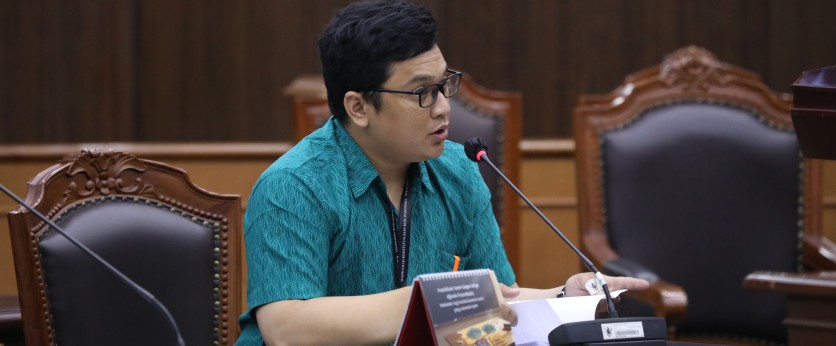
Petitioner Martin Maurer delivering the revised petition on the judicial review of the Criminal Procedure Code on Wednesday (1/4). Photo by MKRI/Panji.
Jakarta (MKRI) - Chief Justice Suhartoyo again chaired a hearing in the judicial review of Law No. 20 of 2025 on the Criminal Procedure Code (KUHAP) on Wednesday, April 1, 2026. Petitioners Martin Maurer (Petitioner I) and Leonardo Olefins Hamonangan (Petitioner II) appeared at the hearing of Case No. 89/PUU-XXIV/2026, which was scheduled to hear the main points of their revised petition.
At the session, the Petitioners informed the Court that they had revised their petition by adding a third Petitioner and elaborating on his legal standing as a legal practitioner who is a prospective advocate, having been formally sworn in at the High Court in January 2026 and actively serving as a judge-mediator at the Central Jakarta District Court.
“The constitutional right of Petitioner III to obtain fair legal protection is harmed by the phrase ‘arrest and detention of a judge shall be based on the permission of the Chief Justice of the Supreme Court,’ which could specifically and potentially affect him when he exercises his authority while assisting clients. This bureaucratic requirement for institutional permission will, in rational terms, cause delay and thus undermine Petitioner III’s power to help expedite criminal proceedings in a swift, simple, and low-cost manner, and may create room for obstruction of investigation,” Martin Maurer said, outlining the key revisions.
In their revised petitum, the Petitioners ask the Court to declare Articles 98 and 101 of the Criminal Procedure Code unconstitutional and without binding legal force.
Also read:
Supreme Court Chief Justice’s Approval to Arrest, Detain Judges Challenged Again
During the preliminary hearing on Monday, March 9, 2026, the Petitioners argued that Articles 98 and 101 of the Criminal Procedure Code are inconsistent with the 1945 Constitution. Martin explained that arrest and detention are two of the nine forms of coercive measures regulated in the KUHAP. Coercive measures, in essence, constitute legal actions that restrict an individual’s freedom, not because of the position that person has, and must be based on objective and subjective requirements that serve as benchmarks for determining whether such actions are appropriate.
According to the Petitioners, an exception granted solely to judges could potentially create discriminatory treatment toward other law enforcement officials. Logically, Maurer continued, this raises the question of why such special treatment applies only to judges, while other professions also perform law enforcement functions—including prosecutors, the police, and advocates, insofar as they are positioned as law enforcement institutions or organs. Consequently, this situation potentially contradicts the guarantee of fair legal certainty as stipulated in Article 28D paragraph (1) of the 1945 Constitution.
In addition, the Petitioners believe that the phrases “arrest shall be based on the permission of the Chief Justice of the Supreme Court” and “detention shall be based on the permission of the Chief Justice of the Supreme Court” in the provisions do not provide equal opportunities to obtain legal guarantees and adequate legal protection due to the different treatment of citizens holding public office.
Case tracking: Petition No. 89/PUU-XXIV/2026 (in Indonesian).
Author : Sri Pujianti
Editor : Lulu Anjarsari P.
PR : Andhini S. F.
Translator : Rizky Kurnia Chaesario/Yuniar Widiastuti (NL)
Disclaimer: The original version of the news is in Indonesian. In case of any differences between the English and the Indonesian versions, the Indonesian version will prevail.
Wednesday, April 01, 2026 | 15:07 WIB 74