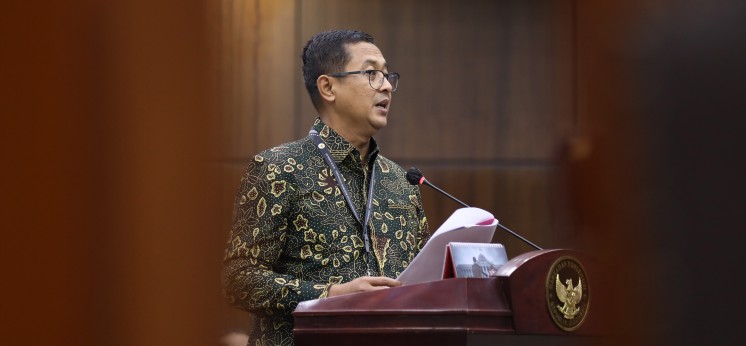
Director of Corruption Detection and Analysis, Iskandar Marwanto, representing KPK to deliver a testimony during a continued hearing on the judicial review hearing of Law No. 20 of 2025 on the Criminal Procedure Code on Wednesday (24/06) at the Courtroom. Photo by MKRI/Ifa
Jakarta (MKRI) – The Constitutional Court (MK) held another material review hearing of Law No. 20 of 2025 on the Criminal Procedure Code (KUHAP) on Wednesday, June 24, 2026. The fifth hearing of Case No. 89/PUU-XXIV/2026, filed by Martin Maurer (Petitioner I) and Leonardo Olefins Hamonangan (Petitioner II), was scheduled to receive testimony from related parties, including the Supreme Court, the National Police, the Attorney General’s Office, and the Corruption Eradication Commission. However, the Attorney General’s Office was not ready to deliver its testimony.
The Supreme Court, in its statement delivered by Adji Prakoso, Judicial Judge at the Supreme Court's Bureau of Law and Public Relations, explained that Articles 98 and 101 of the Criminal Procedure Code (KUHAP) are philosophically necessary to protect judges in the performance of their duties. Under the KUHAP, the judicial immunity provisions essentially require prior approval from the Chief Justice of the Supreme Court before a judge may be arrested or detained, except when the judge is caught in the act, is suspected of committing a crime punishable by death, or is suspected of committing a crime against state security.
"The purpose of these provisions is fundamentally to ensure that judges are protected, in carrying out their duties, from attempts by parties to interfere with judicial independence, including by institutions exercising investigative or prosecutorial functions that have the authority to carry out coercive measures in the form of arrest or detention," Adji explained from the Plenary Courtroom.
He further stated that Articles 98 and 101 of the KUHAP are essentially intended to establish an institutional oversight mechanism before law enforcement authorities may take coercive measures against judges. The provisions do not obstruct the law enforcement process but merely add a requirement for authorization from the Chief Justice of the Supreme Court. From a sociological perspective, the mechanism serves several principal purposes, including preventing the criminalization of judges, maintaining the stability of the judiciary, and ensuring due process of law.
"Accordingly, from a sociological perspective, the protections afforded to judges under Articles 98 and 101 of the KUHAP should not be understood merely as a form of privilege for judges, but rather as part of the institutional design of the criminal justice system aimed at safeguarding the independence and integrity of the judiciary," Adji stated.
Institutional Protection Mechanism
Meanwhile, in a statement submitted by the Indonesian National Police, Veris Septiansyah, Head of the Legal Assistance Bureau of the Legal Division, stated that the requirement for approval from the Chief Justice of the Supreme Court before a judge may be arrested or detained is fundamentally intended as an institutional protection mechanism for judicial independence and the independence of the judicial branch.
The mechanism, Veris continued, should be understood as an effort to prevent the criminalization of, pressure on, or interference with judges in the performance of their judicial functions. Nevertheless, the authorization requirement must not be construed as granting impunity, legal immunity, or exemption from criminal liability where a judge is suspected of committing a criminal offense.
"Accordingly, the provisions governing authorization for the arrest and detention of judges must be applied proportionately. On the one hand, they serve to protect judicial independence from unlawful interference. On the other hand, they must not impede the principle of equality before the law, the effectiveness of law enforcement, or investigators' authority in cases involving judges caught in the act or criminal offenses unrelated to the exercise of judicial functions. Therefore, striking a balance between protecting judicial independence and upholding the principle of equality before the law constitutes an important basis for assessing the constitutionality of the a quo provisions," Veris explained.
Reducing the Effectiveness of Criminal Law Enforcement
Iskandar Marwanto, Director of Corruption Detection and Analysis representing the Corruption Eradication Commission (KPK), then explained that, from a legal perspective, the requirement for prior authorization under Articles 98 and 101 of the KUHAP may reduce the effectiveness of criminal law enforcement. In sting operations, Iskandar continued, law enforcement often requires immediate and urgent action. This is because certain interests require protection, including preventing information leaks and the potential destruction or loss of evidence. Even if the authorization process were conducted efficiently and swiftly through a digital application, it would not eliminate the risk of information leaks that could allow suspects to flee before being apprehended.
"Referring to the Constitutional Court's considerations in Decision No. 15/PUU-XXIV/2025, it should be noted that legal protection concerning the arrest and detention of judges must be applied within reasonable and measurable limits and must not be absolute. Absolute and unlimited legal protection would instead hinder the law enforcement process and weaken the principle of equality before the law," Iskandar said.
Also read:
Supreme Court Chief Justice’s Approval to Arrest, Detain Judges Challenged Again
Petitioners in Criminal Procedure Code Case Strengthen Legal Standing
DPR: Arrest and Detention of Judges Based on Supreme Court Chief Justice Permission Uphold Judiciary Independence
Removing Permission Mechanism from Supreme Court Chief Justice May Lead to Judges’ Criminalization
During the preliminary hearing on Monday, March 9, 2026, the Petitioners argued that Articles 98 and 101 of the Criminal Procedure Code are inconsistent with the 1945 Constitution. Martin explained that arrest and detention are two of the nine forms of coercive measures regulated in the KUHAP. Coercive measures, in essence, constitute legal actions that restrict an individual’s freedom, not because of the position that person has, and must be based on objective and subjective requirements that serve as benchmarks for determining whether such actions are appropriate.
According to the Petitioners, an exception granted solely to judges could potentially create discriminatory treatment toward other law enforcement officials. Logically, Maurer continued, this raises the question of why such special treatment applies only to judges, while other professions also perform law enforcement functions—including prosecutors, the police, and advocates, insofar as they are positioned as law enforcement institutions or organs. Consequently, this situation potentially contradicts the guarantee of fair legal certainty as stipulated in Article 28D paragraph (1) of the 1945 Constitution.
In addition, the Petitioners believe that the phrases “arrest shall be based on the permission of the Chief Justice of the Supreme Court” and “detention shall be based on the permission of the Chief Justice of the Supreme Court” in the provisions do not provide equal opportunities to obtain legal guarantees and adequate legal protection due to the different treatment of citizens holding public office.
Case tracking: Petition No. 89/PUU-XXIV/2026 (in Indonesian).
Author : Sri Pujianti
Editor : Lulu Anjarsari P.
PR : Andhini S. F.
Translator : Rizky Kurnia Chaesario/Yuniar Widiastuti (NL)
Disclaimer: The original version of the news is in Indonesian. In case of any differences between the English and the Indonesian versions, the Indonesian version will prevail.
Wednesday, June 24, 2026 | 14:06 WIB 42