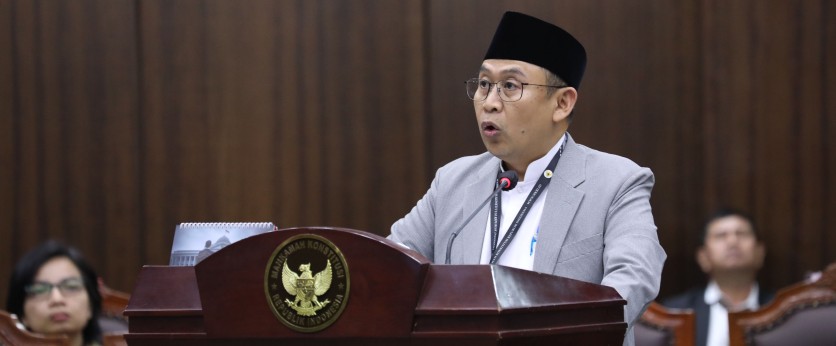
Chairman of Majelis Masyayikh, KH Abdul Ghaffar Rozin (Gus Rozin), delivering his testimony as a related party during the judicial review hearing of Law No. 18 of 2019 on Pesantren at the Plenary Courtroom on Wednesday (3/6). Photo by MKRI/Panji.
Jakarta (MKRI) – The Constitutional Court (MK) resumed the material review hearing of Article 48 paragraphs (2) and (3) of Law No. 18 of 2019 on Pesantren (Islamic Boarding School) on Wednesday, June 3, 2026. The fourth hearing of the case filed by Muh Adam Arrofiu Arfah (Petitioner I) and Isfa’zia Ulhaq (Petitioner II) was scheduled to hear testimony from the related parties: the Majelis Masyayikh and the Muhammadiyah Central Board.
Chairman of Majelis Masyayikh KH Abdul Ghaffar Rozin (Gus Rozin) explained that the use of the word “assist” in Article 48 paragraphs (2) and (3) of the Pesantren Law may lower the state’s constitutional responsibility degree towards pesantren. The phrase may be understood as if the funding for pesantren is voluntary or only serves as a temporary policy.
“It is because nowadays, most assistance for pesantren is in the form of limited affirmative programs, based on proposal, incidental, and has yet to integrate them as funding to improve the quality of sustainable and continuous national education. Whereas pesantren carries out educational functions, which constitutionally is part of the state’s responsibility,” explained Gus Rozin.
Unequal Treatment
He further stated that the norm-setting regarding funding under Article 48 paragraph (2) of the Pesantren Law clearly results in unequal treatment between regular educational institutions and the pesantren. The disparity directly violates citizens’ constitutional rights to be free from discrimination, as strictly guaranteed in Article 28I paragraph (2) of the 1945 Constitution. It is the case that regular education and pesantren, in essence, are organized on the same philosophy and carry out parallel constitutional missions to educate the life of the nation, as mandated by the fourth paragraph of the Preamble to the 1945 Constitution. Pesantren has proven, historically and factually, to be an important pillar shaping the nation’s future generations long before the Republic of Indonesia was established.
Majelis Masyayikh holds that the state should not differentiate between the responsibility to fund pesantren and other educational institutions that carry out educational functions. It is because, if pesantren is acknowledged as an integral part of the national education system and substantially implements the national education goals as referred to in Article 31 of the 1945 Constitution, then funding for pesantren should be considered part of the state’s obligations.
“If the funding for pesantren is only regarded as 'assistance' which is facultative and not imperative, there is a risk that the aspect of quality assurance in pesantren education will be neglected. The lack of funding support will directly affect pesantren education quality, including in terms of human resources, facilities and infrastructure, curriculum development, institutional strengthening, and development of science and technology,” Gus Rozin argued.
Pesantren Funding Policy
Chairman of the Pesantren Development Agency (LP2) of the Muhammadiyah Central Board (PP Muhammadiyah), Maskuri, argued that the pesantren funding policy must be established on several principles: equality before the law, transparency and accountability, just distribution, non-politicization, and equality among religious education institutions.
Maskuri mentioned that the principle of equality before the law in the context of the state’s funding for pesantren means that every pesantren that has fulfilled the administrative and substantive requirements under statutory law must have the same opportunity to receive government assistance or funding. It must be conducted without regard to organizational affiliation, mazhab, group, region, social status, or close ties to certain officials. Every pesantren that has met administrative requirements must have the same opportunity to receive funding without discrimination.
The next principle is transparency and accountability, in the form of the state’s obligation to establish a funding record system, verification, and distribution that are open, measurable, and publicly monitorable. Transparency and accountability in the distribution of pesantren funds are a constitutional mandate and an implementation of good governance. Transparency requires the government to make information on all processes for the distribution of assistance public, while accountability requires that every use of public funds be subject to legal and administrative oversight.
In practice, Maskuri added, the two principles are important to ensure that the state’s assistance is provided based on objective needs and criteria rather than political closeness, social influence, or other non-legal factors. Therefore, pesantren assistance can serve the function as an instrument for equitable access to education and social justice.
Moreover, there must be a principle of allocation and distributive justice, meaning that the funding must not be enjoyed only by certain groups but must reach all pesantrens proportionally, based on the state’s needs and capacity. If funding can only be distributed to large, well-known pesantren, while small pesantren that have greater needs struggle to access assistance, it risks violating the principle of distributive justice.
Subsequently, the principle of non-politization ensures that pesantren funding must not be used as a political tool or a means of cooptation against religious education institutions. The last principle concerns equality between religious education institutions. The state must also give proportionate attention to religious education for other faiths in order to ensure the principles of equality and justice among followers of different religions in Indonesia, a country founded on belief in the One Almighty God but not a theocratic state.
“PP Muhammadiyah views that the norm on pesantren funding as stipulated in Article 48 paragraphs (2) and (3) of Law No. 18 of 2019 on Pesantren, Pesantren Law, must be interpreted constitutionally that ‘Pesantren funding is the state’s obligation in the framework of the national education funding which implementation is conducted in a just, objective, transparent and accountable manner and equal to all pesantrens that met the objective requirement based on the state’s financial capacity.’ The constitutional interpretation is essential to prevent discrimination in budget distribution, provide right certainty to all registered pesantren, ensure the legal certainty for pesantren, ensure the implementation of social justice principles, and strengthen pesantren as an integral part of the national education system,” explained Maskuri during the plenary session led by Chief Justice Suhartoyo along with other Constitutional Justices.
Also read:
Petition on Pesantren Law Highlights 20 Percent Education Budget Mandate
Petitioners Expand Arguments in Judicial Review of Pesantren Law
DPR and Govt Clarify Pesantren Education Funding
The petition in Case No. 75/PUU-XXIV/2026 was filed by two students of Nahdlatul Ulama Indonesia University (UNUSIA), Muh Adam Arrofiu Arfah (Petitioner I) and Isfa’zia Ulhaq (Petitioner II). Muh Adam Arrofiu Arfah is also a student of Pondok Pesantren Pendawa, while Isfa’zia Ulhaq is an alumnus of Pondok Pesantren Al-Majidiyah Sumedang.
Article 48 paragraph (2) of the Pesantren Law provides that “the Central Government shall assist in funding the administration of pesantren through the state budget in accordance with the State’s financial capacity and statutory regulations.” Article 48 paragraph (3) states that “Regional Governments shall assist in funding the administration of pesantren through regional budgets in accordance with their authority and statutory regulations.”
During the preliminary hearing on Friday, February 27, 2026, Muh Adam Arrofiu Arfah argued that the constitutionally mandated minimum of 20 percent of the state budget for education is, in practice, split into operational spending and an accumulating education endowment reserved for long-term development such as scholarships, capacity building, and research.
He stressed that the endowment is not meant to finance day-to-day pesantren operations, including teachers’ salaries, students’ basic needs, or routine learning activities, so an endowment for pesantren cannot be treated as full compliance with the state’s constitutional duty to fund education.
Adam further argued that rising education budgets over the years show that the phrases “in accordance with the state’s financial capacity” and “in accordance with their authority” are not objective constraints, pointing out that the state clearly has substantial fiscal room, including for large priority programs such as the Free Nutritious Meals (MBG) scheme, which will reach trillions of rupiah in 2026.
“When the state can pour enormous funds into certain programs yet still does not provide definite operational guarantees for pesantren, there is a strong indication that the phrases in the article in question are no longer rational or proportionate in today’s fiscal context,” Adam told the Court.
The Petitioners therefore question the constitutionality of the phrases tying pesantren funding to “the state’s financial capacity” and to governmental “authority,” arguing that they risk undermining the certainty of education funding guarantees mandated by Article 31 paragraph (4) of the 1945 Constitution.
Case tracking: Petition No. 75/PUU-XXIV/2026
Author: Sri Pujianti
Editor: N. Rosi.
Translator: Rizky Kurnia Chaesario
Disclaimer: The original version of the news is in Indonesian. In case of any differences between the English and the Indonesian versions, the Indonesian version will prevail.
Wednesday, June 03, 2026 | 16:47 WIB 9