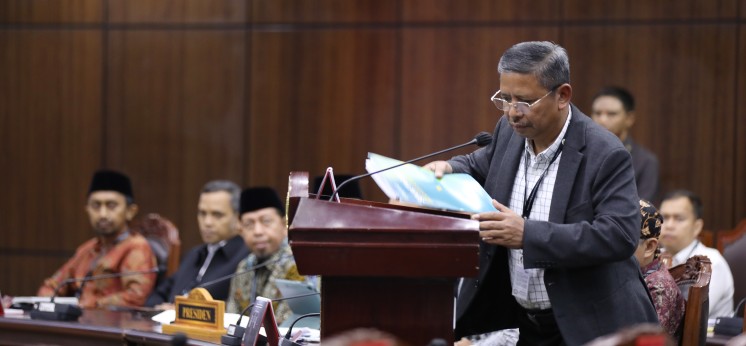
Representing the government, Suyitno from the Directorate General of Islamic Education, delivering his testimony during the resumed hearing on the judicial review of Law No. 18 of 2019 on Pesantren, Wednesday (06/05) at the Courtroom. Photo by MKRI/Ifa.
Jakarta (MKRI) – Pesantren Salafiyah is not categorized as a mandatory educational unit organizer. However, the central and local governments have the obligation to support the funding of such organizations based on the needs, authorities, and the state’s financial capabilities.
These statements were delivered by Suyitno from the Directorate General of Islamic Education during the material review hearing of Article 48 paragraphs (2) and (3) of Law No. 18 of 2019 on Pesantren (Pesantren Law) on Wednesday, May 6, 2026, at the Constitutional Court (MK), Jakarta. The third hearing of Case No. 75/PUU-XXIV/2026 filed by Muh Adam Arrofiu Arfah (Petitioner I) and Isfa’zia Ulhaq (Petitioner II) was scheduled to hear testimony from the People’s Representative Council (DPR) and the President/government.
The government is of the opinion that the pesantren education unit where the Petitioners study is an educational unit that organizes pesantren education in the study of At-Turats (Kitab Kuning). It is a non-formal education under the Equivalent School of Pondok Pesantren Salafiyah (PKPPS). Pesantren Salafiyah has a distinct curriculum and learning methods, and autonomous, independent management, focusing on Islamic religious studies and not obliged to teach general knowledge. It is a form of complementary education. Therefore, it is not considered the organizer of basic mandatory education. For this reason, the Petitioners do not suffer any loss from the enactment of Article 48 paragraphs (2) and (3) of the Pesantren Law.
“Related to the Petitioners’ argument on the constitutional obligation to guarantee educational funding for society-based education units, including pesantren, which is connected to Constitutional Court reasoning in Decision No. 3/PUU-XXII/2024, it is inaccurate. Considering this, in the context of mandatory education, Pesantren Salafiyah has a different function and capacity compared to other mandatory education units as provided by statutory laws,” explained Suyitno in the Plenary Courtroom presided over by Chief Justice Suhartoyo, alongside Deputy Chief Justice Saldi Isra and seven other Justices.
The government also further asserted that pesantren, as a society-based unit, is funded mainly by the society. The government is to support funding from several sources, including the state budget and the pesantren endowment fund.
Support for Pesantren
The government also contributes to improving the quality of pesantren education, including the Petitioners' informal education unit, by rehabilitating the dormitory in 2021 and 2024. This shows that the government is consistently fulfilling its constitutional obligations to ensure the quality of pesantren.
Suyitno added that the government uses the state budget to support the pesantren based on their needs, as mentioned in the proposal. Support cannot be provided without considering the needs, including technical and administrative aspects, as well as eligibility. These aspects need to be considered to maintain the principles of state budget management, which demand accountability, transparency, and good administration, so that implementation can be held accountable.
Presidential Regulation No. 82 of 2021 on Pesantren Funding was issued to strengthen funding for pesantrens. It is to optimize funding for pesantren to support their educational, teaching, and society-empowerment functions, and open the opportunity for pesantren to receive funding for their operations from various sources based on specific parameters.
The state’s acknowledgment of Pesantren is clear and certain through the Pesantren Law. It serves as evidence that the state supports pesantren in all its activities, in accordance with its functions, especially its educational function, which is an integral part of the national education system.
“Moreover, the state also guarantees the specialty, tradition, and independence of pesantren so that it can be well maintained, and there is no formal intervention or the obligation for pesantren to adhere to certain formal standards that bind the pesantren, which will disturb the order and fundamental principles of the pesantren,” Suyitno explained.
State’s Acknowledgment and Affirmation
Suyitno said that the right to education, as guaranteed by Article 31 of the 1945 Constitution, primarily guarantees access, opportunity, and the sustainability of the national education system. It is not a constitutional guarantee of a specific funding model, the amount of the budget, or an absolute funding obligation for every educational unit. The 1945 Constitution does not require that all educational units, including pesantren, receive permanent, absolute funding from the state, regardless of the state’s fiscal capacity.
The government asserted that the phrase “based on the state’s financial capacity” in Article 48 of the Pesantren Law is not a means of reducing the state’s responsibility, but a manifestation of constitutional principles in the management of a healthy, rational, and sustainable state budget. The existence of the Pesantren Law is a form of acknowledgment and affirmation by the state of Pesantren as an integral part of the national education system, which previously lacked a specific regulatory basis.
“The funding regulations in Article 48 of Law No. 18 of 2019 provide a clear legal basis for the central and local governments to facilitate funding for pesantren, so that the Petitioners’ argument stating that there is no clear guarantee of funding is not aligned with the norm itself,” Suyitno explained.
Pesantren Source of Funding
The DPR testimony was delivered by one of its members, Abdullah, who stated that pesantren is an example of an organization fully owned by society, from its educational inputs, processes, and outputs to funding. Within the pesantren, society not only supports, participates, and becomes a partner, but also has ownership.
Meanwhile, regarding funding, Abdullah mentioned that it comprises several components from the society, state, and local budgets, as well as other legal and non-binding sources, in accordance with Article 6 paragraph (1) of Presidential Regulation No. 82 of 2021. The norm emphasizes that pesantren funding primarily comes from society and is used for education, teaching, and societal empowerment. Funding from the state budget supports pesantren’s three functions: education, derived from the education budget; teaching, derived from the religious sector; and societal empowerment, funded outside the education and religious budgets.
Abdullah mentioned that education accounts for 20% of the 2026 state budget. Therefore, it has fulfilled its constitutional obligation, allocating the education budget through the state budget to the Ministry of Religion or to local agencies. For funding outside the Ministry of Religion, 19 other ministries also receive an education budget, including the Ministry of Primary and Secondary Education and the Ministry of Higher Education, Science, and Technology. The Ministry of Religion receives around 75 trillion rupiah, which is the second-highest among ministries receiving the education budget.
“The use of phrase 'based on the state’s financial capacity' in Article 48 paragraph (2) of the Pesantren Law does not place pesantren funding in conditional position, but it considers the state’s limited fiscal capacity and the fulfillment of the right to education as part of the right to economy, social, and culture which are related to the availability of the means, resources, and budget,” Abdullah explained.
Also read:
Petition on Pesantren Law Highlights 20 Percent Education Budget Mandate
Petitioners Expand Arguments in Judicial Review of Pesantren Law
The petition in Case No. 75/PUU-XXIV/2026 was filed by two students of Nahdlatul Ulama Indonesia University (UNUSIA), Muh Adam Arrofiu Arfah (Petitioner I) and Isfa’zia Ulhaq (Petitioner II). Muh Adam Arrofiu Arfah is also a student of Pondok Pesantren Pendawa, while Isfa’zia Ulhaq is an alumnus of Pondok Pesantren Al-Majidiyah Sumedang.
Article 48 paragraph (2) of the Pesantren Law provides that “the Central Government shall assist in funding the administration of pesantren through the state budget in accordance with the State’s financial capacity and statutory regulations.” Article 48 paragraph (3) states that “Regional Governments shall assist in funding the administration of pesantren through regional budgets in accordance with their authority and statutory regulations.”
During the preliminary hearing on Friday, February 27, 2026, Muh Adam Arrofiu Arfah argued that the constitutionally mandated minimum of 20 percent of the state budget for education is, in practice, split into operational spending and an accumulating education endowment reserved for long-term development such as scholarships, capacity building, and research.
He stressed that the endowment is not meant to finance day-to-day pesantren operations, including teachers’ salaries, students’ basic needs, or routine learning activities, so an endowment for pesantren cannot be treated as full compliance with the state’s constitutional duty to fund education.
Adam further argued that rising education budgets over the years show that the phrases “in accordance with the state’s financial capacity” and “in accordance with their authority” are not objective constraints, pointing out that the state clearly has substantial fiscal room, including for large priority programs such as the Free Nutritious Meals (MBG) scheme, which will reach trillions of rupiah in 2026.
“When the state can pour enormous funds into certain programs yet still does not provide definite operational guarantees for pesantren, there is a strong indication that the phrases in the article in question are no longer rational or proportionate in today’s fiscal context,” Adam told the Court.
The Petitioners therefore question the constitutionality of the phrases tying pesantren funding to “the state’s financial capacity” and to governmental “authority,” arguing that they risk undermining the certainty of education funding guarantees mandated by Article 31 paragraph (4) of the 1945 Constitution.
Case tracking: Petition No. 75/PUU-XXIV/2026
Author: Sri Pujianti
Editor: N. Rosi.
Translator: Rizky Kurnia Chaesario
Disclaimer: The original version of the news is in Indonesian. In case of any differences between the English and the Indonesian versions, the Indonesian version will prevail.
Wednesday, May 06, 2026 | 16:22 WIB 48