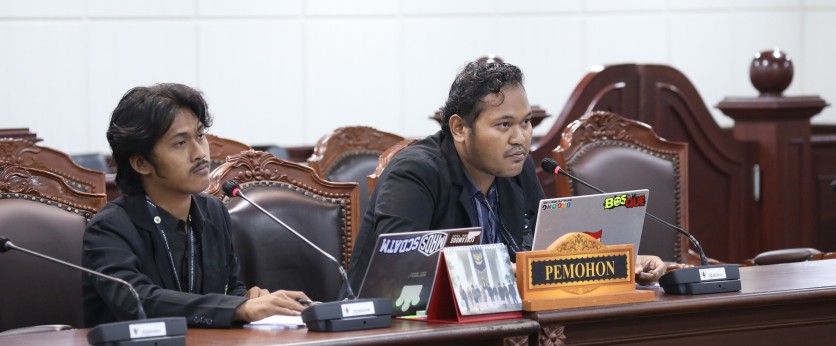
Petitioners Isfa' Zia Ulhaq and Muh. Adam Arrofiu Arfah delivering the main points of the judicial review petition on Law No. 18 of 2019 on Pesantren on Friday (27/2) at the Panel Courtroom. Photo by MKRI/Panji.
Jakarta (MKRI) - The Constitutional Court held a material review hearing on Article 48 paragraphs (2) and (3) of Law No. 18 of 2019 on Pesantren (Islamic Boarding School) on Friday, February 27, 2026. The petition in Case No. 75/PUU-XXIV/2026 was filed by two students of Nahdlatul Ulama Indonesia University (UNUSIA), Muh Adam Arrofiu Arfah (Petitioner I) and Isfa’zia Ulhaq (Petitioner II), and was heard by Deputy Chief Justice Saldi Isra with Justices Ridwan Mansyur and Adies Kadir.
The challenged provisions state that the central government “helps fund” pesantren through the state budget “in accordance with the state’s financial capacity,” and that local governments “help fund” pesantren through regional budgets “in accordance with their authority.”
In court, Adam argued that the constitutionally mandated minimum of 20 percent of the state budget for education is, in practice, split into operational spending and an accumulating education endowment reserved for long-term development such as scholarships, capacity building, and research.
He stressed that the endowment is not meant to finance day-to-day pesantren operations, including teachers’ salaries, students’ basic needs, or routine learning activities, so an endowment for pesantren cannot be treated as full compliance with the state’s constitutional duty to fund education.
Adam further argued that rising education budgets over the years show that the phrases “in accordance with the state’s financial capacity” and “in accordance with their authority” are not objective constraints, pointing out that the state clearly has substantial fiscal room, including for large priority programs such as the Free Nutritious Meals (MBG) scheme, which will reach trillions of rupiah in 2026.
This comparison, he said, reveals a gap in budget priorities: short-term operational programs can secure massive, structured funding, while pesantren education—historically, sociologically, and constitutionally part of the national education system—still depends on open-ended, conditional clauses. The core issue, he argued, lies not in limited fiscal capacity but in a normative design and distribution priority that fails to guarantee equal funding protection for pesantren.
“When the state can pour enormous funds into certain programs yet still does not provide definite operational guarantees for pesantren, there is a strong indication that the phrases in the article in question are no longer rational or proportionate in today’s fiscal context,” Adam told the Court.
The Petitioners therefore question the constitutionality of the phrases tying pesantren funding to “the state’s financial capacity” and to governmental “authority,” arguing that they risk undermining the certainty of education funding guarantees mandated by Article 31 paragraph (4) of the 1945 Constitution.
Justices’ Advice
Justice Ridwan Mansyur offered several notes on the petition, saying the arguments had not yet been laid out coherently, especially in connecting the challenged provisions to the Petitioners’ alleged constitutional harms.
“You have not systematically elaborated which articles you believe cause harm and how they conflict with the constitutional benchmarks. The parameters of harm are also not clearly structured,” he said.
He urged the Petitioners to study previous Constitutional Court decisions that granted similar claims and to provide a more detailed explanation of how the norms under review relate to their legal standing. Ridwan also pointed out that the law regulates both pesantren and madrasah, and asked the Petitioners to clarify the position of the non-formal pesantren they wish to see covered by state funding.
“If the law distinguishes between pesantren and madrasah, you must state clearly that it is non-formal pesantren you want to receive state budget support,” he said.
Justice Ridwan emphasized the need to spell out concrete harms suffered by the Petitioners themselves and by others in similar positions so the Court can assess whether the challenged norms truly cause the alleged constitutional injury.
At the end of the hearing, the panel granted the Petitioners 14 days to revise their petition, with the amended petition due at the Court by March 12, 2026, at 12:00 PM Western Indonesian Time.
Case tracking: Petition No. 75/PUU-XXIV/2026
Author: Utami Argawati
Editor: N. Rosi.
Translator: Rizky Kurnia Chaesario
Disclaimer: The original version of the news is in Indonesian. In case of any differences between the English and the Indonesian versions, the Indonesian version will prevail.
Friday, February 27, 2026 | 09:26 WIB 360