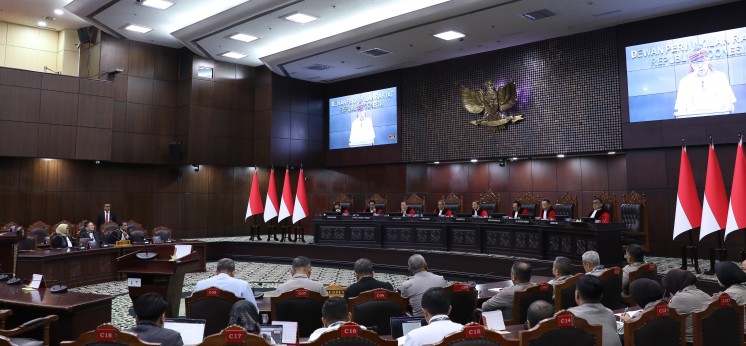
The Constitutional Court holding a hearing on the judicial review of Law No. 2 of 2002 on the Indonesian National Police to hear testimonies from the DPR and the President, Wednesday (5/12/2026). Photo by MKRI/Ifa.
JAKARTA (MKRI) — The Constitutional Court (MK) held another hearing for the material judicial review of Law No. 2 of 2002 on the Indonesian National Police (Police Law) on Wednesday, May 13, 2026. The hearing for Case No. 63/PUU-XXIV/2026, filed by Christian Adrianus Sihite, Syamsul Jahidin, and Edy Rudyanto, heard testimonies from the Government/President, delivered by Deputy Minister of Law Edward Omar Sharif Hiariej, and from the House of Representatives (DPR), delivered by Commission III member Hinca I.P. Pandjaitan XIII.
Hiariej explained that Article 8 paragraphs (1) and (2) of the Police Law have provided legal certainty regarding Polri’s position as a state apparatus under the President, thereby eliminating ambiguity in the institutional structure. Such a position, he said, is necessary to ensure clear coordination, command, and accountability in carrying out governmental functions in security and law enforcement.
“In this regard, Polri cannot be equated with a ministry because it has distinct characteristics and functions as a state apparatus in security and law enforcement. Therefore, placing it directly under the President constitutes a rational and constitutional legal policy to maintain effectiveness, responsiveness, and unity of command in carrying out its duties,” Hiariej explained.
He further stated that although the President is assisted by ministers in a presidential system, not all state institutions must be placed within ministerial structures. In Indonesia’s constitutional practice, certain non-ministerial institutions are directly under the President to carry out specialized functions. According to Hiariej, placing Polri under the President also implements Article 30 paragraph (4) of the 1945 Constitution and Article 6 paragraph (1) and Article 7 paragraph (2) of MPR Decree No. VII/2000, which explicitly position Polri under the President.
He also referred to the Court’s legal considerations in Decision No. 19/PUU-XXIII/2025, which affirmed that Polri’s position cannot be reduced to that of a ministry and that the President, as the holder of executive power, has the authority to determine the accountability structure of institutions carrying out governmental functions, including Polri.
Oversight Mechanisms
Hiariej further asserted that equality before the law is not determined by the administrative position of an institution, but guaranteed through generally applicable legal norms and an independent judiciary. Any actions by law enforcement officials, including Polri officers, remain subject to the law and may be reviewed through oversight mechanisms and available legal remedies.
“Furthermore, Polri’s position under the President supports the realization of good governance principles because it creates clearer accountability and more effective coordination in administering security and law enforcement functions. Oversight of Polri continues to be conducted through various internal and external mechanisms, thereby safeguarding accountability,” Hiariej stated.
Dualism of Command
Regarding Petition No. 63/PUU-XXIV/2026, Hinca explained that in Indonesia’s presidential system, ministers assist the President in handling specific governmental affairs. Therefore, placing Polri under the Ministry of Home Affairs (MOHA) would delegate the President’s direct constitutional responsibility and potentially create dualism of command within the police institution.
“This could obscure the chain of command that has functioned effectively thus far. The concept of Polri being under the President, as stipulated in Article 8 paragraph (1) of Law No. 2 of 2002, is direct in nature and does not require an intermediary within its accountability structure,” Hinca stated during the virtual hearing.
Also Read:
Polri Under MOHA, Petitioners Argue
Petitioners Strengthen Constitutional Arguments for Placing Polri under MOHA
DPR, Government Ask Court to Postpone Police Law Hearing
At the preliminary hearing on Thursday, February 19, 2026, the Petitioners challenged the constitutionality of Article 8 paragraphs (1) and (2) of the Police Law. They argued that the provisions contravene Article 1 paragraph (3), Article 28D paragraph (1), Article 30 paragraph (4), Article 17 paragraph (1), and Article 22E paragraph (1) of the 1945 Constitution.
Article 8 paragraph (1) of the Police Law states that “The Indonesian National Police shall be under the President,” while paragraph (2) states that Polri is led by the Chief of Police, who is accountable to the President in accordance with statutory laws and regulations.
The Petitioners argued that placing Polri under the President creates the potential for discriminatory treatment against advocates defending opposition groups or parties opposing the Government. They believe this could impair their right to provide effective legal defense and create legal uncertainty, opening room for executive intervention contrary to the principles of the rule of law, equality before the law, and the protection of constitutional rights.
In their petitum, the Petitioners request that the Court declare Article 8 paragraphs (1) and (2) unconstitutional and not legally binding unless interpreted to mean that Polri is under and accountable to the minister administering domestic government affairs.
Author: Sri Pujianti
Editor: N. Rosi
PR: Fauzan F.
Translator: Yuanna Sisilia
Disclaimer: The original version of the news is in Indonesian. In case of any differences between the English and the Indonesian versions, the Indonesian version will prevail.
Explore the case: Case No. 63/PUU-XXIV/2026
Wednesday, May 13, 2026 | 16:04 WIB 39