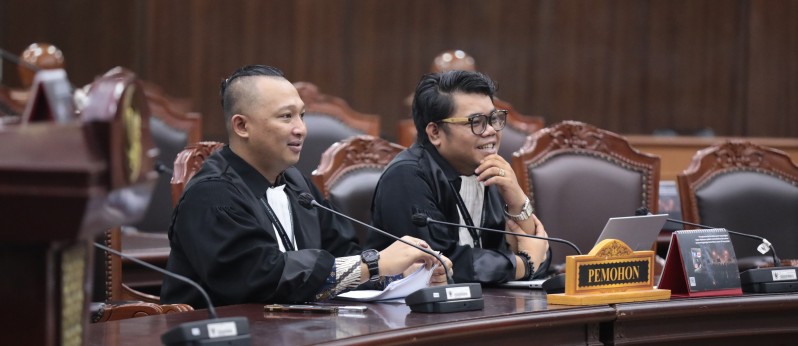
Petitioners for the judicial review of the Police Law presenting revisions to their petition at a hearing examining the revised petition, Wednesday (3/4/2026). Photo by MKRI/IlhamWM.
JAKARTA (MKRI) — The Constitutional Court (MK) held another hearing on the judicial review of Law No. 2 of 2002 on the Indonesian National Police (Police Law) on Wednesday, March 4, 2026. The second hearing for Case No. 63/PUU-XXIV/2026, filed by Christian Adrianus Sihite (Petitioner I), Syamsul Jahidin (Petitioner II), and Edy Rudyanto (Petitioner III), heard the main points of the revised petition submitted by the Petitioners.
During the hearing, Syamsul Jahidin explained that the Petitioners had added provisions of the 1945 Constitution as additional grounds for the judicial review. They also strengthened the constitutional arguments underpinning their petition, while the remaining parts largely maintained the substance of the previously submitted petition.
Reading the petitioners’ petitum, Christian Adrianus Sihite requested the Court to declare Article 8 paragraph (1) of Law No. 2 of 2002 on the Indonesian National Police unconstitutional and not legally binding insofar as it is not interpreted to mean that “the Indonesian National Police shall be under the President through the minister responsible for domestic governmental affairs.”
He further requested the Court to declare Article 8 paragraph (2) of the same law unconstitutional and not legally binding insofar as it is not interpreted to mean that “the Indonesian National Police shall be led by the Chief of the Indonesian National Police, who in carrying out his duties is accountable to the minister responsible for domestic governmental affairs in accordance with statutory laws and regulations.”
The panel hearing was presided over by Constitutional Justice Enny Nurbaningsih, accompanied by Constitutional Justice Anwar Usman and Constitutional Justice Arsul Sani, in the plenary courtroom of the Court’s Building I.
Also read:
Polri under MOHA, Petitioners Argue
At the preliminary hearing on Thursday, February 19, 2026, the Petitioners challenged the constitutionality of Article 8 paragraphs (1) and (2) of the Police Law against Article 1 paragraph (3), Article 28D paragraph (1), Article 30 paragraph (4), Article 17 paragraph (1), and Article 22E paragraph (1) of the 1945 Constitution.
The Petitioners argued that placing the Indonesian National Police (Polri) directly under the President could create the potential for discriminatory treatment. Advocates representing opposition groups or parties critical of the government, they contended, might be treated differently from those representing the government or its supporters. Such circumstances could undermine the Petitioners’ rights as advocates to provide effective legal assistance and defense.
They further asserted that these conditions could result in both actual and potential constitutional losses, as they affect the effectiveness of advocates in performing their professional duties in legal defense.
According to the Petitioners, the provisions in question give rise to legal uncertainty, open the possibility of executive intervention, and contradict the principles of the rule of law, equality before the law, and the protection of citizens’ constitutional rights. As a state governed by law, they argued, all aspects of the exercise of state power, including law enforcement carried out by the police, must adhere to the rule of law rather than operate under unchecked authority.
Placing the police institution directly under the President without adequate supervisory and limiting mechanisms, they added, could potentially lead to abuses of power that contradict the principles of a constitutional state.
Explore The Case: Case No. 63/PUU-XXIV/2026
Author: Sri Pujianti
Editor: N. Rosi
PR: Fauzan F.
Translator: Yuanna Sisilia
Disclaimer: The original version of the news is in Indonesian. In case of any differences between the English and the Indonesian versions, the Indonesian version will prevail.
Wednesday, March 04, 2026 | 15:00 WIB 143