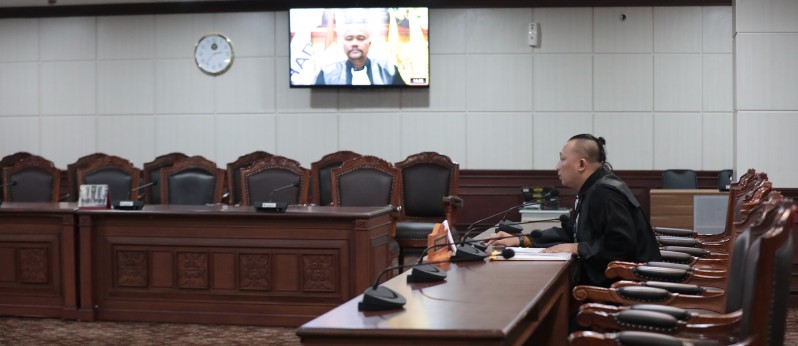
Petitioners for the Judicial Review of the Police Law presenting their arguments in person and online at the preliminary hearing for Case No. 63/PUU-XXIV/2026, Thursday (2/19/2026), examining their petition. Photo by MKRI/Ilham WM.
JAKARTA (MKRI) — Christian Adrianus Sihite (Petitioner I), Syamsul Jahidin (Petitioner II), and Edy Rudyanto (Petitioner III) filed a petition for judicial review of Law No. 2 of 2002 on the Indonesian National Police (Police Law) with the Constitutional Court (MK). They challenge Article 8 paragraph (1) and paragraph (2) of the Police Law against Article 1 paragraph (3), Article 28D paragraph (1), Article 30 paragraph (4), Article 17 paragraph (1), and Article 22E paragraph (1) of the 1945 Constitution.
The preliminary hearing for Case No. 63/PUU-XXIV/2026 was held on Thursday, February 19, 2026, in the panel courtroom of the Court. The panel was chaired by Constitutional Justice Enny Nurbaningsih, with Constitutional Justice Anwar Usman and Constitutional Justice Arsul Sani in attendance.
Article 8 paragraph (1) of the Police Law stipulates that “The Indonesian National Police shall be under the President.” Meanwhile, paragraph (2) provides that “The Indonesian National Police shall be led by the Chief of Police who, in carrying out his duties, shall be accountable to the President in accordance with statutory laws and regulations.”
From the panel courtroom, Syamsul Jahidin stated that as advocates, the Petitioners believe that placing the Police directly under the President creates the potential for discrimination. Advocates who represent opposition figures or parties critical of the government, they argued, risk being treated differently from those handling cases involving the government or its supporters. This situation, according to the Petitioners, may impair their ability to provide effective legal assistance and defense.
They further contended that such impairment constitutes both actual and potential constitutional harm, as it directly affects the effectiveness of their professional duties in the legal defense process. The challenged provisions, in their view, engender legal uncertainty, open the door to executive intervention, and contravene the principles of the rule of law, equality before the law, and the protection of citizens’ constitutional rights.
As a state governed by law, they emphasized, all exercises of state power, including law enforcement by the Police, must be subject to the rule of law rather than unfettered authority. The direct subordination of the Police to the President, without adequate oversight and institutional checks, they argued, carries the risk of abuse of power that is incompatible with constitutional principles.
Reading out the petitum, Edy Rudyanto requested the Court to declare Article 8 paragraph (1) of Law No. 2 of 2002 on the Indonesian National Police unconstitutional and not legally binding insofar as it is not interpreted to mean that “The Indonesian National Police shall be under the President through the minister in charge of home affairs.” They similarly asked the Court to declare Article 8 paragraph (2) unconstitutional and not legally binding insofar as it is not interpreted to mean that “The Indonesian National Police shall be led by the Chief of Police who, in carrying out his duties, shall be accountable to the minister in charge of home affairs in accordance with statutory laws and regulations.”
Legal Standing
Responding to the petition, Constitutional Justice Arsul Sani advised the Petitioners to elaborate more clearly on their legal standing in relation to the enactment of the challenged norms. On the substance of the petition, he suggested that they comprehensively articulate the alleged contradiction between the provisions in question and the constitutional articles cited as the basis of review.
“This must be linked to the concept of open legal policy so that it becomes clear and significant, what exactly is problematic about the Police being under the President from the standpoint of rationality, particularly when connected to Article 28D paragraph (1) of the 1945 Constitution,” Arsul said. He added that while the Petitioners seek to place the Police under the President through the Ministry of Home Affairs (MOHA), their argument has yet to sufficiently explain what is meant by “through the minister in charge of home affairs.”
Constitutional Justice Enny Nurbaningsih also advised the Petitioners to streamline their petition to make it more focused and accessible. “Certain parts are unnecessary. For example, the legal grounds can be made more straightforward and to the point. Then, what specific constitutional loss do you suffer due to the enactment of this norm? If this is not clearly explained, there may be no legal standing,” Enny remarked, underscoring the importance of demonstrating constitutional injury to substantiate standing.
Before adjourning the hearing, Justice Enny granted the Petitioners 14 days to revise and refine their petition. The revised petition must be submitted to the Court’s Registrar’s Office by Wednesday, March 4, 2026 at 12:00 p.m. WIB. The Court will subsequently schedule the second hearing to examine the principal revisions of the Petitioners’ arguments.
Explore the Case: Case No. 63/PUU-XXIV/2026
Author: Sri Pujianti
Editor: N. Rosi
Translator: Yuanna Sisilia
Disclaimer: The original version of the news is in Indonesian. In case of any differences between the English and the Indonesian versions, the Indonesian version will prevail.
Thursday, February 19, 2026 | 15:28 WIB 224