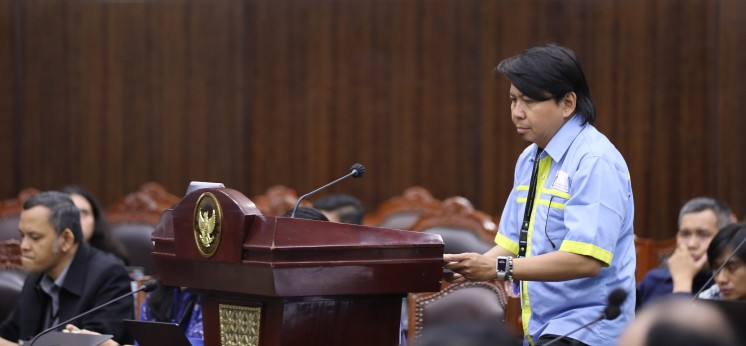
PPUI Chair Irwansyah testifying at the continued hearing on the judicial review of Law No. 14 of 2005 on Teachers and Lecturers on Tuesday (5/5/2026) at the Constitutional Court courtroom. Photo by MKRI/Ifa.
JAKARTA (MKRI) — The University of Indonesia Workers Association (PPUI), the Gadjah Mada University Workers Union (Sejagad), the Indonesian Caucus for Academic Freedom (KIKA), and the Indonesian Lecturers Communication Forum (FKDSI) appeared as Relevant Parties in the continued judicial review hearing of Law No. 14 of 2005 on Teachers and Lecturers (Teachers and Lecturers Law) on Tuesday, May 5, 2026. The hearing for Case No. 272/PUU-XXIII/2025 agenda was to hear the Relevant Parties’ testimonies regarding the constitutional review of Article 52 paragraph (1), paragraph (2), and paragraph (3) of the Teachers and Lecturers Law.
Campus Autonomy Heavily Determines Wage Standards
At the sixth hearing, the Relevant Parties presented their testimonies concerning lecturers’ income components, which they argued have yet to consistently guarantee decent living standards. PPUI Chair Irwansyah stated that Article 52 paragraph (2) of the Teachers and Lecturers Law, which stipulates that lecturers appointed by the government are paid in accordance with statutory laws and regulations applicable to civil servants, does not automatically ensure welfare protection for non-civil servant permanent lecturers at State Universities with Legal Entity Status (PTN-BH).
Although they work within state-run institutions, their status as university employees means that wage standards are highly dependent on campus autonomy.
Irwansyah explained that this arrangement is regulated under Article 51 of the University of Indonesia Rector Regulation No. 033 of 2018 on UI Human Resources Management, which states that “UI provides compensation to UI employees by considering competence, position level, and performance.” Such compensation consists of base salary, allowances, incentives, and benefits.
According to Irwansyah, this provision demonstrates that Article 52 paragraph (2) has failed to provide equal protection for all educators at government-administered universities because salary distribution does not necessarily comply with statutory provisions capable of ensuring decent wages.
“It should be noted that due to institutional autonomy, although we have officially been registered as a labor union with the manpower office, the University of Indonesia and other PTN-BH institutions have never applied the Manpower Law. I am an employee of the University of Indonesia, not a civil servant. In fact, I should be regulated under labor law provisions, but instead I am only governed by internal management regulations,” Irwansyah explained.
A similar statement was delivered by Sejagad representative Amalinda Savirani, who asserted that most PTN-BH institutions, including Gadjah Mada University, currently employ both civil servant permanent lecturers and non-civil servant permanent lecturers. The wage standards for non-civil servant lecturers, she emphasized, are highly contingent upon campus autonomy.
“As a result, Article 52 paragraph (2) fails to provide equal protection for all educators at government-administered universities because salary allocation is not automatically aligned with statutory regulations capable of guaranteeing decent wages,” said Amalinda, who chairs the Gadjah Mada University Workers Union.
Economic Conditions of Campus Workers and Academic Freedom
Representing KIKA, Herdiansyah Hamzah explained that the UNESCO Recommendation Concerning the Status of Higher-Education Teaching Personnel explicitly defines academic freedom as “the right to freedom of teaching and discussion, freedom in carrying out research and disseminating and publishing the results thereof, freedom to express freely their opinion about the institution or system in which they work, freedom from institutional censorship, and freedom to participate in professional or representative academic bodies.”
Based on UNESCO’s definition, academic freedom encompasses the freedom to determine research topics based on scholarly considerations rather than political or economic agendas; the freedom to employ research methods deemed scientifically appropriate; the freedom to formulate conclusions based on objective data and analysis rather than external pressure; the freedom to publish research findings without censorship or intervention; the freedom to determine teaching materials according to pedagogical and academic considerations; and the freedom to express critical views on social, political, and economic phenomena as part of public intellectual responsibility.
“The ambiguity and vagueness of the norms contained in Article 52 paragraph (1), paragraph (2), and paragraph (3) of the Teachers and Lecturers Law directly affect academic freedom. The causal relationship between the economic conditions of campus workers and academic freedom is neither speculative nor merely hypothetical. Campus workers operate within structures shaped not only by academic logic, but also by power relations and the distribution of economic, social, and symbolic capital,” Herdiansyah stated.
Unclear Income Standards
FKDSI Chair A. Herenal Daeng Toto argued that Article 52 paragraph (1) fails to provide legal certainty and has caused constitutional harm, particularly through the phrase “income above minimum living needs.”
According to him, the norm lacks an objective benchmark, rendering it open-ended and difficult to operationalize effectively in practice. Consequently, the provision creates legal uncertainty and opens the door to inadequate wage practices.
Based on FKDSI data as of April 2026, approximately 76.7 percent of FKDSI-affiliated lecturers earn below the regional minimum wage (UMR). Substantively, Herenal added, the relationship between non-state civil apparatus lecturers and universities fulfills the essential elements of an employment relationship, namely work, wages, and authority. Therefore, doctrinally, non-রাষ্ট্র civil servant lecturers cannot be separated from labor law protection principles.
“The ambiguity surrounding the phrase ‘income above minimum living needs’ in Article 52 has created horizontal disharmony among legal regimes, where the teaching profession, which should receive protection, is instead placed in a more vulnerable position compared to workers in other sectors. This condition reflects the failure of the norm to provide fair and equal protection,” Herenal stressed.
Also Read:
CALS Warns Lack of Minimum Salary Standards Jeopardizes Lecturers’ Welfare and Higher Education Quality
Govt: Wage Components for Non-Civil Servant Lecturers Governed by Labor Laws
Court Postpones Hearing Teachers and Lecturers Law as DPR, Government Not Ready to Deliver Statements
Private University Lecturers Strengthen Legal Standing in Decent Wage Judicial Review
Private University Lecturers Seek Decent Wages
For information, Case No. 272/PUU-XXIII/2025 concerning the review of Article 52 paragraph (1), paragraph (2), and paragraph (3) of the Teachers and Lecturers Law was filed by campus labor unions along with Isman Rahmani Yusron and Riski Alita Istiqomah.
At the preliminary hearing before the Constitutional Court on Tuesday, January 13, 2026, the Petitioners argued that the challenged provisions were reviewed due to concerns over compensation and appreciation for lecturers and teaching personnel in higher education, which they considered disproportionate to their dedication, workload, and qualifications. Ideally, lecturers’ service should be valued according to humanitarian principles, as emphasized by the Court in Decision No. 67/PUU-XI/2013 dated September 11, 2014.
In their petition, the Petitioners argued that Article 52 paragraph (1) of the Teachers and Lecturers Law conditionally contravenes the constitutional guarantee of a decent livelihood and the right to fair and proper compensation, as protected under Article 27 paragraph (2), Article 28D paragraph (1), and Article 28D paragraph (2) of the 1945 Constitution. The provision, they asserted, fails to establish clear standards to ensure that lecturers receive adequate minimum wages and social security protections. Factually, lecturers’ income has yet to meet decent living standards.
The legal uncertainty surrounding the parameter of “Minimum Living Needs” in the a quo law, the Petitioners maintained, has had severe implications for lecturers’ welfare. Wages or salaries for educators are not merely figures in university or foundation financial reports, but constitute the primary foundation for their personal and family livelihood. This aligns with the Court’s view that wages are a vital humanitarian element, as reflected in Constitutional Court Decision No. 58/PUU-IX/2011, which essentially states that wages are fundamental to workers’ lives and those of their families.
The Petitioners also argued that leaving lecturers’ wage arrangements solely to “employment agreements” or “mutual agreements,” as stipulated under Article 52 paragraph (3) of the Teachers and Lecturers Law, disregards the sociological realities of employment relations. Within the relationship between educational foundations/providers and lecturers, there is no equal bargaining position.
Author: Sri Pujianti
Editor: N. Rosi
PR: Andhini SF
Translator: Yuanna Sisilia
Disclaimer: The original version of the news is in Indonesian. In case of any differences between the English and the Indonesian versions, the Indonesian version will prevail.
Explore the case: Case No. 272/PUU-XXIII/2025
Tuesday, May 05, 2026 | 18:57 WIB 27