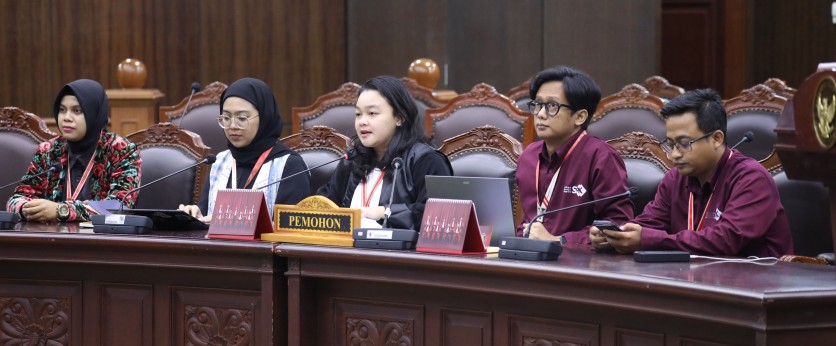
Raden Viola Reininda Hafidz, acting as legal counsel, conveying the main points of the petition together with the Petitioners in the judicial review of the Law on Teachers and Lecturers at the panel hearing of the Constitutional Court, Tuesday (1/13/2026). Photo by MKRI/Panji.
JAKARTA (MKRI) — The Campus Workers Union (Petitioner I), along with Isman Rahmani Yusron (Petitioner II) and Riski Alita Istiqomah (Petitioner III), both lecturers, filed a material judicial review of Article 52 paragraphs (1), (2), and (3) of Law No. 14 of 2005 on Teachers and Lecturers (the Teachers and Lecturers Law) with the Constitutional Court. The preliminary hearing for Case No. 272/PUU-XXIII/2025 was held on Tuesday (1/13/2026).
The panel hearing, convened in the Plenary Courtroom of Building I of the Court, was presided over by Constitutional Justice Arief Hidayat, with Constitutional Justices Enny Nurbaningsih and M. Guntur Hamzah as panel members.
Article 52 paragraph (1) of the Teachers and Lecturers Law stipulates that income above minimum living needs as referred to in Article 51 paragraph (1) letter a comprises basic salary, salary-related allowances, as well as other forms of income in the form of professional allowances, functional allowances, special allowances, honorary allowances, and additional benefits related to lecturers’ duties, determined under the principle of merit-based appreciation.
Article 52 paragraph (2) provides that lecturers appointed by higher education institutions administered by the central or regional governments shall receive salaries in accordance with statutory laws and regulations.
Meanwhile, Article 52 paragraph (3) stipulates that lecturers appointed by higher education institutions administered by the public shall receive salaries based on employment agreements or collective labor agreements.
According to Raden Viola Reininda Hafidz, legal counsel to the Petitioners, the petition was filed due to concerns over compensation and appreciation for lecturers and higher education educators that are not commensurate with their dedication, workload, and qualifications. She emphasized that lecturers’ service must be valued based on humanitarian principles, as affirmed by the Court in its legal considerations in Constitutional Court Decision No. 67/PUU-XI/2013 dated September 11, 2014.
Wages Below Decent Living Standards
In their petition, the Petitioners argued that Article 52 paragraph (1) of the Teachers and Lecturers Law conditionally contravenes the guarantees of a decent livelihood and the right to fair and proper remuneration as enshrined in Article 27 paragraph (2), Article 28D paragraph (1), and Article 28D paragraph (2) of the 1945 Constitution. The provision, they contended, fails to set clear standards to ensure that lecturers receive a decent minimum wage and social security. Empirically, lecturers’ income has yet to meet reasonable living standards.
Viola further explained that although Petitioner III had been appointed as a permanent lecturer since September 2017, she did not receive a monthly income, employment contract, or teaching assignment from 2017 to 2019. Teaching assignments were only granted starting September 2019, with remuneration lower than the wage stipulated in the contract. At present, Petitioner III is advocating for decent income standards in the academic environment, and a labor inspection has been conducted by the Manpower and Transmigration Office of West Java Province.
The Petitioners also maintained that the parameter of “minimum living needs” under Article 52 paragraph (1) is vague, as it does not specify a method for calculating its value. By contrast, the prevailing “regional minimum wage” in national labor policy provides a clearer benchmark, consisting of a basic wage without allowances.
Such legal uncertainty regarding the “minimum living needs” parameter, they argued, has had serious implications for lecturers’ welfare. Wages are not merely figures in a foundation’s or university’s financial reports but constitute the essential basis for lecturers’ and their families’ livelihoods. This aligns with the Court’s view that wages are a vital element of human dignity, as articulated in Constitutional Court Decision No. 58/PUU-IX/2011.
Sociological Realities of Employment Relations
The Petitioners further argued that leaving lecturers’ wages solely to “employment agreements” or “collective agreements” as provided in Article 52 paragraph (3) disregards the sociological realities of employment relations. In the relationship between foundations or education providers and lecturers, there is no equal bargaining position. Accordingly, the principle of freedom of contract cannot be used to legitimize low wages.
Absent constitutional interpretation by the Court, lecturers at both public and private higher education institutions would continue to face unjust wage treatment, lack of guarantees for a decent livelihood, denial of fair and proper remuneration, and legal uncertainty, contrary to Articles 27 paragraph (2), 28D paragraph (1), and 28D paragraph (2) of the 1945 Constitution.
Petitums
Based on these arguments, the Petitioners requested the Court to declare Article 52 paragraph (1) of the Teachers and Lecturers Law conditionally unconstitutional and not legally binding insofar as it is not interpreted to mean that income above minimum living needs includes a basic salary at least equivalent to the applicable regional minimum wage where the higher education institution is located, supported by other fixed compensations to meet lecturers’ productive and professional needs, including salary-related allowances, professional allowances, functional allowances, special allowances, honorary allowances, and additional benefits determined under the principle of merit-based appreciation.
They likewise requested the Court to declare the phrase “salary” in Article 52 paragraphs (2) and (3) conditionally unconstitutional and not legally binding unless interpreted in the same manner.
Legal Standing
In his advice to the panel, Constitutional Justice M. Guntur Hamzah highlighted issues concerning the legal standing of the three Petitioners, consisting of one private legal entity and two individual lecturers. He noted that Petitioner I had yet to demonstrate, under its articles of association and bylaws, which officials were authorized to represent the organization in court proceedings. He also questioned whether the lecturers had pursued other legal remedies prior to filing with the Court and emphasized the need to clarify standards for lecturers whose income remains below the regional minimum wage.
Constitutional Justice Enny Nurbaningsih observed that the Petitioners were lecturers at private universities, thus requiring clearer elaboration of their legal standing to avoid conflating constitutional review with normative implementation issues. She also suggested adding comparative explanations regarding how minimum living needs are met for lecturers at state-owned and private universities.
Meanwhile, Constitutional Justice Arief Hidayat instructed the Petitioners to revise their petition in accordance with Constitutional Court Regulation No. 7 of 2025 on Procedures for Judicial Review Cases. While concrete cases may be included to illustrate constitutional conflicts, he emphasized the need for stronger explanations in the legal arguments and encouraged comparative analysis, for instance with Malaysia or Thailand, to provide clearer context.
Before closing the hearing, Justice Arief stated that the Petitioners were granted 14 days to revise their petition. The revised submission must be filed no later than Monday, January 26, 2026, at 12:00 p.m. WIB with the Court’s Registrar. The Court will subsequently hold a second hearing to examine the revised petition.
Explore the case: Case No. 272/PUU-XXIII/2025 (in Bahasa Indonesia)
Author: Sri Pujianti
Editor: N. Rosi
Translator: Yuanna Sisilia
Disclaimer: The original version of the news is in Indonesian. In case of any differences between the English and the Indonesian versions, the Indonesian version will prevail.
Tuesday, January 13, 2026 | 19:46 WIB 337